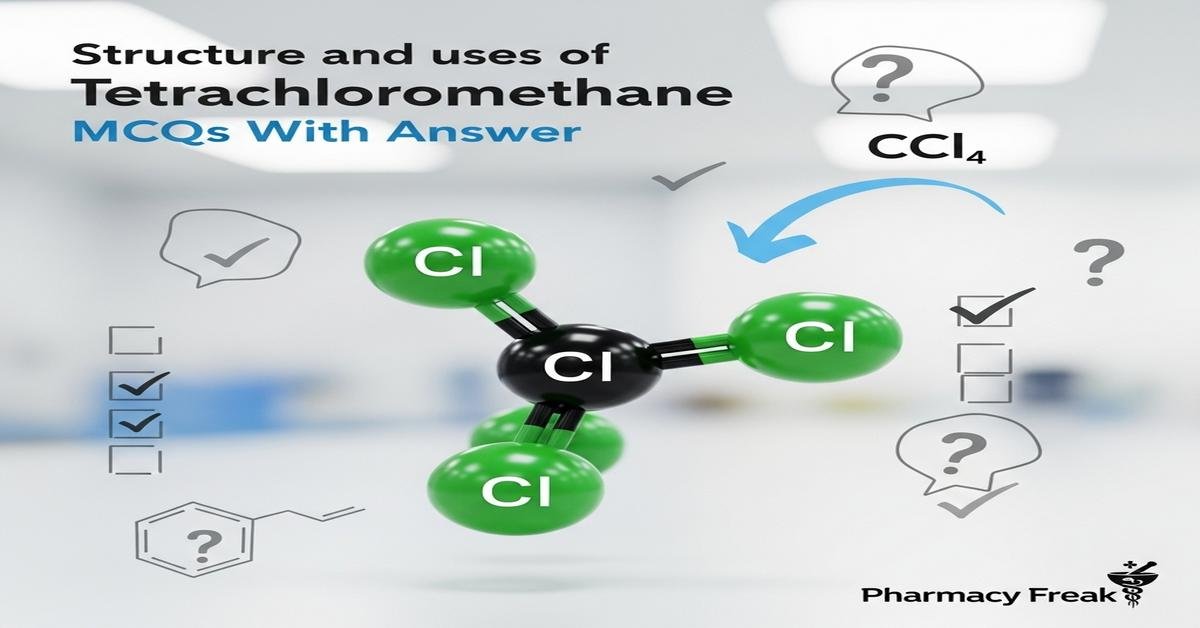
For B.Pharm students, understanding the structure and uses of tetrachloromethane (carbon tetrachloride, CCl4) is essential for courses on pharmaceutical chemistry, toxicology, and industrial pharmacy. This introduction covers molecular geometry, bonding, physical properties, common pharmaceutical and industrial uses, metabolic activation, and safety concerns. Key concepts include tetrahedral geometry, sp3 hybridization, nonpolar solvent behavior, hepatotoxicity via CYP-mediated radical formation, and regulatory restrictions under the Montreal Protocol. Emphasis is placed on practical implications for formulation, laboratory handling, and safer alternatives. Familiarity with CCl4’s reactivity and hazards informs responsible pharmaceutical practice. Now let’s test your knowledge with 50 MCQs on this topic.
Q1. What is the molecular formula of tetrachloromethane commonly used in pharmaceutical contexts?
- CCl4
- CHCl3
- C2Cl4
- CCL2
Correct Answer: CCl4
Q2. What is the common trivial name for tetrachloromethane?
- Chloroform
- Carbon tetrachloride
- Methylene chloride
- Carbontet
Correct Answer: Carbon tetrachloride
Q3. What is the idealized molecular geometry of CCl4?
- Trigonal planar
- Tetrahedral
- Linear
- Square planar
Correct Answer: Tetrahedral
Q4. What is the hybridization of the central carbon atom in CCl4?
- sp
- sp2
- sp3
- sp3d
Correct Answer: sp3
Q5. Which physical property best describes CCl4 at room temperature?
- Colorless liquid
- Colorless gas
- White solid
- Viscous oil
Correct Answer: Colorless liquid
Q6. Why is CCl4 considered a nonpolar solvent?
- Because C–Cl bonds are nonpolar
- Because the tetrahedral symmetry cancels dipoles
- Because it contains hydrogen atoms
- Because it ionizes in water
Correct Answer: Because the tetrahedral symmetry cancels dipoles
Q7. Which of the following is a major historical industrial use of carbon tetrachloride?
- Antibiotic synthesis
- Dry cleaning solvent
- Tablet binder
- Parenteral preservative
Correct Answer: Dry cleaning solvent
Q8. Which enzyme system is primarily responsible for metabolic activation of CCl4 in the liver?
- CYP3A4
- CYP2E1
- Alcohol dehydrogenase
- Monoamine oxidase
Correct Answer: CYP2E1
Q9. Metabolic activation of CCl4 leads to which reactive species that causes hepatotoxicity?
- CCl3• radical
- Cl2 molecule
- CO2 radical anion
- HCl gas
Correct Answer: CCl3• radical
Q10. What is a major toxicological concern associated with CCl4 exposure?
- Carcinogenicity and hepatotoxicity
- Hyperglycemia
- Hypotension only
- Vitamin deficiency
Correct Answer: Carcinogenicity and hepatotoxicity
Q11. Which international treaty restricts use of CCl4 due to ozone depletion potential?
- Kyoto Protocol
- Stockholm Convention
- Montreal Protocol
- Rotterdam Convention
Correct Answer: Montreal Protocol
Q12. Which property makes CCl4 useful as an organic solvent in laboratory extraction of nonpolar compounds?
- High water solubility
- High polarity
- Nonpolarity and good dissolving power for lipophilic substances
- Strong hydrogen bonding with solutes
Correct Answer: Nonpolarity and good dissolving power for lipophilic substances
Q13. Which statement about CCl4 and flame is correct?
- It is flame-retardant and completely safe in fires
- Combustion can produce phosgene and toxic gases
- It supports combustion like oxygen
- It prevents formation of toxic gases when burned
Correct Answer: Combustion can produce phosgene and toxic gases
Q14. What is the approximate boiling point of carbon tetrachloride?
- 25 °C
- 76 °C
- 150 °C
- −10 °C
Correct Answer: 76 °C
Q15. Which spectroscopic feature makes CCl4 useful as a solvent in infrared spectroscopy of certain organic compounds?
- It has strong IR absorptions in the fingerprint region that obscure sample bands
- It is transparent in some IR regions allowing clear observation of solute bands
- It is strongly UV-absorbing interfering with analysis
- It fluoresces under IR light
Correct Answer: It is transparent in some IR regions allowing clear observation of solute bands
Q16. Which substitution is characteristic when CCl4 undergoes nucleophilic substitution reactions?
- Frequent SN1 reactions due to tertiary carbon
- Direct nucleophilic substitution is difficult; CCl4 is relatively inert
- Undergoes facile SN2 with amines at room temperature
- Undergoes hydrolysis to methane
Correct Answer: Direct nucleophilic substitution is difficult; CCl4 is relatively inert
Q17. Why is CCl4 no longer widely used as a solvent in pharmaceutical formulations?
- Because it is too expensive
- Due to severe toxicity and environmental regulations
- Because it reacts vigorously with APIs to form salts
- Because it is too polar for most drugs
Correct Answer: Due to severe toxicity and environmental regulations
Q18. Which of the following is a safer alternative solvent to replace CCl4 in many lab applications?
- Chlorobenzene
- Hexane or dichloromethane depending on application
- Hydrochloric acid
- Mercury
Correct Answer: Hexane or dichloromethane depending on application
Q19. How does the bond polarity of C–Cl in CCl4 compare to C–H in methane?
- C–Cl is less polar than C–H
- C–Cl is more polar than C–H but symmetry cancels overall dipole
- They are equally polar
- C–H is ionic while C–Cl is covalent
Correct Answer: C–Cl is more polar than C–H but symmetry cancels overall dipole
Q20. Which organ system is primarily affected by acute CCl4 poisoning?
- Cardiovascular system only
- Liver (hepatotoxicity)
- Musculoskeletal system
- Endocrine system exclusively
Correct Answer: Liver (hepatotoxicity)
Q21. In drug formulation labs, what is a major handling precaution when using CCl4?
- No special precautions are needed
- Use in open bench without PPE
- Use appropriate ventilation, gloves, and avoid inhalation and skin contact
- Store near oxidizers for stability
Correct Answer: Use appropriate ventilation, gloves, and avoid inhalation and skin contact
Q22. Which physical parameter explains why CCl4 separates from water in extraction procedures?
- High miscibility with water
- High density and immiscibility with water
- Ionic nature making it dissolve in aqueous layers
- It forms emulsions readily with water
Correct Answer: High density and immiscibility with water
Q23. What is the approximate density of CCl4 relative to water?
- About 0.8 g/mL (lighter than water)
- About 1.59 g/mL (heavier than water)
- Approximately equal to water (1.0 g/mL)
- Less than 0.1 g/mL
Correct Answer: About 1.59 g/mL (heavier than water)
Q24. Which by-product forms when CCl4 is exposed to ultraviolet light in the atmosphere contributing to environmental harm?
- Ozone formation only
- Chlorine radicals that can deplete ozone
- Pure oxygen increases
- Nitrous oxide is produced
Correct Answer: Chlorine radicals that can deplete ozone
Q25. Historically, CCl4 was used in fire extinguishers. Why is this practice discontinued?
- It was ineffective at extinguishing flames
- It produced highly toxic phosgene at high temperatures
- It was too cheap and widely available
- It reacted with water to give harmless gas
Correct Answer: It produced highly toxic phosgene at high temperatures
Q26. Which reaction involving CCl4 is commonly used in organic synthesis as a chlorinating or radical reagent?
- Wurtz coupling with CCl4 as reagent
- Free radical chlorination under UV or radical initiators
- Acid-catalyzed substitution to form alcohols
- Hydrogenation to methane
Correct Answer: Free radical chlorination under UV or radical initiators
Q27. In toxicology studies, which animal organ shows centrilobular necrosis after CCl4 exposure?
- Kidney
- Liver
- Brain
- Skin
Correct Answer: Liver
Q28. Which spectroscopic technique can detect CCl4 contamination due to its characteristic 13C signal pattern?
- UV-Vis spectroscopy
- 13C NMR spectroscopy
- Polarimetry
- Fluorescence spectroscopy
Correct Answer: 13C NMR spectroscopy
Q29. Which statement about CCl4 solubility in water is correct?
- Highly soluble in water
- Practically insoluble in water (very low solubility)
- Forms a homogeneous solution at all proportions
- Reactively forms hydrochloric acid on mixing
Correct Answer: Practically insoluble in water (very low solubility)
Q30. Which OSHA/HazCom concern is most relevant for laboratories handling CCl4?
- It is non-hazardous and requires no labeling
- It is hazardous: acute toxicity, carcinogenicity, and environmental hazard labeling required
- Only flammable labeling is required
- Only corrosive hazard labeling is required
Correct Answer: It is hazardous: acute toxicity, carcinogenicity, and environmental hazard labeling required
Q31. Which of the following best explains why CCl4 was used historically as a solvent for fats and oils?
- It forms hydrogen bonds with triglycerides
- Its nonpolar nature dissolves lipophilic substances effectively
- It increases polarity of oils making them water-soluble
- It reacts chemically to saponify fats
Correct Answer: Its nonpolar nature dissolves lipophilic substances effectively
Q32. Which precaution is important when disposing of CCl4-contaminated waste in a pharmaceutical lab?
- Pour down the sink with plenty of water
- Collect as hazardous halogenated organic waste for proper incineration or specialist disposal
- Neutralize with household bleach and discard
- Mix with flammable solvent and burn in the open
Correct Answer: Collect as hazardous halogenated organic waste for proper incineration or specialist disposal
Q33. Which physical constant of CCl4 influences its use as a heavy, immiscible extraction solvent?
- Low boiling point only
- High density relative to water
- High viscosity making phase separation slow
- Magnetic susceptibility
Correct Answer: High density relative to water
Q34. Carbon tetrachloride can act as a solvent for which class of pharmaceutical compounds?
- Highly polar ionic salts
- Lipophilic nonpolar drugs and natural products
- Proteins and peptides in their native state
- All water-soluble vitamins
Correct Answer: Lipophilic nonpolar drugs and natural products
Q35. Which metabolic consequence of CCl4 exposure contributes to lipid peroxidation?
- Formation of hydroxyl radicals via Fenton reaction only
- Formation of trichloromethyl radicals that initiate lipid peroxidation
- Direct interaction with DNA producing adducts only
- Immediate excretion without biotransformation
Correct Answer: Formation of trichloromethyl radicals that initiate lipid peroxidation
Q36. What type of bonding predominates in CCl4 between carbon and chlorine?
- Ionic bonding
- Covalent bonding with some polar character
- Hydrogen bonding
- Metallic bonding
Correct Answer: Covalent bonding with some polar character
Q37. Which factor explains low dielectric constant of CCl4 and its poor ability to dissolve ionic substances?
- High polarity and hydrogen bonding capacity
- Nonpolar molecular nature and low dielectric constant
- It is strongly protic solvent
- It forms coordinate bonds with ions readily
Correct Answer: Nonpolar molecular nature and low dielectric constant
Q38. In the context of environmental chemistry, why is atmospheric release of CCl4 a concern?
- It rapidly degrades to harmless products in days
- It has long atmospheric lifetime and contributes to ozone depletion
- It reduces greenhouse gas concentrations beneficially
- It reacts to form essential nutrients for plants
Correct Answer: It has long atmospheric lifetime and contributes to ozone depletion
Q39. Which laboratory technique historically used CCl4 as a solvent for density determinations of oils?
- Gas chromatography with CCl4 as carrier gas
- Density gradient separation because of its high density
- HPLC with aqueous mobile phase
- TLC with water as solvent
Correct Answer: Density gradient separation because of its high density
Q40. Which statement about CCl4’s refractive properties is true for pharmaceutical applications?
- It is highly refractive and useful for optical rotation studies
- It has refractive index useful for refractometric measurements of nonpolar substances
- It is opaque to visible light, limiting its use
- It strongly fluoresces and interferes with photometric assays
Correct Answer: It has refractive index useful for refractometric measurements of nonpolar substances
Q41. Which chemical conversion in industrial chemistry used CCl4 as a chlorinating reagent historically?
- Conversion of alkanes to alkenes via dehydrohalogenation
- Chlorination of hydrocarbons under radical conditions
- Oxidation of alcohols to aldehydes
- Hydrolysis to produce methanol
Correct Answer: Chlorination of hydrocarbons under radical conditions
Q42. Which workplace monitoring parameter is most relevant for CCl4 to protect workers?
- Chronic noise exposure only
- Airborne concentration (ppm) monitoring and biological monitoring where appropriate
- Radiation dose monitoring
- Blood sugar monitoring only
Correct Answer: Airborne concentration (ppm) monitoring and biological monitoring where appropriate
Q43. Which mechanistic step is critical in CCl4-induced cell injury in hepatocytes?
- Activation of radical species leading to membrane lipid peroxidation
- Direct enzymatic glycosylation of proteins
- Immediate DNA replication stimulation
- Production of benign metabolic water
Correct Answer: Activation of radical species leading to membrane lipid peroxidation
Q44. Which pharmaceutical practice would be most affected by a restriction on CCl4 availability?
- Use as injectable solvent in formulations
- Use as a nonpolar extraction solvent in analytical lab procedures
- Use as a tablet coating agent
- Use as a parenteral sterilant
Correct Answer: Use as a nonpolar extraction solvent in analytical lab procedures
Q45. Which statement about CCl4 and ozone is correct regarding mechanism of depletion?
- CCl4 releases chlorine atoms in the stratosphere that catalyze ozone destruction
- CCl4 directly reacts with ground-level ozone to form oxygen
- CCl4 increases ozone production by emitting free oxygen molecules
- CCl4 has no interaction with atmospheric chemistry
Correct Answer: CCl4 releases chlorine atoms in the stratosphere that catalyze ozone destruction
Q46. For a B.Pharm student, which module would most likely discuss CCl4 toxicity and metabolism?
- Pharmaceutics I only
- Toxicology and Biotransformation modules
- Pharmacognosy exclusively
- Community pharmacy practice
Correct Answer: Toxicology and Biotransformation modules
Q47. Which laboratory safety item is essential when handling volatile CCl4 in small-scale experiments?
- Closed-toe shoes only
- Fume hood operation and appropriate gloves
- No special PPE is required
- Only eye wash is needed without gloves
Correct Answer: Fume hood operation and appropriate gloves
Q48. Which chemical change occurs when CCl4 is exposed to metal sodium in the presence of ethers (Reformatsky-type conditions)?
- Immediate dissolution to form ionic chloride salts only
- Radical or electron transfer processes possibly leading to chlorinated radicals and coupling products
- Complete hydrolysis to hydrochloric acid
- Formation of polymeric polyethylene
Correct Answer: Radical or electron transfer processes possibly leading to chlorinated radicals and coupling products
Q49. Which healthcare-related application is NOT an appropriate use of CCl4?
- Laboratory solvent for nonpolar extractions with strict controls
- Ingredient in over-the-counter topical preparations
- Industrial degreasing agent historically
- Research reagent under regulated conditions
Correct Answer: Ingredient in over-the-counter topical preparations
Q50. Which monitoring marker might be elevated in patients with severe CCl4-induced liver injury?
- Serum amylase only
- Elevated serum transaminases (ALT and AST)
- Decreased bilirubin exclusively
- Elevated hemoglobin concentration only
Correct Answer: Elevated serum transaminases (ALT and AST)

