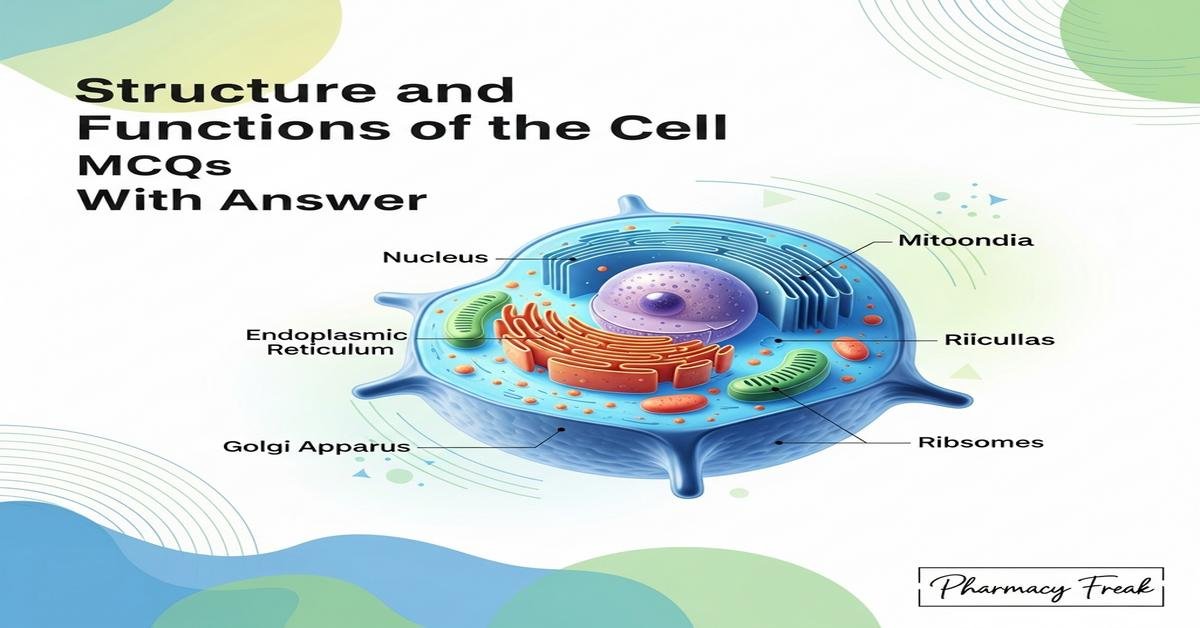
Understanding the structure and functions of the cell is essential for B.Pharm students, linking cell biology with pharmacology and drug action. This concise overview emphasizes organelles — nucleus, mitochondria, endoplasmic reticulum, Golgi apparatus, lysosomes — and core concepts such as cell membrane composition, membrane transport, signal transduction, cytoskeleton, and cell cycle. Mastery of cellular ultrastructure and mechanisms like ATP production, receptor-mediated endocytosis, ion channels, and intracellular trafficking supports drug targeting, pharmacokinetics, and toxicology. These MCQs probe functional details and clinical relevance to strengthen exam readiness and practical understanding in drug development and therapeutic interventions. Now let’s test your knowledge with 30 MCQs on this topic.
Q1. Which component of the plasma membrane primarily determines membrane fluidity at physiological temperature?
- Cholesterol content
- Integral membrane proteins
- Carbohydrate side chains
- Peripheral proteins
Correct Answer: Cholesterol content
Q2. Which organelle is the main site of ATP production through oxidative phosphorylation?
- Mitochondrion
- Golgi apparatus
- Rough endoplasmic reticulum
- Lysosome
Correct Answer: Mitochondrion
Q3. Which structure is involved in protein synthesis and is abundant on the rough endoplasmic reticulum?
- Ribosomes
- Peroxisomes
- Clathrin-coated pits
- Proteasomes
Correct Answer: Ribosomes
Q4. Clathrin-coated vesicles are primarily associated with which cellular process?
- Receptor-mediated endocytosis
- Autophagy
- Constitutive exocytosis
- Proteasomal degradation
Correct Answer: Receptor-mediated endocytosis
Q5. Which pump is directly responsible for maintaining the resting membrane potential in most animal cells?
- Na+/K+ ATPase
- Ca2+ ATPase
- H+/K+ ATPase
- Glucose transporter (GLUT)
Correct Answer: Na+/K+ ATPase
Q6. Which cytoskeletal element is the main track for kinesin- and dynein-mediated vesicle transport?
- Microtubules
- Actin microfilaments
- Intermediate filaments
- Extracellular matrix fibers
Correct Answer: Microtubules
Q7. Which organelle contains hydrolytic enzymes and functions in intracellular digestion and autophagy?
- Lysosome
- Peroxisome
- Endosome
- Golgi apparatus
Correct Answer: Lysosome
Q8. The Golgi apparatus modifies and sorts proteins destined for secretion. Which modification commonly occurs in the Golgi?
- Glycosylation of proteins
- Translation of proteins from mRNA
- ATP synthesis
- Lipid beta-oxidation
Correct Answer: Glycosylation of proteins
Q9. Which membrane transport process requires specific carrier proteins but no direct energy input?
- Facilitated diffusion
- Primary active transport
- Endocytosis
- Exocytosis
Correct Answer: Facilitated diffusion
Q10. Which nuclear substructure is the site of ribosomal RNA (rRNA) transcription and ribosome assembly?
- Nucleolus
- Nuclear lamina
- Nuclear pore complex
- Chromatin
Correct Answer: Nucleolus
Q11. Which process is a major mechanism for regulated secretion of peptide hormones and neurotransmitters?
- Calcium-dependent exocytosis of secretory vesicles
- Autophagy-mediated release
- Passive diffusion through channels
- Proteasomal export
Correct Answer: Calcium-dependent exocytosis of secretory vesicles
Q12. Which organelle is primarily involved in detoxification of hydrogen peroxide and fatty acid oxidation?
- Peroxisome
- Mitochondrion
- Lysosome
- Smooth endoplasmic reticulum
Correct Answer: Peroxisome
Q13. Which type of cell junction allows direct cytoplasmic exchange of small molecules and ions between adjacent cells?
- Gap junctions
- Tight junctions
- Desmosomes
- Hemi-desmosomes
Correct Answer: Gap junctions
Q14. Which enzyme complex on the inner mitochondrial membrane creates a proton gradient used for ATP synthesis?
- Electron transport chain (ETC)
- Fatty acid synthase
- DNA polymerase
- Ribulose bisphosphate carboxylase
Correct Answer: Electron transport chain (ETC)
Q15. Ubiquitin-proteasome pathway targets proteins for degradation mainly by tagging them with:
- Ubiquitin molecules
- Glycosyl residues
- Phosphate groups
- Lipid anchors
Correct Answer: Ubiquitin molecules
Q16. Which receptor class commonly signals via heterotrimeric G proteins and influences second messengers like cAMP?
- G protein-coupled receptors (GPCRs)
- Ligand-gated ion channels
- Intracellular nuclear receptors
- Tyrosine kinase receptors
Correct Answer: G protein-coupled receptors (GPCRs)
Q17. Which of the following best describes receptor-mediated endocytosis specificity?
- Ligand binds to a specific cell-surface receptor triggering internalization
- Random engulfment of extracellular fluid
- Direct diffusion of large proteins through the membrane
- Secretion of ligands into extracellular space
Correct Answer: Ligand binds to a specific cell-surface receptor triggering internalization
Q18. Which organelle network synthesizes lipids, detoxifies drugs, and stores calcium?
- Smooth endoplasmic reticulum
- Rough endoplasmic reticulum
- Golgi apparatus
- Peroxisome
Correct Answer: Smooth endoplasmic reticulum
Q19. Which ion movement primarily sets the membrane potential according to the Goldman equation besides Na+ and K+?
- Cl- (chloride)
- Ca2+ (calcium)
- Mg2+ (magnesium)
- Glucose
Correct Answer: Cl- (chloride)
Q20. During mitosis, which structure ensures correct chromosome segregation by attaching to kinetochores?
- Mitotic spindle microtubules
- Actin filaments
- Intermediate filaments
- Centrosomal membranes
Correct Answer: Mitotic spindle microtubules
Q21. Which cellular process is primarily responsible for programmed cell death and has pharmacological relevance in cancer therapy?
- Apoptosis
- Necrosis
- Autophagy
- Necroptosis
Correct Answer: Apoptosis
Q22. Which membrane lipid commonly faces the extracellular side and participates in cell recognition and signaling?
- Glycolipids
- Cardiolipin
- Phosphatidylserine (inner leaflet)
- Sphingosine in inner leaflet
Correct Answer: Glycolipids
Q23. Which transporter family often contributes to multidrug resistance by exporting drugs out of cells?
- ATP-binding cassette (ABC) transporters
- Solute carrier (SLC) family only
- Gap junction proteins
- Cytoskeletal motor proteins
Correct Answer: ATP-binding cassette (ABC) transporters
Q24. Which signaling molecule mobilizes intracellular Ca2+ by acting on IP3 receptors on the endoplasmic reticulum?
- Inositol 1,4,5-trisphosphate (IP3)
- cAMP
- Diacylglycerol (DAG)
- Nitric oxide (NO)
Correct Answer: Inositol 1,4,5-trisphosphate (IP3)
Q25. Which protein structure motif often directs proteins to mitochondria via an N-terminal targeting sequence?
- Amphipathic alpha-helix
- Poly-lysine transmembrane segment
- C-terminal KDEL sequence
- Nuclear localization signal rich in arginine
Correct Answer: Amphipathic alpha-helix
Q26. Which mechanism explains how aquaporins increase water permeability across the plasma membrane?
- Forming selective water channels
- Acting as lipid carriers for water
- Creating pores for ions
- Digesting membrane lipids
Correct Answer: Forming selective water channels
Q27. Which process describes the movement of solute and solvent such that water flows toward higher solute concentration across a semipermeable membrane?
- Osmosis
- Active transport
- Facilitated diffusion
- Phagocytosis
Correct Answer: Osmosis
Q28. Which intracellular compartment receives newly synthesized membrane proteins from the ER for further processing and sorting?
- Golgi apparatus (cis face)
- Mitochondrial matrix
- Nucleoplasm
- Lysosomal lumen
Correct Answer: Golgi apparatus (cis face)
Q29. Which enzyme complex in the cytosol is responsible for degrading misfolded proteins tagged with ubiquitin?
- Proteasome (26S)
- Ribosome
- Lipase complexes
- Peroxisomal oxidases
Correct Answer: Proteasome (26S)
Q30. Which cell-surface receptor type typically undergoes dimerization and autophosphorylation to activate downstream signaling pathways important in growth and cancer?
- Receptor tyrosine kinases (RTKs)
- Ionotropic neurotransmitter receptors
- GPCRs without kinase activity
- Scavenger receptors
Correct Answer: Receptor tyrosine kinases (RTKs)


I am a Registered Pharmacist under the Pharmacy Act, 1948, and the founder of PharmacyFreak.com. I hold a Bachelor of Pharmacy degree from Rungta College of Pharmaceutical Science and Research. With a strong academic foundation and practical knowledge, I am committed to providing accurate, easy-to-understand content to support pharmacy students and professionals. My aim is to make complex pharmaceutical concepts accessible and useful for real-world application.
Mail- Sachin@pharmacyfreak.com