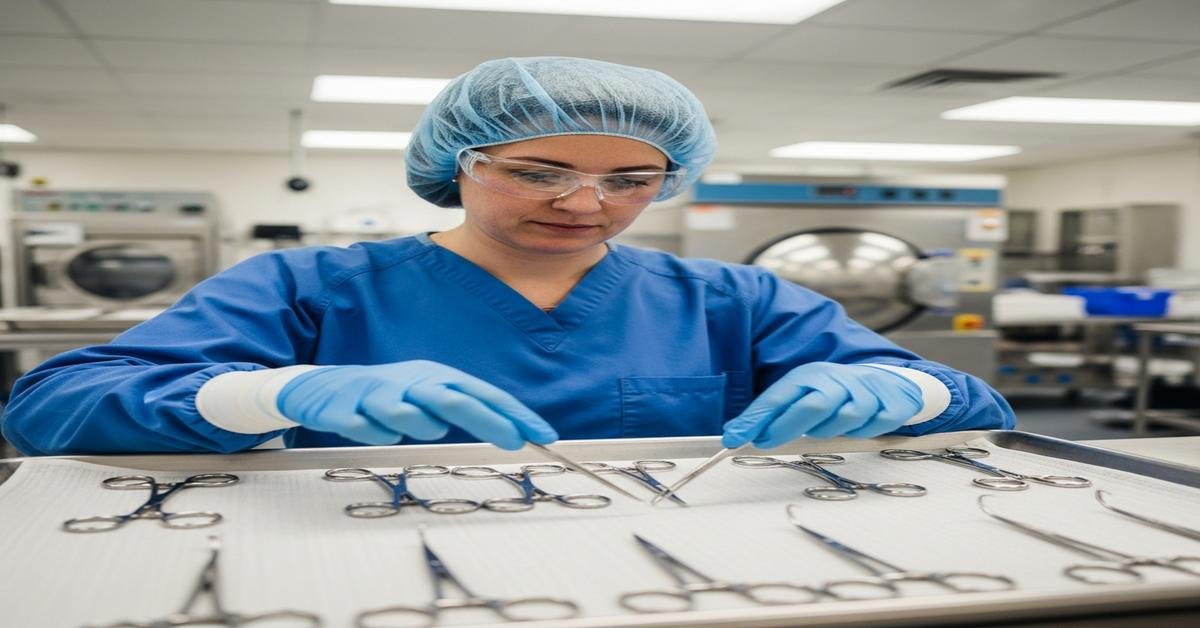
Sterile processing is the quiet engine that keeps hospitals safe. If instruments aren’t cleaned, inspected, sterilized, and tracked correctly, surgeries stop and infections rise. That’s why the Certified Registered Central Service Technician (CRCST) credential has become the gold standard for entering the field. It proves you can do the work that protects every patient on the schedule. This guide explains why the CRCST role is the most important entry-level job in the hospital, and how to earn the certification with confidence.
What Sterile Processing Does—and Why It Decides Patient Outcomes
Sterile Processing Departments (SPD) clean, disinfect, sterilize, assemble, and distribute the tools used for surgery and procedures. Every clamp, endoscope, tray, peel pack, and implant passes through SPD. If any step fails, patients are exposed to risk.
- Infection prevention: Proper cleaning removes bioburden. Sterilization only works on clean items. If cleaning is rushed or skipped, surviving microbes can cause surgical site infections.
- OR uptime: The operating room depends on SPD for on-time, complete sets. Missing or wet packs delay cases. Delays increase anesthesia time and cost.
- Traceability and recalls: SPD tracks load data, sterilizer cycles, biological indicators, and lot numbers. When there’s a recall or a sterilizer issue, accurate tracking is the only way to find affected patients.
- Cost control: SPD prevents instrument loss and damage. Each missing micro instrument or implant screw adds direct cost and potential case cancellations.
In short, SPD decides whether safe surgery is possible that day. That’s why entry-level technicians with the right training are critical.
Why CRCST Is the Gatekeeper for Safe Care
CRCST is a professional credential from the Healthcare Sterile Processing Association (HSPA). It verifies you understand the science, standards, and hands-on steps of sterile processing. Hospitals rely on it because it sets a baseline of competence.
- Standardized knowledge: CRCST aligns with national standards and manufacturer instructions for use (IFUs). This reduces variability between technicians and facilities.
- Competency by practice: The credential requires 400 hours of supervised hands-on work across all SPD areas. This builds muscle memory and safe habits.
- Regulatory readiness: Surveyors ask for proof of training, competencies, and adherence to IFUs. CRCST holders are trained to document and defend processes.
- Legal and state rules: Several states, including New Jersey, New York, Connecticut, and Tennessee, require certification. Many hospitals in other states require it by policy because it lowers risk.
Calling CRCST the most important entry-level job is not hype. It’s recognition that safe care hinges on what happens in decontamination, prep and pack, and sterilization. CRCST is the foundation that makes the rest of the system reliable.
What the Job Looks Like Day to Day
SPD work follows a strict flow. Each step exists for a reason—skipping it breaks the chain of sterility.
- Decontamination: Receive dirty instruments. Pre-clean, manually scrub, flush lumens, and run mechanical washers or ultrasonics. Use full PPE and follow water quality and detergent specs. Why: debris blocks disinfectants and sterilant, so instruments must be visibly clean.
- Inspection and assembly: Inspect under magnification. Check hinges, box locks, insulation, and cutting edges. Assemble sets per count sheets and IFUs. Why: damaged or misassembled tools fail in surgery.
- Packaging: Wrap or peel-pack to allow sterilant penetration and maintain sterility until use. Label with load and lot data. Why: traceability and barrier integrity protect the patient and the facility.
- Sterilization and disinfection: Choose the right method (steam, low-temp hydrogen peroxide gas plasma, ethylene oxide, or high-level disinfection for certain devices). Run daily tests like Bowie-Dick for vacuum efficiency and biological indicators for cycle verification. Why: method-device compatibility and monitoring prove sterility assurance.
- Storage and distribution: Cool and dry items before storage. Monitor environmental conditions. Pick cases, manage loaners, and deliver to point of use. Why: moisture, mishandling, or wrong picks undo sterile work.
- Documentation and tracking: Record load contents, cycle parameters, indicator results, and operator IDs. Why: if there’s a recall or a BI failure, you must identify every patient and tray affected.
Expect standing, lifting, moving carts, and working with heat and chemicals. The environment is controlled and procedural. Accuracy matters more than speed, but you must be efficient to support the schedule.
Skills You Need to Succeed
- Attention to detail: Small steps—like brushing a lumen or verifying a lot code—keep patients safe.
- Manual dexterity and stamina: You will assemble delicate items and handle heavy sets throughout a shift.
- Comfort with procedures: You’ll follow IFUs, AAMI standards, and checklists every time.
- Communication: You’ll coordinate with OR, endoscopy, materials management, and vendors.
- Computer skills: Tracking systems, count sheets, and documentation are part of the job.
Pay, Hours, and Career Growth
Pay varies by region and shift. Entry-level CRCST technicians often earn about $18–$28 per hour in many U.S. markets, with shift differentials and overtime boosting pay. Larger systems and union hospitals may pay more.
SPD runs 24/7 in surgical hospitals. Expect evenings, nights, weekends, and holidays. Why: instruments must be reprocessed continuously to support emergency and next-day cases.
Career paths include lead tech, instrument coordinator, flexible endoscope specialist, educator, supervisor, manager, and director. Additional HSPA credentials—like Certified Instrument Specialist (CIS), Certified Healthcare Leader (CHL), and Certified Flexible Endoscope Reprocessor (CER)—open doors to leadership and specialty roles.
How to Earn the CRCST: Step-by-Step
- 1) Confirm you meet basic prerequisites. Most employers expect a high school diploma or GED, immunizations, and ability to meet physical demands. Some states require certification within a set timeframe after hire.
- 2) Choose your training route.
- School-based programs: Community colleges or workforce programs offer structured courses and help with clinical placements.
- Employer-based training: Some hospitals hire trainees and sponsor education while you complete hours.
- Self-study plus externship: You study the HSPA manual and secure an internship for the 400 hours.
Why: a structured path increases your odds of passing the exam and getting the hours you need.
- 3) Apply and schedule the exam. The CRCST exam is multiple-choice and timed (typically 150 questions in about 3 hours). You can test before or after your 400 hours.
- 4) Complete your 400 hands-on hours. You must finish them within a defined window (often within six months before or after the exam) under supervision, with documentation.
- 5) Pass the exam and submit proof. If you pass before completing hours, you’ll receive a provisional status until your hours are verified.
- 6) Maintain your credential. Complete continuing education each year (commonly 12 CE credits) and renew on time.
Costs to plan for: textbooks and study guides, exam fees, course tuition (if applicable), scrubs, immunizations, and background checks if required for clinicals. Investing up front makes you employable across many hospitals.
The 400 Clinical Hours, Explained
HSPA requires supervised hours across core areas so you learn the full process, not just one station. A common distribution totals 400 hours:
- Decontamination: 120 hours
- Preparation and Packaging: 120 hours
- Sterilization and Disinfection: 96 hours
- Sterile Storage and Distribution: 24 hours
- Quality Assurance: 16 hours
- Equipment: 24 hours
Keep a detailed log signed by your preceptor. Record dates, tasks, and competencies. Why: accurate documentation is required to validate your experience and helps you on interviews.
How to secure an externship:
- Ask local hospitals’ SPD or HR about student placements or volunteer programs.
- Leverage a school’s clinical agreements. Programs often have existing hospital partners.
- Network with SPD leaders through professional meetings. A short tour and strong first impression often leads to a spot.
- Offer value: flexible hours, willingness to take nights/weekends, and a commitment to complete all required immunizations and onboarding.
What’s on the Exam—and How to Study
The CRCST exam covers the full life cycle of device reprocessing. Expect questions that test understanding and judgment, not just memorization.
- Decontamination science: Spaulding classification; water quality; detergents and enzymes; ultrasonic cavitation; manual cleaning steps; PPE and safety.
- Sterilization methods and monitoring: Steam cycles (e.g., 270–275°F/132–135°C pre-vac for metal instruments; 250°F/121°C gravity cycles), low-temp hydrogen peroxide, ethylene oxide, and other methods. Bowie-Dick tests, chemical indicators, biological indicators, load release criteria.
- High-level disinfection and endoscope reprocessing: Leak testing, manual cleaning, channel flushing, contact times, drying and storage, and documentation.
- Assembly and packaging: Textile and rigid container systems, peel-pack selection, load configuration, IFU-driven set assembly, and count sheet use.
- Storage and distribution: Environmental controls, shelf-life concepts, event-related sterility, and handling.
- Quality, safety, and regulations: Incident reporting, recalls, competency validation, and workplace safety (chemicals, heat, sharps).
- Instrumentation basics: Names and functions, finishes, joint types, and inspection criteria.
How to study effectively:
- Use the HSPA CRCST manual as your core text. Read every chapter and complete end-of-chapter questions.
- Study IFUs for varied items: hinged instruments, power tools, lumen devices, and flexible endoscopes. Why: the exam expects you to apply IFUs across scenarios.
- Practice vocabulary and instrument identification with images and real sets if possible.
- Drill sterilization monitoring logic: what to do when a BI fails, when a Bowie-Dick fails, and when a pack is wet.
- Create flashcards for critical parameters and definitions.
- Simulate documentation and traceability steps; know what data belongs on load records and labels.
12-Week Study Plan You Can Copy
- Weeks 1–2: Foundations. Learn department workflow, Spaulding classification, and safety. Tour a department or watch process videos if available. Start vocabulary list.
- Weeks 3–4: Decontamination. Focus on manual cleaning, water quality, detergents, ultrasonics, and mechanical washers. Practice PPE donning/doffing and cleaning checklists.
- Weeks 5–6: Assembly and packaging. Inspect instruments under magnification, identify damage, and assemble sample sets using count sheets. Learn packaging materials and sealing technique.
- Weeks 7–8: Sterilization methods. Steam cycles, load prep, monitoring, and documentation. Introduce low-temp methods and compatibility. Work practice questions daily.
- Week 9: Endoscopes and HLD. Leak testing, manual cleaning, reprocessors, drying, and storage. Review ST91 concepts and channel verification ideas.
- Week 10: Storage, distribution, loaners, and tracking. Traceability, event-related sterility, and recall procedures. Shadow case picking if possible.
- Week 11: Quality and troubleshooting. BI failures, wet packs, sterilizer aborts, and policy escalations. Do two full-length practice tests.
- Week 12: Review weak areas. Re-read high-yield chapters, redo missed questions, and rest well before the exam.
Landing Your First Job
Resume tips: Lead with “CRCST-certified (or exam passed), 400 verified clinical hours.” List hours by area and include key competencies (e.g., steam sterilization monitoring, endoscope HLD, tracking systems). Add any safety training and immunizations completed.
Interview talking points:
- Explain a time you caught a defect or contamination during inspection and how you handled it.
- Describe how you would respond to a failed BI or a Bowie-Dick failure.
- Show that you follow IFUs over habit, especially for complex devices.
- Emphasize accuracy first, then efficiency. Managers want safe, reliable throughput.
Where to apply: Community hospitals, surgery centers, endoscopy centers, and large academic medical centers. Be open to evenings or nights for faster entry and higher pay.
Common Pitfalls and How to Avoid Them
- Rushing cleaning: Skipping brushing or lumen flushing leaves debris. Slow down, follow the timer, and inspect.
- Ignoring IFUs: Using the wrong cycle or detergent can damage devices or fail sterilization. Always verify IFUs and document.
- Overloading trays or sterilizers: Poor loading blocks steam or sterilant penetration. Follow weight limits and spacing rules.
- Reprocessing shortcuts for endoscopes: Missing steps risks outbreaks. Leak test every time, dry thoroughly, and document.
- Weak documentation: Incomplete load records or labels break traceability. Double-check entries and label immediately.
- Safety lapses: No PPE in decon, improper chemical handling, or handling hot loads. Protect yourself so you can protect patients.
FAQ: Practical Details Candidates Ask
- Is CRCST required to start? In many places you can be hired and then must earn certification within a set time. Some states and hospitals require certification at hire.
- How long does it take? With focused study and a good clinical site, many candidates finish in 3–6 months. Part-time paths may take longer.
- What if I can’t find a clinical site? Enroll in a program with established partners, or contact multiple hospitals’ SPD leaders. Offer flexible hours and show proof of vaccinations to speed onboarding.
- What if I fail the exam? Retakes are allowed after a waiting period. Use your score report to target weak domains and schedule the next attempt while content is fresh.
Why This Role Is Worth It
As a CRCST, you directly protect patients you may never meet. Your work stops infections before they start, keeps operating rooms running, and gives surgeons confidence that every instrument will perform. The responsibility is real. So is the satisfaction when a busy surgical day ends without a single set error or delay.
If you want a healthcare career where precision matters and your results show up in safer outcomes, sterile processing is a smart start. Earn your CRCST, build your skills, and you’ll have a stable, respected role that touches every service line in the hospital.


I am a Registered Pharmacist under the Pharmacy Act, 1948, and the founder of PharmacyFreak.com. I hold a Bachelor of Pharmacy degree from Rungta College of Pharmaceutical Science and Research. With a strong academic foundation and practical knowledge, I am committed to providing accurate, easy-to-understand content to support pharmacy students and professionals. My aim is to make complex pharmaceutical concepts accessible and useful for real-world application.
Mail- Sachin@pharmacyfreak.com