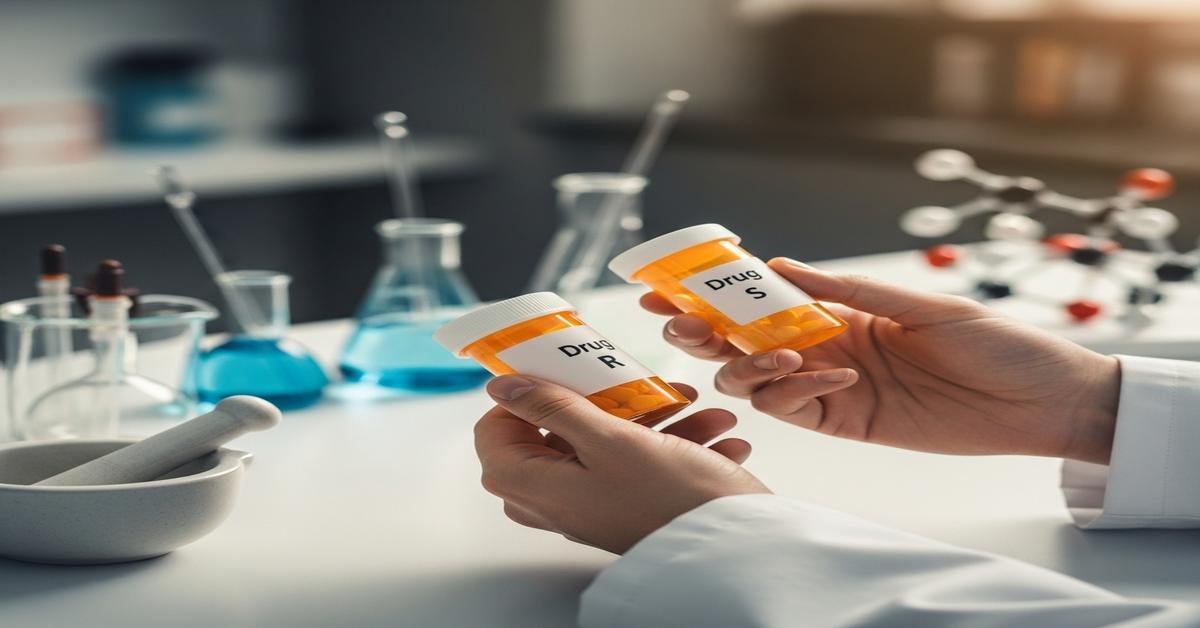
Stereochemistry is the three-dimensional shape of a molecule. In pharmacy, that shape can decide whether a drug heals, harms, or does nothing. Many drugs exist as mirror-image forms called enantiomers. We label them “R” and “S.” They have the same atoms and formula, but they fit the body differently, like a right hand versus a left glove. Understanding which form a patient receives is not academic. It affects potency, side effects, drug interactions, and sometimes life-or-death outcomes.
What “R” and “S” Mean
“R” and “S” are a way to name the two mirror-image forms of a chiral center. A chiral center is a carbon bonded to four different groups. Chemists assign priorities to those groups (by atomic number) and look at their order in space. If the sequence goes clockwise, the center is “R” (from the Latin rectus, right). If counterclockwise, it is “S” (sinister, left). The label does not say which one is more active or safer; it only describes geometry.
You may also see “d-” and “l-” (optical rotation) or “D-” and “L-” (a historical system tied to sugars). These notations do not always match “R/S.” For clinical work, the label that matters most is often the explicit name of the isomer: levo (L or S), dextro (D or R), or prefixes like levo-, dextro-, es-, and dex- in brand names indicating a single enantiomer.
Why Enantiomers Behave Differently in the Body
Biology is three-dimensional. Receptors, enzymes, and transporters are chiral. They favor one enantiomer the way a right-handed glove fits a right hand. This drives differences in:
- Pharmacodynamics (effect at the target): One enantiomer may bind tightly and activate or block a receptor (the eutomer). The other may be weak or even produce an opposing effect (the distomer).
- Pharmacokinetics (what the body does): Absorption, protein binding, metabolism, and transport are often stereoselective. One enantiomer can be cleared faster, leading to different exposure and interactions.
- Toxicology: Off-target proteins also have shape. The “wrong” isomer can fit an unintended site, causing adverse effects at therapeutic doses of the “right” isomer.
Because of these differences, two vials with the same chemical formula can deliver very different clinical results.
Real Examples Where Stereochemistry Changes Care
- Warfarin (R and S): Both are anticoagulants, but S‑warfarin is several times more potent at inhibiting vitamin K epoxide reductase. It is mainly cleared by CYP2C9. Inhibitors like amiodarone or fluconazole raise S‑warfarin levels and bleeding risk. Genotypes that reduce CYP2C9 activity increase exposure to S‑warfarin and lower dose needs. Why it matters: dose, interactions, and genetic testing hinge on the S‑enantiomer.
- Albuterol vs levalbuterol: Racemic albuterol has R‑ and S‑forms. R‑albuterol is the bronchodilator. S‑albuterol does not relax airway smooth muscle and may contribute to side effects while persisting longer. Levalbuterol contains only the R‑form, which can reduce total exposure and side effects in some patients. Why it matters: in fragile lungs, removing the inactive isomer can improve tolerability.
- Omeprazole vs esomeprazole: Esomeprazole is the S‑enantiomer. It has higher and steadier exposure due to stereoselective metabolism, which can improve acid control in certain patients. Why it matters: same mechanism, different PK, different symptom control for reflux.
- Ofloxacin vs levofloxacin: Levofloxacin is the active L‑isomer of ofloxacin with stronger antibacterial potency at a given dose. Why it matters: spectrum and dosing depend on the active enantiomer.
- Dextromethorphan vs levomethorphan: Dextromethorphan is an antitussive. Its mirror image, levomethorphan, is a potent opioid analgesic with abuse potential. Same atoms, opposite clinical category. Why it matters: stereochemistry can flip therapeutic class and safety profile.
- Ketamine vs esketamine: S‑ketamine (esketamine) has greater NMDA receptor affinity and a different side effect profile. It is used at lower doses for depression. Why it matters: finer control of efficacy and dissociation risk.
- Epinephrine (L‑epinephrine): The natural L‑form is far more potent at adrenergic receptors than the D‑form. Why it matters: cardiac arrest and anaphylaxis protocols specify L‑epinephrine for a reason.
- Ibuprofen (R and S): The S‑form is the active COX inhibitor. The body converts some R‑ibuprofen into S‑ibuprofen (chiral inversion). Why it matters: the racemate works because of in vivo inversion; the S‑isomer can be used to avoid variability in inversion.
Racemic Mixtures, Single-Enantiomer Drugs, and “Chiral Switches”
A racemate is a 50:50 mix of R and S. Historically, many drugs were sold as racemates because it was easier to make them. We now often prefer single-enantiomer products when the benefits are clear: better potency per milligram, fewer side effects, cleaner PK, or fewer interactions.
Not every “chiral switch” adds value. Sometimes the other isomer is harmless and cheap to leave in. Sometimes the body interconverts the two forms, which limits the benefit of purifying one. The classic cautionary tale is thalidomide: the R‑form is sedative; the S‑form is teratogenic. In the body, they interconvert, so an “R‑only” product would not have prevented birth defects. The lesson is to study stereochemistry in vivo, not just in a bottle.
Risks: When the Wrong Isomer Harms
Three risk patterns recur:
- Potency mismatch: A patient receives the racemate when the S‑only product was intended. The dose has half the active isomer, so disease control is worse (e.g., bronchodilation with albuterol vs levalbuterol at equal milligram doses).
- Off-target effects: The nonpreferred isomer accumulates or binds unintended sites, producing side effects without benefit (seen in several beta‑blockers and bronchodilators).
- Drug interactions targeting one isomer: An enzyme inhibitor raises exposure of the more potent enantiomer (e.g., S‑warfarin) disproportionately, spiking toxicity.
The underlying “why” is shape match. When shape is wrong, receptors and enzymes react differently. When metabolism prefers one shape, blood levels diverge. The clinical outcome follows.
Practical Tips for Pharmacists and Clinicians
- Read the name carefully: “Levo-,” “dextro-,” “es-,” and “dex-” often signal a single enantiomer. “Rac-” means racemic. Do not substitute between racemate and single isomer without prescriber approval; they are different APIs.
- Align dose with isomer: Milligram-to-milligram swaps can underdose or overdose. Levofloxacin is not given at the same dose as ofloxacin. Levalbuterol is not a 1:1 swap with racemic albuterol.
- Check interactions by isomer: For warfarin, focus on S‑warfarin and CYP2C9. For PPIs, consider stereoselective metabolism causing variability. Interaction checkers may not show isomer detail; know which enzymes clear the active isomer.
- Consider genetics: CYP2C9 for S‑warfarin, CYP2C19 for PPIs, and other polymorphisms can be isomer‑specific. If genotype is available, use it to guide dosing.
- Counsel on expectations: When switching to a single‑enantiomer drug, explain why the dose or effect changes even though “it’s the same medicine.” This improves adherence and reduces confusion.
- Watch for racemization: Some drugs can interconvert in vivo (e.g., thalidomide, ibuprofen). In those cases, a single‑enantiomer label may not guarantee a single‑enantiomer exposure.
Manufacturing and Quality: Keeping the Right Hand Right
Getting the intended isomer to the patient requires control at every step:
- Chiral synthesis or resolution: Manufacturers build the preferred isomer using catalysts or separate it from the racemate. Either route must minimize the undesired isomer.
- Chiral analytics: Quality testing uses chiral HPLC or similar methods to measure enantiomeric purity and any drift over shelf life. Pharmacopoeias often set limits on the unwanted enantiomer.
- Stability against racemization: pH, solvents, temperature, and light can promote interconversion in some molecules. Formulation and packaging aim to lock the configuration.
- Regulatory expectations: Developers must characterize PK, PD, safety, and metabolism for each isomer and any in vivo interconversion. This is why labels specify which enantiomer is supplied and how it behaves.
For sterile products and high-risk therapies, batch-to-batch consistency in enantiomeric excess is part of patient safety, not just chemistry.
Why This Matters at the Bedside
Therapeutic windows are often narrow. If one isomer is twice as potent or cleared half as fast, small errors can push patients into toxicity or treatment failure. The risk compounds when interactions selectively raise the active isomer. For anticoagulants, bronchodilators, antidepressants, anesthetics, and antibiotics, the “handedness” of the molecule often predicts the real-world outcome better than the total milligrams do.
How to Explain It to Patients
Use simple analogies. Say: “These are mirror-image molecules. Your body’s receptors are like locks. One key fits better. That’s why this version works at a lower dose and may cause fewer side effects.” Invite patients to keep the exact brand or isomer consistent unless the prescriber plans a switch.
Key Takeaways
- R/S labels describe shape, not value judgments. Only data tell you which one is better for a given use.
- Stereochemistry affects both effect and exposure. One enantiomer may be more potent, safer, or metabolized differently.
- Examples are concrete and common. Warfarin, albuterol, PPIs, levofloxacin, ketamine, and epinephrine all hinge on chirality.
- Racemates and single isomers are not interchangeable. Dosing, interactions, and outcomes can change.
- Quality control keeps the right isomer in the vial. Synthesis, testing, and stability guard against the wrong form or drift.
The bottom line: the “R” and “S” forms of a drug are not trivia. They are part of its identity. When we match the right isomer to the patient, we improve efficacy, reduce harm, and make pharmacotherapy more predictable. In some cases, that precision is the difference between success and serious injury.

I am a Registered Pharmacist under the Pharmacy Act, 1948, and the founder of PharmacyFreak.com. I hold a Bachelor of Pharmacy degree from Rungta College of Pharmaceutical Science and Research. With a strong academic foundation and practical knowledge, I am committed to providing accurate, easy-to-understand content to support pharmacy students and professionals. My aim is to make complex pharmaceutical concepts accessible and useful for real-world application.
Mail- Sachin@pharmacyfreak.com