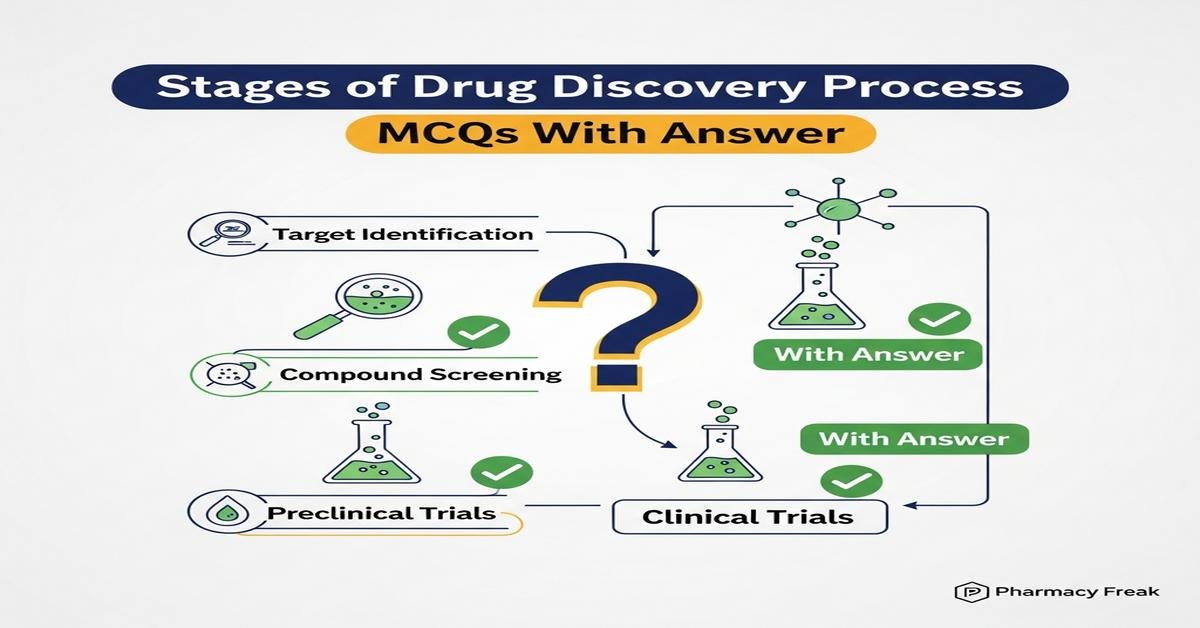
Introduction: The stages of drug discovery outline the systematic drug discovery process from target identification to clinical trials and regulatory approval. For B.Pharm students, understanding target identification, target validation, hit identification, hit-to-lead, lead optimization, ADMET assessment, preclinical studies and clinical trials is essential. Emphasis on structure-based design, high-throughput screening, SAR, pharmacokinetics, toxicology and regulatory submissions prepares students for practical pharmaceutical research and development. Mastery of these concepts improves drug candidate selection, risk assessment and decision-making in discovery pipelines. This focused, keyword-rich overview supports exam preparation and applied learning in pharmaceutical sciences. Now let’s test your knowledge with 30 MCQs on this topic.
Q1. Which stage of the drug discovery process focuses on finding a biological molecule whose modulation affects disease?
- Target identification
- Lead optimization
- Clinical trials
- Scale-up manufacturing
Correct Answer: Target identification
Q2. What is the primary aim of target validation?
- Confirm the target’s role in disease biology and druggability
- Determine manufacturing cost of the drug
- Finalize marketing strategy
- Perform human safety testing
Correct Answer: Confirm the target’s role in disease biology and druggability
Q3. Which method is commonly used in hit identification to rapidly test many compounds?
- High-throughput screening (HTS) of compound libraries
- Phase I clinical trial
- Good Manufacturing Practice (GMP) audit
- Post-marketing surveillance
Correct Answer: High-throughput screening (HTS) of compound libraries
Q4. Structure-based drug design primarily requires which information?
- The three-dimensional structure of the biological target
- Human volunteer blood samples
- Large-scale production facilities
- Marketing authorization data
Correct Answer: The three-dimensional structure of the biological target
Q5. What is the main goal of lead optimization?
- Improve potency, selectivity and ADMET properties of lead compounds
- Conduct phase III trials
- File the New Drug Application (NDA)
- Perform stability testing only
Correct Answer: Improve potency, selectivity and ADMET properties of lead compounds
Q6. ADMET in drug discovery stands for which set of properties?
- Absorption, Distribution, Metabolism, Excretion, Toxicity
- Activity, Drug-likeness, Molecular weight, Efficacy, Toxicology
- Analytical, Design, Manufacturing, Evaluation, Testing
- Adsorption, Diffusion, Metabolism, Elimination, Titration
Correct Answer: Absorption, Distribution, Metabolism, Excretion, Toxicity
Q7. Preclinical studies are primarily performed to:
- Evaluate safety, efficacy and toxicity in animal models before clinical trials
- Obtain marketing approval from regulators
- Assess pharmacovigilance signals after launch
- Design patient recruitment strategies
Correct Answer: Evaluate safety, efficacy and toxicity in animal models before clinical trials
Q8. An Investigational New Drug (IND) application must be submitted prior to which step?
- Initiate human clinical trials (Phase I)
- Begin lead optimization
- Submit marketing authorization (NDA)
- Start post-marketing surveillance
Correct Answer: Initiate human clinical trials (Phase I)
Q9. The primary objective of Phase I clinical trials is to:
- Assess safety, tolerability and pharmacokinetics in healthy volunteers
- Confirm large-scale efficacy in patients
- Obtain pricing approval
- Evaluate long-term post-marketing safety
Correct Answer: Assess safety, tolerability and pharmacokinetics in healthy volunteers
Q10. Phase II clinical trials are mainly designed to:
- Evaluate efficacy and dose-ranging in patients with the disease
- Test formulation stability under stress
- Scale up commercial manufacturing
- Conduct animal toxicology studies
Correct Answer: Evaluate efficacy and dose-ranging in patients with the disease
Q11. What is the main purpose of Phase III clinical trials?
- Confirm efficacy and monitor adverse reactions in large patient populations
- Perform initial target identification
- Screen compound libraries by HTS
- Develop analytical method validation only
Correct Answer: Confirm efficacy and monitor adverse reactions in large patient populations
Q12. Structure–activity relationship (SAR) studies are typically performed using:
- Systematic chemical modification and medicinal chemistry approaches
- Only clinical endpoints in Phase III
- Market research surveys
- GMP manufacturing audits
Correct Answer: Systematic chemical modification and medicinal chemistry approaches
Q13. High-throughput screening (HTS) is intended to:
- Rapidly test thousands of compounds for activity against a target
- Measure long-term clinical outcomes
- Ensure batch-to-batch manufacturing consistency
- Evaluate regulatory labeling requirements
Correct Answer: Rapidly test thousands of compounds for activity against a target
Q14. The hit-to-lead stage primarily aims to:
- Convert initial hits into optimized lead compounds with acceptable properties
- Finalize packaging design for marketing
- Recruit patients for Phase IV studies
- File the clinical trial registry only
Correct Answer: Convert initial hits into optimized lead compounds with acceptable properties
Q15. Pharmacokinetics (PK) studies measure which aspects of a drug?
- Absorption, distribution, metabolism and excretion characteristics
- Only pharmacodynamics at receptor level
- Commercial viability and market share
- Clinical trial recruitment rates
Correct Answer: Absorption, distribution, metabolism and excretion characteristics
Q16. Pharmacodynamics (PD) primarily describes:
- The drug’s biochemical and physiological effects and mechanism of action
- The process of scaling up production
- Regulatory submission timelines
- Stability of the drug product under accelerated conditions
Correct Answer: The drug’s biochemical and physiological effects and mechanism of action
Q17. Nonclinical toxicology studies intended for regulatory submission must follow:
- Good Laboratory Practice (GLP) standards
- Good Distribution Practice (GDP) guidelines only
- Marketing authorization rules
- Clinical trial informed consent procedures
Correct Answer: Good Laboratory Practice (GLP) standards
Q18. Which stage is typically the most expensive in the drug discovery process?
- Late-stage clinical trials (Phase III) due to scale and duration
- Target identification only
- Initial medicinal chemistry design
- Early in silico screening
Correct Answer: Late-stage clinical trials (Phase III) due to scale and duration
Q19. Biomarkers in drug discovery are used to:
- Indicate target engagement, efficacy or potential toxicity
- Replace all animal toxicology studies
- Define marketing price
- Serve as manufacturing excipients
Correct Answer: Indicate target engagement, efficacy or potential toxicity
Q20. Orphan drug designation is beneficial when developing drugs for:
- Rare diseases with small patient populations
- Common conditions with millions of patients
- Non-therapeutic cosmetic agents
- OTC vitamins only
Correct Answer: Rare diseases with small patient populations
Q21. Virtual screening in hit identification refers to:
- In silico docking and computational screening of compound databases
- Physical robotic screening of compounds only
- Clinical trial simulations
- Manufacturing process simulation
Correct Answer: In silico docking and computational screening of compound databases
Q22. Lead-likeness of a compound generally favors which properties?
- Low molecular weight and simple scaffolds amenable to optimization
- Very high molecular weight and high lipophilicity
- Complex natural extracts only
- Irreversible covalent binding always
Correct Answer: Low molecular weight and simple scaffolds amenable to optimization
Q23. Oral bioavailability is defined as:
- The proportion of an administered dose reaching systemic circulation unchanged
- The potency of a drug in vitro
- The marketing uptake after launch
- The time to reach maximum marketing share
Correct Answer: The proportion of an administered dose reaching systemic circulation unchanged
Q24. Which preclinical study is often performed first to assess immediate hazard?
- Acute toxicity (single-dose) studies in animals
- Phase III clinical efficacy trials
- Long-term epidemiological studies
- Large-scale manufacturing validation
Correct Answer: Acute toxicity (single-dose) studies in animals
Q25. For marketing approval in the US, which submission is required?
- New Drug Application (NDA)
- Investigational New Drug (IND) only
- Clinical Trial Authorization (CTA) for EU only
- Good Manufacturing Practice (GMP) certificate only
Correct Answer: New Drug Application (NDA)
Q26. A lead compound is best described as:
- A compound with desirable activity and properties for further optimization
- A final marketed drug product with full labeling
- Only a toxic metabolite
- A formulation excipient
Correct Answer: A compound with desirable activity and properties for further optimization
Q27. Structure–activity relationship (SAR) analysis helps scientists to:
- Understand how chemical modifications affect biological activity
- Determine marketing pricing strategies
- Replace clinical trials entirely
- Standardize packaging design
Correct Answer: Understand how chemical modifications affect biological activity
Q28. Which biophysical assay is commonly used to measure ligand–target binding affinity?
- Surface plasmon resonance (SPR) assay
- Phase I clinical endpoint
- Manufacturing yield test
- Accelerated stability test
Correct Answer: Surface plasmon resonance (SPR) assay
Q29. During lead optimization, which property is considered a major liability?
- High metabolic clearance leading to a very short half-life
- Moderate potency with good selectivity
- Balanced lipophilicity and solubility
- Predictable, low-toxicity profile
Correct Answer: High metabolic clearance leading to a very short half-life
Q30. Good Manufacturing Practice (GMP) in drug discovery ensures:
- Consistent quality and safety of drug products during manufacturing
- Improved target validation in vitro
- Faster in silico screening results
- Lowered biological assay sensitivity
Correct Answer: Consistent quality and safety of drug products during manufacturing


