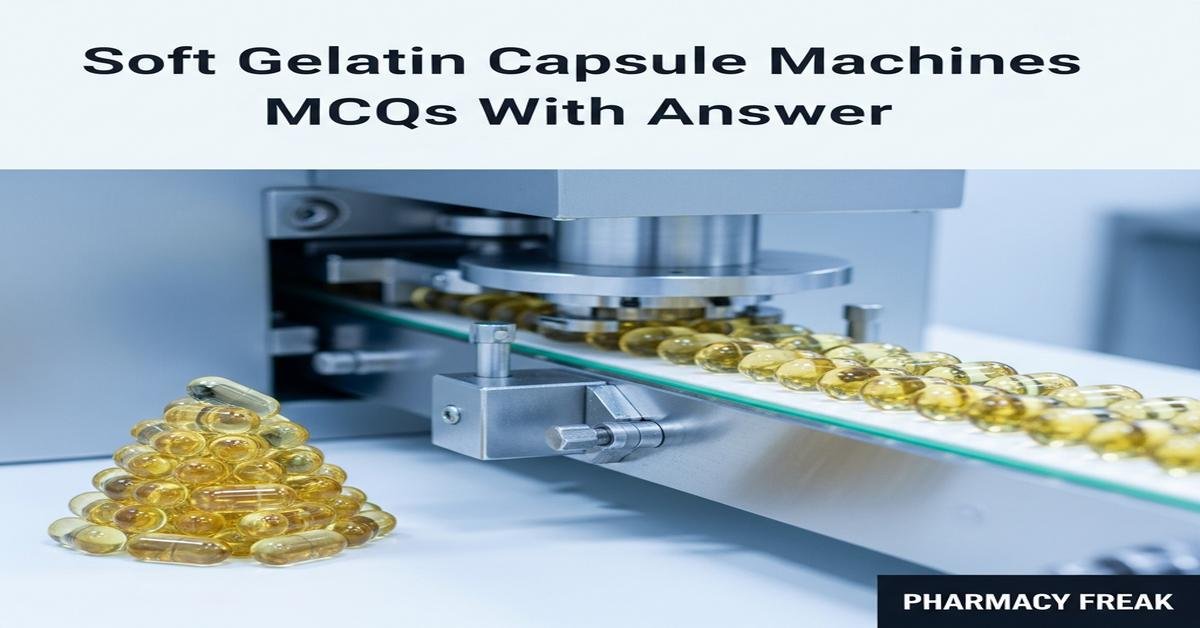
Introduction: Soft Gelatin Capsule Machines MCQs With Answer is designed for M.Pharm students studying MIP 203T – Pharmaceutical Production Technology. This collection offers focused, exam-oriented multiple-choice questions on the design, operation, process parameters, troubleshooting and quality control of soft gelatin capsule (softgel) manufacturing machines. Questions cover rotary die encapsulation principles, dosing systems, gelatin formulation variables, drying, sealing, machine validation and safety aspects. The set aims to deepen conceptual understanding and practical awareness necessary for industrial formulation, scale-up and regulatory compliance. Use these MCQs for self-assessment, revision and to prepare for university exams and viva voce discussions.
Q1. What is the principal encapsulation mechanism used in a rotary die soft gelatin capsule machine?
- Two ribbons of gelatin are brought together and liquid fill is injected between them at the die rolls
- A single sheet of gelatin is folded around pellets and heat-sealed
- Capsules are molded from molten gelatin in a cold mold
- Gelatin is extruded through nozzles into a crosslinking bath
Correct Answer: Two ribbons of gelatin are brought together and liquid fill is injected between them at the die rolls
Q2. Which parameter of gelatin most directly affects the firmness and handling of softgel ribbons during encapsulation?
- Moisture content expressed as % w/w
- Bloom strength (gel strength)
- pH of the gelatin solution
- Plasticizer type
Correct Answer: Bloom strength (gel strength)
Q3. In softgel manufacturing, which plasticizer is most commonly used to impart flexibility to the gelatin matrix?
- Polyethylene glycol 4000
- Glycerin
- Calcium stearate
- Hydroxypropyl methylcellulose
Correct Answer: Glycerin
Q4. What is the main purpose of the dosing system in a softgel rotary encapsulation machine?
- To heat the gelatin to the required viscosity
- To meter and deliver the precise volume of liquid fill into the die cavity
- To trim excess gelatin around the capsule
- To convey dried capsules to packaging
Correct Answer: To meter and deliver the precise volume of liquid fill into the die cavity
Q5. Which dosing pump type is preferred for accurate, pulsation-free delivery of low-viscosity liquid fills in high-speed softgel machines?
- Peristaltic pump
- Rotary lobe pump
- Gear (positive displacement) pump
- Squeeze pump
Correct Answer: Gear (positive displacement) pump
Q6. Excessive moisture in finished soft gelatin capsules is most likely to cause which problem during storage?
- Increased capsule brittleness and cracking
- Capsule sticking and microbial growth
- Permanent shrinkage of the capsule shell
- Immediate dissolution of the shell
Correct Answer: Capsule sticking and microbial growth
Q7. Which of the following is the primary function of the die rolls on a rotary softgel machine?
- Heat the gelatin to a molten state
- Create matching cavities, form shell seams and support fill injection
- Cut the capsules from a continuous strip after drying
- Homogenize the fill formulation
Correct Answer: Create matching cavities, form shell seams and support fill injection
Q8. Cross-linking of gelatin shells during storage can be accelerated by which ingredient or contaminant?
- Antioxidants such as BHT
- Free aldehydes or oxidizing agents
- High levels of non-volatile plasticizer
- Low molecular weight polyethylene glycols
Correct Answer: Free aldehydes or oxidizing agents
Q9. Which quality test is specifically used to detect leaking or improperly sealed soft gelatin capsules?
- Disintegration test
- Dissolution test
- Sealing integrity (leak) test such as dye ingress or vacuum decay
- Hardness (tensile) test of shell
Correct Answer: Sealing integrity (leak) test such as dye ingress or vacuum decay
Q10. During softgel encapsulation, synchronization between the dosing pump and turret speed is critical primarily to control what?
- Ambient humidity around the drying tunnel
- Exact fill volume per capsule and minimize weight variation
- Gelatin bloom strength
- Final drying time
Correct Answer: Exact fill volume per capsule and minimize weight variation
Q11. Which step immediately follows the encapsulation (fill and sealing) station on most rotary softgel lines?
- Final packaging into blister packs
- Drying in a controlled tunnel or tray dryer
- Coating with enteric polymers
- Freeze-drying to remove solvent
Correct Answer: Drying in a controlled tunnel or tray dryer
Q12. A formulation scientist wants to minimize API migration into the gelatin shell. Which formulation strategy is most appropriate?
- Use a highly water-miscible solvent to increase migration
- Increase the solubility of the API in the shell by adding surfactants
- Use low polarity fill solvents and include suitable impermeable excipients
- Raise the fill temperature to 90°C during encapsulation
Correct Answer: Use low polarity fill solvents and include suitable impermeable excipients
Q13. Which machine maintenance practice is essential to prevent contamination and ensure consistent softgel shell formation?
- Only lubricating moving parts weekly
- Regular cleaning of gelatin feed tanks, pumps and die surfaces (CIP where applicable)
- Using cold water to rinse die rolls during production
- Disabling the ventilation system during operation
Correct Answer: Regular cleaning of gelatin feed tanks, pumps and die surfaces (CIP where applicable)
Q14. Which filled materials are most challenging for softgel encapsulation due to phase separation or high viscosity?
- Low-viscosity hydrophobic oils
- Solutions of small molecules in volatile solvents
- Highly viscous suspensions and semi-solids containing solids or waxes
- Simple water-based syrups
Correct Answer: Highly viscous suspensions and semi-solids containing solids or waxes
Q15. What is the typical role of a drying tunnel’s controlled relative humidity profile in softgel processing?
- To maintain gelatin at its molten state during transit
- To gradually remove moisture and avoid surface hardening that traps internal moisture
- To raise plasticizer content in the shell
- To sterilize the capsules by high humidity
Correct Answer: To gradually remove moisture and avoid surface hardening that traps internal moisture
Q16. Which physical property of the fill fluid most strongly influences the choice of dosing system and pump on a softgel machine?
- Electrical conductivity
- Viscosity
- Color
- Melting point of the API
Correct Answer: Viscosity
Q17. During process validation of a softgel line, which metric is commonly used to demonstrate fill uniformity?
- Average capsule diameter
- Coefficient of variation (CV%) of fill weight or assay
- Gelatin bloom strength variability
- Relative humidity of the filling room
Correct Answer: Coefficient of variation (CV%) of fill weight or assay
Q18. Which safety precaution is particularly important when manufacturing softgels with flammable organic solvents as the fill medium?
- Using only stainless steel rollers without grounding
- Operation in explosion-proof equipment with proper ventilation and solvent recovery
- Increasing room temperature above solvent flash point
- Eliminating inert gas systems to reduce cost
Correct Answer: Operation in explosion-proof equipment with proper ventilation and solvent recovery
Q19. What is a common cause of poor sealing (leakage) at the capsule seam observed after encapsulation?
- Excessive plasticizer content in the gelatin shell
- Insufficient compression or inadequate heating at the die roll seam
- Using gelatin with excessively high bloom strength
- Too low ambient humidity in the manufacturing room
Correct Answer: Insufficient compression or inadequate heating at the die roll seam
Q20. For a biopharmaceutically sensitive API intended for softgel filling, which machine and process control is most critical to preserve potency?
- High-temperature gelatin melting to sterilize the fill
- Precise temperature control of fill and gelatin to avoid thermal degradation and maintain viscosity
- Extremely long drying times at elevated temperatures
- Frequent manual handling of filled ribbons before sealing
Correct Answer: Precise temperature control of fill and gelatin to avoid thermal degradation and maintain viscosity

