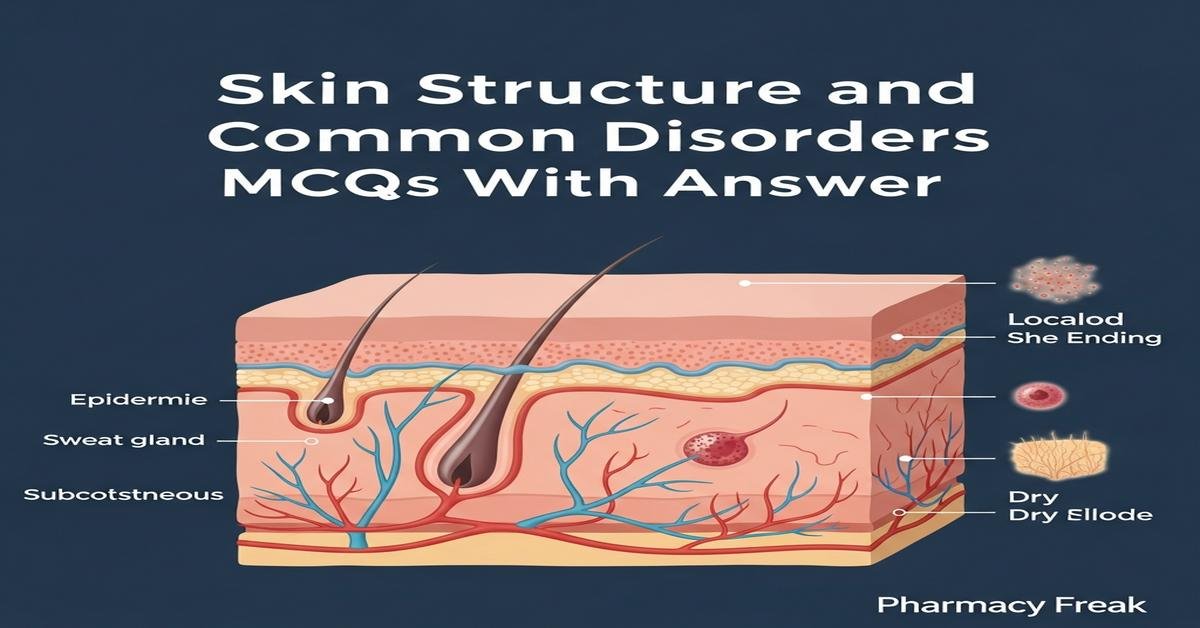
Skin structure and common disorders MCQs With Answer is designed for M.Pharm students preparing for advanced coursework and competitive exams in Cosmetics & Cosmeceuticals (MPH 204T). This quiz collection focuses on the anatomy, cellular biology, barrier function, appendages and molecular pathology of common dermatologic conditions relevant to cosmeceutical formulation and therapeutic strategies. Each question emphasizes mechanistic understanding — for example, epidermal differentiation, melanogenesis, lipid composition of the stratum corneum, immune pathways in dermatitis and psoriasis, and principles of topical drug/permeation and photoprotection. Detailed, clinically and pharmaceutically oriented options train students to integrate basic science with formulation and treatment considerations.
Q1. Which sequence correctly lists the layers of the epidermis from deepest to most superficial in thick (palmar/plantar) skin?
- Stratum basale → Stratum spinosum → Stratum granulosum → Stratum lucidum → Stratum corneum
- Stratum corneum → Stratum lucidum → Stratum granulosum → Stratum spinosum → Stratum basale
- Stratum basale → Stratum granulosum → Stratum spinosum → Stratum corneum → Stratum lucidum
- Stratum spinosum → Stratum basale → Stratum granulosum → Stratum corneum → Stratum lucidum
Correct Answer: Stratum basale → Stratum spinosum → Stratum granulosum → Stratum lucidum → Stratum corneum
Q2. What is the predominant cell type in the epidermis responsible for structural barrier and keratin production?
- Melanocytes
- Langerhans cells
- Keratinocytes
- Merkel cells
Correct Answer: Keratinocytes
Q3. Loss-of-function mutations in which protein are strongly associated with increased risk of atopic dermatitis due to impaired barrier and natural moisturizing factor (NMF) formation?
- Keratin 14
- Filaggrin
- Involucrin
- Desmoglein 1
Correct Answer: Filaggrin
Q4. Which enzyme is the rate-limiting catalyst in melanin biosynthesis within melanocytes?
- Tyrosinase
- Monoamine oxidase
- Phenylalanine hydroxylase
- Melanocortin receptor 1 (MC1R)
Correct Answer: Tyrosinase
Q5. Which type of melanin provides greater photoprotection and reduces reactive oxygen species formation?
- Pheomelanin
- Eumelanin
- Norepinephrine-derived melanin
- Neuromelanin
Correct Answer: Eumelanin
Q6. Desmogleins and desmocollins, key proteins in intercellular adhesion of the epidermis, belong to which protein family?
- Integrins
- Cadherins
- Claudins
- Connexins
Correct Answer: Cadherins
Q7. The natural moisturizing factor (NMF) of the stratum corneum is primarily derived from degradation products of which protein?
- Ceramide synthase
- Filaggrin (amino acids and PCA)
- Loricrin
- Collagen type I
Correct Answer: Filaggrin (amino acids and PCA)
Q8. Which cutaneous appendage is principally responsible for thermoregulatory sweating in humans?
- Apocrine sweat glands
- Eccrine sweat glands
- Sebaceous glands
- Hair follicles
Correct Answer: Eccrine sweat glands
Q9. Which organism is most characteristically associated with acne vulgaris pathogenesis?
- Staphylococcus epidermidis
- Cutibacterium acnes (formerly Propionibacterium acnes)
- Candida albicans
- Malassezia furfur
Correct Answer: Cutibacterium acnes (formerly Propionibacterium acnes)
Q10. The immunologic axis most implicated in psoriasis pathogenesis and targeted by biologic therapies is:
- Th1/IFN-γ axis
- IL-4/Th2 axis
- IL-23/Th17 axis
- Complement alternative pathway
Correct Answer: IL-23/Th17 axis
Q11. Topical retinoids exert therapeutic effects in acne primarily by which mechanism?
- Inhibiting bacterial protein synthesis
- Modulating gene transcription via retinoic acid receptors to normalize keratinocyte differentiation and reduce microcomedone formation
- Blocking androgen receptors in sebaceous glands
- Acting as topical keratolytics by dissolving intercellular lipids
Correct Answer: Modulating gene transcription via retinoic acid receptors to normalize keratinocyte differentiation and reduce microcomedone formation
Q12. Which ultraviolet wavelength penetrates deepest into the skin and contributes most to photoaging through dermal matrix damage?
- UVC (200–280 nm)
- UVB (280–320 nm)
- UVA (320–400 nm)
- Visible light (400–700 nm)
Correct Answer: UVA (320–400 nm)
Q13. Normal healthy skin surface pH (acid mantle) typically falls within which range?
- 2.0–3.0
- 4.5–5.5
- 6.8–7.4
- 7.8–8.5
Correct Answer: 4.5–5.5
Q14. Which family of proteases plays a central role in desquamation by cleaving corneodesmosomal proteins?
- Matrix metalloproteinases (MMPs)
- Cathepsins
- Kallikreins (serine proteases, e.g., KLK5, KLK7)
- Caspases
Correct Answer: Kallikreins (serine proteases, e.g., KLK5, KLK7)
Q15. Sun Protection Factor (SPF) primarily quantifies protection against which component of solar UV radiation?
- UVA-induced photoaging
- UVA-II (340–400 nm)
- UVB-induced erythema and sunburn
- Visible light-induced pigmentation
Correct Answer: UVB-induced erythema and sunburn
Q16. Which lipid class is most abundant and critical for the barrier function of the stratum corneum?
- Phospholipids
- Cholesterol esters
- Ceramides
- Triglycerides
Correct Answer: Ceramides
Q17. Non-bullous impetigo, a superficial bacterial skin infection common in children, is most often caused by which pathogen?
- Staphylococcus aureus
- Escherichia coli
- Pseudomonas aeruginosa
- Corynebacterium minutissimum
Correct Answer: Staphylococcus aureus
Q18. Allergic contact dermatitis is mediated by which immunologic mechanism?
- Type I hypersensitivity (IgE-mediated)
- Type II hypersensitivity (antibody-dependent cytotoxicity)
- Type III hypersensitivity (immune complex-mediated)
- Type IV hypersensitivity (delayed, T cell–mediated)
Correct Answer: Type IV hypersensitivity (delayed, T cell–mediated)
Q19. Topical terbinafine treats dermatophyte infections by inhibiting which enzyme in fungal sterol biosynthesis?
- Lanosterol 14α-demethylase (CYP51)
- Squalene epoxidase
- HMG-CoA reductase
- Δ7-sterol reductase
Correct Answer: Squalene epoxidase
Q20. The primary biochemical action of topical ascorbic acid (vitamin C) in cosmeceuticals is:
- Irreversible inhibition of tyrosinase by covalent binding
- Scavenging reactive oxygen species and regenerating vitamin E (antioxidant activity)
- Promoting sebum production via mTOR activation
- Directly cross-linking collagen fibers to increase tensile strength
Correct Answer: Scavenging reactive oxygen species and regenerating vitamin E (antioxidant activity)


I am a Registered Pharmacist under the Pharmacy Act, 1948, and the founder of PharmacyFreak.com. I hold a Bachelor of Pharmacy degree from Rungta College of Pharmaceutical Science and Research. With a strong academic foundation and practical knowledge, I am committed to providing accurate, easy-to-understand content to support pharmacy students and professionals. My aim is to make complex pharmaceutical concepts accessible and useful for real-world application.
Mail- Sachin@pharmacyfreak.com