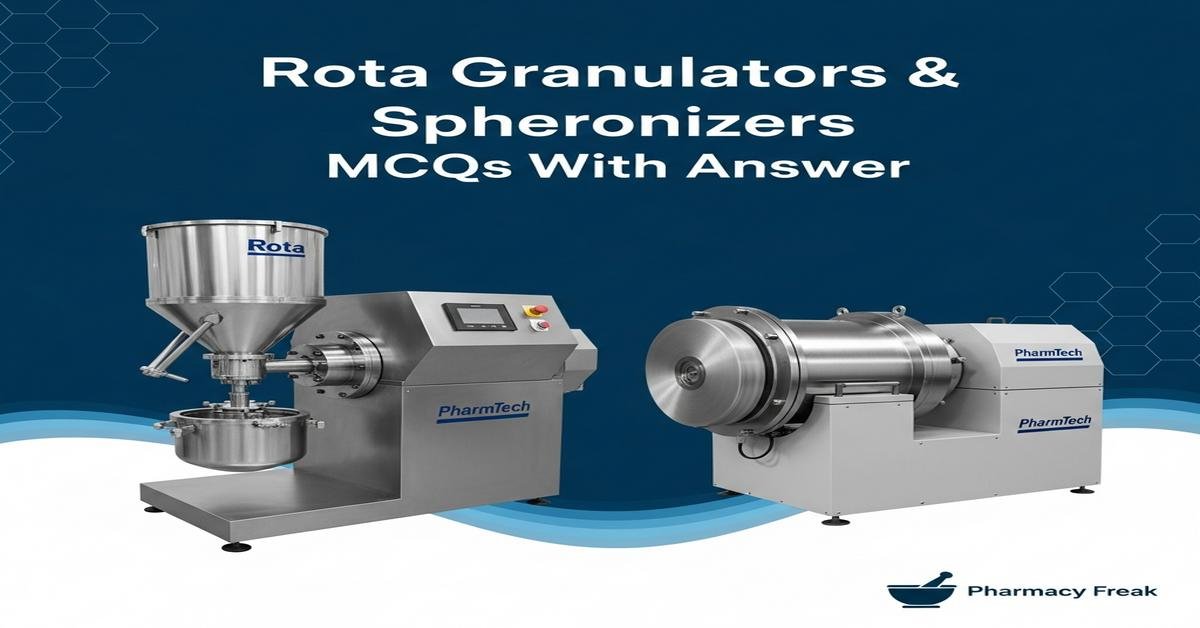
Rota Granulators & Spheronizers MCQs With Answer
This quiz collection is designed for M.Pharm students studying MIP 203T – Pharmaceutical Production Technology. It focuses on rota (rotary) granulators and spheronizers, presenting core principles, equipment components, process variables, troubleshooting and scale-up considerations. The questions emphasize mechanistic understanding — how wet mass properties, equipment geometry and operating parameters influence granule and pellet quality (size, shape, strength, porosity and drug release). Use these MCQs to test and reinforce applied knowledge required for lab practice and exam preparation. Explanations (where needed) should be consulted from course texts; these items prioritize conceptual accuracy and operational relevance encountered in industrial pelletization and granulation processes.
Q1. What is the primary function of a rota (rotary) granulator in wet granulation?
- To convert dry powders into spherical pellets by rolling
- To convert wet mass into granules by forcing it through a perforated screen with rotating elements
- To directly coat granules with polymeric film
- To compress granules into tablets
Correct Answer: To convert wet mass into granules by forcing it through a perforated screen with rotating elements
Q2. Which statement best describes the principle of spheronization?
- Extrusion of dry powders through a nozzle to form filaments
- Conversion of cylindrical extrudates into spherical pellets by rolling and frictional forces on a rotating friction plate
- Drying of granules to produce dense spheres using heated air
- Coating of tablets to improve appearance and taste
Correct Answer: Conversion of cylindrical extrudates into spherical pellets by rolling and frictional forces on a rotating friction plate
Q3. Which is the correct sequential order of the extrusion–spheronization process?
- Extrusion → Wet massing → Spheronization → Drying → Size classification
- Mixing → Wet massing → Extrusion → Spheronization → Drying → Size classification
- Mixing → Drying → Extrusion → Coating → Spheronization
- Wet massing → Drying → Extrusion → Spheronization → Compression
Correct Answer: Mixing → Wet massing → Extrusion → Spheronization → Drying → Size classification
Q4. How does increasing the friction plate speed in a spheronizer generally affect pellet characteristics (within practical limits)?
- Decreases sphericity and increases agglomeration
- Increases sphericity and can reduce pellet size up to an optimum, but very high speeds cause attrition
- Has no effect on pellet shape or size
- Always increases pellet porosity with no change in shape
Correct Answer: Increases sphericity and can reduce pellet size up to an optimum, but very high speeds cause attrition
Q5. What is the principal role of a binder in extrusion–spheronization?
- To act as a disintegrant in the final dosage form
- To provide plasticity and interparticulate cohesion necessary for extrusion and spheroid formation
- To function as a lubricant during tableting
- To reduce the density of pellets
Correct Answer: To provide plasticity and interparticulate cohesion necessary for extrusion and spheroid formation
Q6. Which process parameter most directly determines the mean pellet diameter after spheronization?
- The friction plate speed of the spheronizer
- The extrudate diameter produced by the extruder
- The drying temperature after spheronization
- The coating thickness applied to pellets
Correct Answer: The extrudate diameter produced by the extruder
Q7. What is the consequence of having excessively low moisture content in the wet mass fed to an extruder?
- Excessive stickiness and large agglomerates
- Improved sphericity due to hard extrudates
- Poor plasticity leading to cracked, friable extrudates and irregular pellets
- Faster drying during spheronization
Correct Answer: Poor plasticity leading to cracked, friable extrudates and irregular pellets
Q8. Which statement best distinguishes a rota granulator from a spheronizer?
- A rota granulator forms spherical pellets from extrudates; a spheronizer converts wet mass to granules by sieving
- A rota granulator is primarily used for spray coating; a spheronizer is used for tableting
- A rota granulator converts wet mass into granules via rotating impaction and screen; a spheronizer rounds cylindrical extrudates into spheres using a friction plate
- There is no practical difference; both perform identical functions
Correct Answer: A rota granulator converts wet mass into granules via rotating impaction and screen; a spheronizer rounds cylindrical extrudates into spheres using a friction plate
Q9. How does friction plate geometry (e.g., cross-hatched vs. radial ribs) influence spheronization?
- It controls the air flow during drying but not pellet shape
- It determines pellet surface texture, roundness and residence movement — different geometries can improve sphericity or throughput
- It only affects the motor power consumption and not pellet quality
- It eliminates the need for extrusion
Correct Answer: It determines pellet surface texture, roundness and residence movement — different geometries can improve sphericity or throughput
Q10. In rota granulation, which equipment parameter is most commonly adjusted to control the granule size distribution?
- Screen or perforation size of the granulator
- The color of the hopper
- The pH of the binder solution
- The tablet compression force downstream
Correct Answer: Screen or perforation size of the granulator
Q11. Which excipient is frequently used as a pellet-forming aid in extrusion–spheronization due to its excellent plasticity and water-absorbing properties?
- Microcrystalline cellulose (MCC)
- Sodium chloride
- Magnesium stearate
- Calcium carbonate
Correct Answer: Microcrystalline cellulose (MCC)
Q12. What is the main purpose of the drying step after spheronization?
- To increase the pellet diameter intentionally
- To remove residual water and harden/stabilize pellet shape and mechanical strength
- To change the chemical composition of the drug
- To convert pellets into powder for tableting
Correct Answer: To remove residual water and harden/stabilize pellet shape and mechanical strength
Q13. Which product attribute is least likely to be improved directly by spheronization?
- Bulk flowability of the particulate product
- Content uniformity in coated controlled-release pellets
- Immediate disintegration time of an uncoated rapidly dissolving tablet
- Surface uniformity for film coating
Correct Answer: Immediate disintegration time of an uncoated rapidly dissolving tablet
Q14. If pellets produced by spheronization are elongated rather than spherical, what is a likely root cause?
- Excessive spheronizer speed
- Insufficient spheronization time or inadequate rolling action
- Overdrying after spheronization
- Using too fine a screen in the rota granulator
Correct Answer: Insufficient spheronization time or inadequate rolling action
Q15. During scale-up of a spheronization process, which strategy is commonly used to preserve pellet shape and kinematics?
- Maintain constant batch weight regardless of equipment size
- Maintain constant peripheral (tip) speed of the friction plate
- Always double the residence time
- Keep rpm identical without regard to plate diameter
Correct Answer: Maintain constant peripheral (tip) speed of the friction plate
Q16. Which morphological parameter is commonly used to quantify pellet sphericity?
- Aspect ratio (ratio of minor to major axis) or circularity measures
- Melting point
- Compressibility index
- pH of the binder solution
Correct Answer: Aspect ratio (ratio of minor to major axis) or circularity measures
Q17. Increasing binder concentration in the wet mass typically leads to which of the following pellet property changes?
- Lower mechanical strength and lower density
- Increased pellet mechanical strength and a tendency toward larger, more cohesive agglomerates
- Complete elimination of porosity
- Instant drug release irrespective of coating
Correct Answer: Increased pellet mechanical strength and a tendency toward larger, more cohesive agglomerates
Q18. How does rotating speed of the impeller or rotor in a rota granulator influence granule formation?
- Higher rotor speed decreases impaction energy and produces larger granules
- Higher rotor speed increases shear and impaction energy, typically producing finer granules and higher throughput until an optimum is reached
- Rotor speed only affects hopper refilling rate, not granule size
- Rotor speed controls the chemical stability of the drug
Correct Answer: Higher rotor speed increases shear and impaction energy, typically producing finer granules and higher throughput until an optimum is reached
Q19. Why are spheronized pellets advantageous for coated controlled-release formulations?
- They are porous and cannot be coated uniformly
- They provide a uniform and reproducible substrate for coating, leading to predictable film thickness and drug release
- They dissolve immediately, preventing sustained release
- They eliminate the need for binders
Correct Answer: They provide a uniform and reproducible substrate for coating, leading to predictable film thickness and drug release
Q20. Which operation is NOT an inherent step of rota granulation or spheronization?
- Wet massing/mixing
- Extrusion of the wet mass
- Spheronization (rolling on friction plate)
- Compression of pellets directly into tablets as part of the same unit operation
Correct Answer: Compression of pellets directly into tablets as part of the same unit operation

