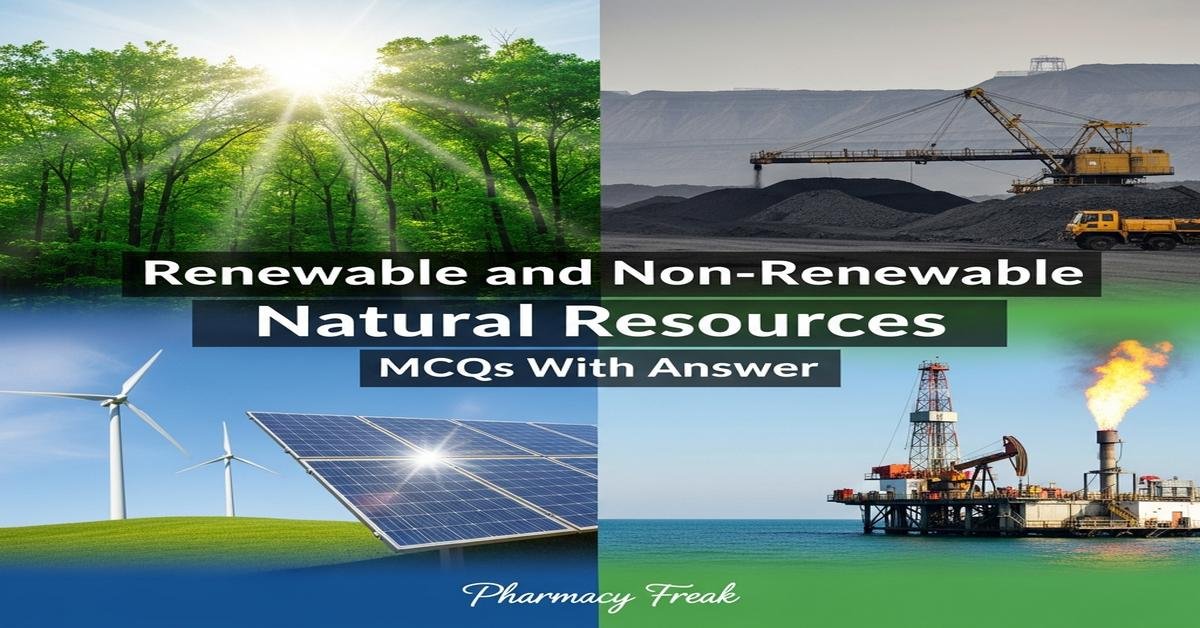
Renewable and non-renewable natural resources MCQs With Answer is tailored for M.Pharm students preparing for advanced topics in Hazards and Safety Management. This concise collection focuses on the classification, environmental and occupational hazards, regulatory context, and practical implications of resource use in pharmaceutical industries. Questions cover life-cycle thinking, renewable energy adoption, solvent sourcing, waste handling, contamination risks, and strategies for reducing reliance on finite resources through green chemistry and circular economy measures. The set aims to deepen conceptual understanding and link theoretical concepts to operational safety and sustainability decisions encountered in pharmaceutical manufacturing and waste management.
Q1. Which statement correctly distinguishes renewable from non‑renewable natural resources?
- Renewable resources regenerate on a human timescale; non‑renewable resources form over geological timescales.
- Renewable resources are always inexhaustible; non‑renewable resources are always toxic.
- Non‑renewable resources can be synthesized easily in the laboratory; renewable resources cannot be modified.
- Renewable resources are only biological; non‑renewable resources are only mineral.
Correct Answer: Renewable resources regenerate on a human timescale; non‑renewable resources form over geological timescales.
Q2. Which description best fits petroleum as a resource relevant to pharmaceutical manufacturing?
- A renewable bioresource produced annually by photosynthesis.
- A non‑renewable fossil fuel formed from ancient organic matter and used for solvents and raw materials.
- A synthetic resource manufactured from recycled plastics.
- An infinite energy source harnessed from tidal motion.
Correct Answer: A non‑renewable fossil fuel formed from ancient organic matter and used for solvents and raw materials.
Q3. Which combination lists renewable energy sources commonly implemented to reduce carbon footprint in pharmaceutical plants?
- Coal combustion and diesel generators.
- Solar photovoltaic panels and wind turbines.
- Oil-fired boilers and peat burners.
- Natural gas combined cycle and shale gas fracking.
Correct Answer: Solar photovoltaic panels and wind turbines.
Q4. What is the primary environmental hazard associated with mining of non‑renewable mineral resources that impacts pharmaceutical raw material quality?
- Heavy metal contamination of surrounding soil and groundwater affecting raw material purity.
- Increased ultraviolet radiation in adjacent areas.
- Depletion of atmospheric oxygen locally.
- Instantaneous neutralization of acidic wastes.
Correct Answer: Heavy metal contamination of surrounding soil and groundwater affecting raw material purity.
Q5. Which international agreement specifically addresses transboundary movements of hazardous wastes relevant to pharmaceutical waste management?
- Montreal Protocol on Substances that Deplete the Ozone Layer.
- Basel Convention on the Control of Transboundary Movements of Hazardous Wastes.
- Kyoto Protocol on greenhouse gas emissions.
- Stockholm Convention on Persistent Organic Pollutants (POPs).
Correct Answer: Basel Convention on the Control of Transboundary Movements of Hazardous Wastes.
Q6. Life‑cycle assessment (LCA) is used in resource management to:
- Quantify environmental impacts across all stages from raw material extraction to disposal.
- Only estimate the economic cost of raw materials.
- Measure the thermal stability of pharmaceutical compounds.
- Evaluate pharmacokinetics in human subjects.
Correct Answer: Quantify environmental impacts across all stages from raw material extraction to disposal.
Q7. Which of the following solvents commonly used in pharmaceutical synthesis is derived from non‑renewable petrochemical feedstocks?
- Ethyl lactate produced from biomass fermentation.
- Hexane derived from petroleum refining.
- Dimethyl carbonate synthesized from CO2 and methanol.
- Supercritical CO2 obtained from captured carbon.
Correct Answer: Hexane derived from petroleum refining.
Q8. The most effective strategy to reduce dependence on non‑renewable solvents in drug manufacture is:
- Switching to more concentrated hazardous solvents without process redesign.
- Implementing green chemistry principles such as solvent selection, catalysis, and atom economy.
- Outsourcing all solvent handling to third parties.
- Increasing batch sizes without changing solvent use.
Correct Answer: Implementing green chemistry principles such as solvent selection, catalysis, and atom economy.
Q9. Biomass qualifies as a renewable resource for pharmaceutical feedstocks when:
- It is harvested faster than it regrows and exported internationally.
- It is managed sustainably with regrowth and minimal ecosystem disruption.
- It originates exclusively from fossilized plant matter.
- It contains synthetic additives to prolong shelf life.
Correct Answer: It is managed sustainably with regrowth and minimal ecosystem disruption.
Q10. Depletion of accessible non‑renewable resources typically results in which operational hazard for industries including pharmaceuticals?
- Lower energy requirements for extraction and processing.
- Deeper, more energy‑intensive extraction with increased environmental contamination and occupational risks.
- Immediate conversion of non‑renewable resources into renewable forms.
- Reduction of regulatory oversight on waste handling.
Correct Answer: Deeper, more energy‑intensive extraction with increased environmental contamination and occupational risks.
Q11. Which energy source is non‑renewable yet widely used in pharmaceutical process heating and steam generation?
- Geothermal heat.
- Natural gas combustion.
- Solar thermal collectors.
- Hydroelectric power.
Correct Answer: Natural gas combustion.
Q12. An example of a circular economy practice in pharmaceutical resource management is:
- Single‑use plastics disposal to landfill after every batch.
- Solvent recovery, purification, and reuse in multiple production cycles.
- Importing raw materials without supplier audits.
- Burning all process waste for quick disposal.
Correct Answer: Solvent recovery, purification, and reuse in multiple production cycles.
Q13. Compared to renewables, coal combustion primarily poses which additional environmental hazard relevant to site safety?
- Significant emissions of SOx, NOx, mercury and particulates affecting air quality and worker health.
- Generation of oxygen as a byproduct causing storage issues.
- Elimination of all greenhouse gases immediately upon combustion.
- Complete sterilization of surrounding soils.
Correct Answer: Significant emissions of SOx, NOx, mercury and particulates affecting air quality and worker health.
Q14. Which common pharmaceutical excipient is typically produced from petrochemical feedstocks?
- Polyethylene glycol (PEG) derived from petrochemicals.
- Microcrystalline cellulose obtained from plant cellulose.
- Sodium starch glycolate derived from modified starch.
- Gelatin produced from animal collagen.
Correct Answer: Polyethylene glycol (PEG) derived from petrochemicals.
Q15. Which assessment tool is most appropriate for comparing renewable versus non‑renewable feedstock impacts across environmental categories?
- Life‑cycle assessment (LCA).
- Randomized controlled trial (RCT).
- In vitro dissolution testing.
- Clinical pharmacokinetic modeling.
Correct Answer: Life‑cycle assessment (LCA).
Q16. Improper disposal of pharmaceutical residues derived from non‑renewable sources may primarily lead to:
- Development of antimicrobial resistance and contamination of aquatic ecosystems.
- Instant neutralization of soil pH globally.
- Transformation of non‑renewable resources into renewable ones.
- Increased ultraviolet radiation in wastewater.
Correct Answer: Development of antimicrobial resistance and contamination of aquatic ecosystems.
Q17. Which renewable energy is particularly suitable for providing stable low‑carbon process heat to pharmaceutical facilities?
- Geothermal energy providing consistent heat streams.
- Petroleum distillates used in boilers.
- Coal gasification in onsite gasifiers.
- Diesel generator sets for peak loads.
Correct Answer: Geothermal energy providing consistent heat streams.
Q18. Which metric is commonly used to estimate how long proven reserves of a non‑renewable resource will last at current production rates?
- Reserve‑to‑production (R/P) ratio.
- Acute toxicity index (ATI).
- Half‑life decay constant.
- Minimum inhibitory concentration (MIC).
Correct Answer: Reserve‑to‑production (R/P) ratio.
Q19. A primary operational advantage of using solar photovoltaic electricity in a pharmaceutical plant versus coal‑based power is:
- Lower operational greenhouse gas emissions and reduced local air pollutant discharge.
- Guaranteed uninterrupted 24/7 base‑load power without storage.
- Increased emissions of SOx and mercury.
- Requirement for larger onsite coal stockpiles.
Correct Answer: Lower operational greenhouse gas emissions and reduced local air pollutant discharge.
Q20. For safe handling of volatile fossil‑fuel derived solvents in the lab, the most critical control measure is:
- Use of explosion‑proof ventilation, proper grounding of equipment, and appropriate personal protective equipment (PPE).
- Leaving containers open to the lab air to speed evaporation.
- Storing large quantities of solvent next to ignition sources for convenience.
- Heating solvents directly on open flames to remove impurities.
Correct Answer: Use of explosion‑proof ventilation, proper grounding of equipment, and appropriate personal protective equipment (PPE).

