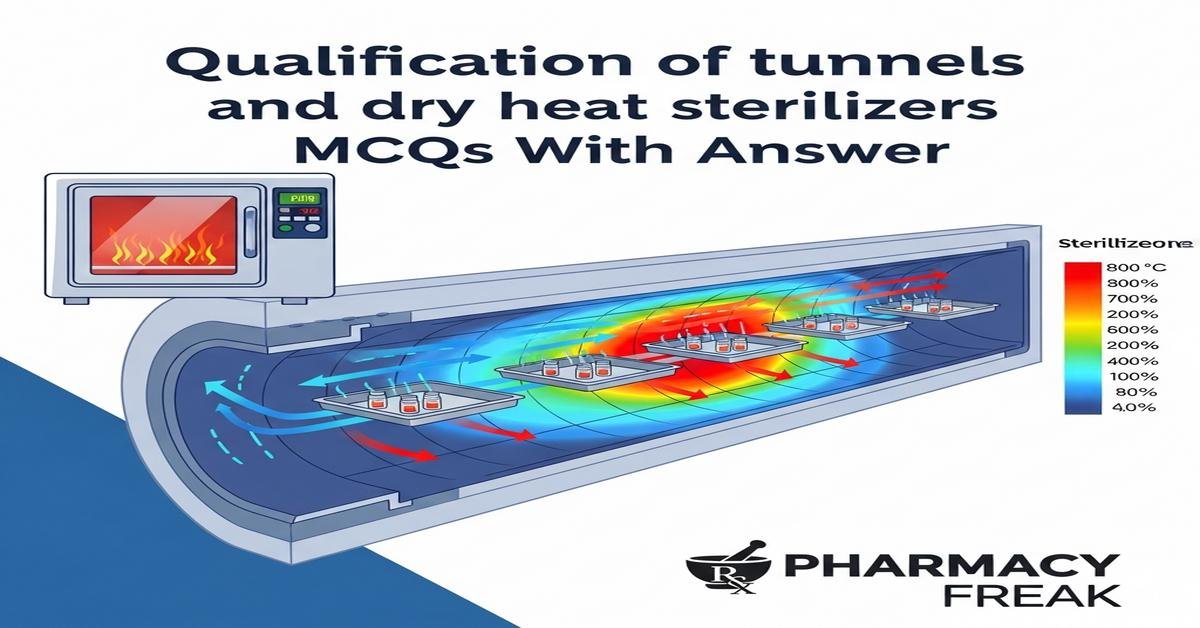
Qualification of tunnels and dry heat sterilizers is a critical topic in pharmaceutical validation, ensuring that thermal sterilization equipment consistently achieves required microbial inactivation without compromising product quality. This blog quiz is tailored for M.Pharm students to deepen understanding of installation, operational and performance qualifications (IQ/OQ/PQ), thermal mapping, instrumentation, biological indicators, load effects, and acceptance criteria. Questions emphasize practical considerations such as sensor placement, worst‑case load scenarios, calibration standards, and interpretation of thermal profiles. Use this set to reinforce theory, prepare for viva/board exams, and apply validation principles to real-world sterilization systems in pharmaceutical manufacturing.
Q1. Which biological indicator organism is most appropriate for validating a dry heat sterilization process?
- Bacillus stearothermophilus
- Geobacillus thermophilus
- Bacillus atrophaeus
- Escherichia coli
Correct Answer: Bacillus atrophaeus
Q2. During IQ of a tunnel sterilizer, which document is least likely to be verified?
- Manufacturer’s drawings and serial number
- Calibration certificates for installed thermocouples
- Microbial growth curve for production batches
- Electrical and utility connections
Correct Answer: Microbial growth curve for production batches
Q3. The primary objective of Operational Qualification (OQ) for a dry heat sterilizer is to:
- Install the equipment according to manufacturer instructions
- Demonstrate the equipment operates within defined limits under simulated conditions
- Prove consistent sterilization on full production loads
- Qualify the production personnel handling the sterilizer
Correct Answer: Demonstrate the equipment operates within defined limits under simulated conditions
Q4. Which sensor placement strategy is most appropriate for thermal mapping of a tunnel sterilizer?
- Place all sensors only at the air inlet
- Place sensors at representative product positions, extremes, and along conveyor direction
- Place sensors only on the chamber walls
- Use a single sensor in the warmest location
Correct Answer: Place sensors at representative product positions, extremes, and along conveyor direction
Q5. For dry heat sterilization of glassware, a commonly recommended cycle is approximately:
- 121°C for 15 minutes
- 160°C for 2 hours
- 100°C for 30 minutes
- 75°C for 10 minutes
Correct Answer: 160°C for 2 hours
Q6. Which of the following is a critical operational parameter to monitor in a hot-air tunnel sterilizer?
- Conveyor speed (dwell time)
- pH of cleaning solution
- Volume of packaging material shipped
- Electrical conductivity of water
Correct Answer: Conveyor speed (dwell time)
Q7. In qualification terminology, PQ (Performance Qualification) primarily involves:
- Verifying installation drawings and spare parts list
- Demonstrating consistent performance under normal production conditions using actual product loads
- Calibrating instruments used for mapping
- Writing the equipment SOP
Correct Answer: Demonstrating consistent performance under normal production conditions using actual product loads
Q8. Which of the following best describes a worst-case load for dry heat sterilizer PQ?
- An empty chamber with maximum airflow
- A heavily loaded chamber with dense, insulating items and worst thermal inertia
- A chamber loaded with metal trays only
- A chamber with only biological indicators exposed to air
Correct Answer: A heavily loaded chamber with dense, insulating items and worst thermal inertia
Q9. Acceptance criteria for temperature uniformity during thermal mapping are typically stated as:
- Any temperature is acceptable as long as the setpoint is reached once
- Temperatures must remain within a specified range (e.g., ±2°C) across mapped locations
- Only the average temperature matters, not local variations
- Temperature variation must be within ±20°C
Correct Answer: Temperatures must remain within a specified range (e.g., ±2°C) across mapped locations
Q10. Which calibration practice is essential before performing OQ/PQ thermal mapping?
- Calibrating air filters
- Calibration and accuracy verification of thermocouples/data loggers with traceable standards
- Calibrating the conveyor motor speed by feel
- No calibration is needed if manufacturer supplies sensors
Correct Answer: Calibration and accuracy verification of thermocouples/data loggers with traceable standards
Q11. The primary heat transfer mechanism in forced‑air dry heat sterilizers is:
- Condensation
- Conduction through water
- Convection by circulated hot air
- Ultraviolet radiation
Correct Answer: Convection by circulated hot air
Q12. During qualification of a tunnel sterilizer, product temperature lag compared to air temperature is important because:
- It indicates the sterilizer has excess power
- Product core may not reach required sterilizing temperature, creating a cold spot risk
- It shows the thermocouples are faulty
- It is irrelevant for surface-sterilized packaging
Correct Answer: Product core may not reach required sterilizing temperature, creating a cold spot risk
Q13. When using biological indicators in PQ for a dry heat sterilizer, the correct recovery step is to:
- Immediately discard the BI after the cycle
- Incubate the BI in appropriate growth medium under specified conditions to detect survivors
- Rinse the BI with sterile water and reuse
- Expose the BI to UV light and observe
Correct Answer: Incubate the BI in appropriate growth medium under specified conditions to detect survivors
Q14. Which qualification activity verifies that tunnel conveyor speed settings produce the intended dwell time at set temperature zones?
- IQ documentation review
- Conveyor speed validation during OQ with timing measurements and thermoprobes
- Electrical load testing
- Cleaning validation
Correct Answer: Conveyor speed validation during OQ with timing measurements and thermoprobes
Q15. A common acceptance criterion for lethality demonstration in dry heat sterilization is achieving a specified log reduction. Which term denotes a one‑log (90%) reduction in a microbial population?
- D-value
- Z-value
- F0-value
- G-value
Correct Answer: D-value
Q16. Which parameter describes the temperature change required to change the D‑value by a factor of ten?
- D-value
- Z-value
- F-value
- k-value
Correct Answer: Z-value
Q17. During PQ of a tunnel sterilizer handling prefilled syringes, what is a key concern to monitor besides temperature?
- Sterilizer paint color
- Product integrity: deformation, seal integrity, and content stability
- Manufacturer’s country of origin
- Ambient noise levels
Correct Answer: Product integrity: deformation, seal integrity, and content stability
Q18. If thermal mapping shows a persistent cold spot in a tunnel sterilizer, the appropriate corrective action is to:
- Ignore it if most locations pass
- Adjust process parameters (temperature, airflow, dwell time) or modify load/configuration and revalidate
- Reduce production volume without investigation
- Replace all thermocouples immediately
Correct Answer: Adjust process parameters (temperature, airflow, dwell time) or modify load/configuration and revalidate
Q19. Which regulatory expectation applies to documentation produced during qualification of sterilization equipment?
- Documents should be informal and handwritten only
- Complete, traceable, version‑controlled records including protocols, raw data, deviations, and final reports
- No documentation is required for legacy equipment
- Only verbal approvals are sufficient
Correct Answer: Complete, traceable, version‑controlled records including protocols, raw data, deviations, and final reports
Q20. Which statement best describes the role of simulated worst‑case runs in OQ for tunnels and dry heat sterilizers?
- They are only needed after a failure occurs
- They demonstrate the process can meet defined parameters under conditions that challenge heat penetration and uniformity
- They replace the need for biological indicators in PQ
- They are performed without any instrumentation to simulate manual operation
Correct Answer: They demonstrate the process can meet defined parameters under conditions that challenge heat penetration and uniformity


I am a Registered Pharmacist under the Pharmacy Act, 1948, and the founder of PharmacyFreak.com. I hold a Bachelor of Pharmacy degree from Rungta College of Pharmaceutical Science and Research. With a strong academic foundation and practical knowledge, I am committed to providing accurate, easy-to-understand content to support pharmacy students and professionals. My aim is to make complex pharmaceutical concepts accessible and useful for real-world application.
Mail- Sachin@pharmacyfreak.com