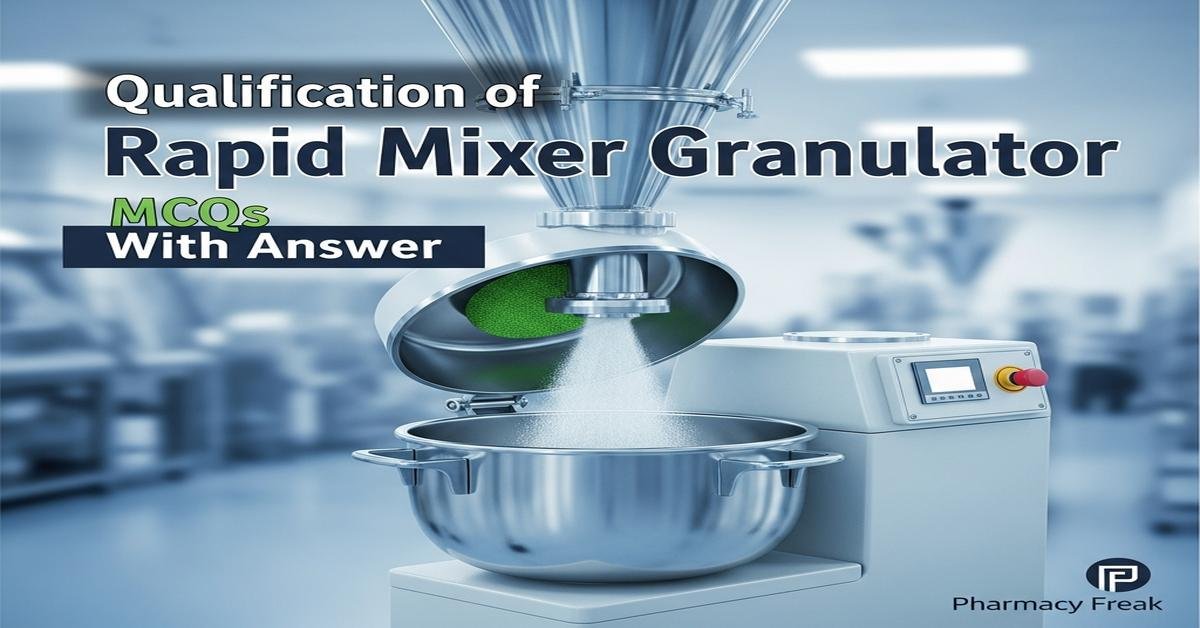
Introduction: This quiz set focuses on the qualification of Rapid Mixer Granulator (RMG) equipment—an essential topic for M.Pharm students studying Scale Up & Technology Transfer. The questions target IQ/OQ/PQ practices, critical process parameters (CPPs), acceptance criteria, instrumentation, and scale-up strategies specific to RMG systems. Emphasis is placed on practical aspects such as torque and power measurement, residence time distribution, binder spray control, PAT integration, cleaning and validation, and FAT/SAT documentation. These MCQs will help students deepen their understanding of how to design, execute, and interpret qualification activities to ensure robust, reproducible granulation processes during technology transfer and commercial scale-up.
Q1. Which qualification phase primarily verifies that the Rapid Mixer Granulator is installed according to design specifications and utilities are correctly connected?
- Performance Qualification (PQ)
- Operational Qualification (OQ)
- Installation Qualification (IQ)
- Process Qualification (Process Validation)
Correct Answer: Installation Qualification (IQ)
Q2. During OQ of an RMG, which test most directly assesses the accuracy and repeatability of impeller and chopper speed controls?
- Torque profiling across a range of formulations
- Speed ramp tests with tachometer verification
- Residence time distribution measurement
- Cleaning validation swab test
Correct Answer: Speed ramp tests with tachometer verification
Q3. Which of the following is the best PAT method for determining granulation end point in-line during RMG operation?
- NIR spectroscopy to monitor moisture and API distribution
- Periodic off-line sieve analysis
- Final tablet hardness testing
- Visual inspection of granules post-drying
Correct Answer: NIR spectroscopy to monitor moisture and API distribution
Q4. What does torque measurement during granulation primarily indicate about the process?
- Rotational imbalance of the motor
- Changes in batch viscosity and granule growth (process end-point)
- Amount of residual moisture after drying
- Level of microbial contamination
Correct Answer: Changes in batch viscosity and granule growth (process end-point)
Q5. For scale-up of RMG from lab to pilot, which scale-up rule focuses on maintaining similar shear conditions experienced by particles?
- Maintain constant fill height
- Maintain constant impeller tip speed
- Maintain constant power per unit mass (P/V)
- Maintain constant batch duration
Correct Answer: Maintain constant impeller tip speed
Q6. Which critical utility should be qualified to ensure consistent binder atomization during wet granulation in an RMG?
- Compressed air system pressure and filtration
- Steam generator for CIP only
- HVAC flow in the tablet coating room
- Boiler feed water conductivity
Correct Answer: Compressed air system pressure and filtration
Q7. In an OQ protocol, what acceptance criterion is most appropriate for impeller speed control accuracy?
- ±20% of set speed
- Within manufacturer’s unspecified range
- ±1% to ±3% of set speed depending on criticality
- Only documented if failure occurs
Correct Answer: ±1% to ±3% of set speed depending on criticality
Q8. Which parameter is NOT typically considered a Critical Process Parameter (CPP) for wet granulation in an RMG?
- Binder spray rate
- Impeller and chopper speeds
- Room color scheme where equipment is placed
- Granulation time and endpoint
Correct Answer: Room color scheme where equipment is placed
Q9. What is the primary purpose of conducting a Performance Qualification (PQ) for an RMG?
- To prove the RMG system was installed per drawings
- To prove the system performs as intended under simulated real production conditions
- To qualify vendor technical support
- To test cleaning agents compatibility only
Correct Answer: To prove the system performs as intended under simulated real production conditions
Q10. Which documentation is essential to accompany FAT and SAT when qualifying an RMG for technology transfer?
- Only the purchase order
- Acceptance test protocols, traceable calibration certificates, and I/O lists
- Only operator training certificates
- Only the machine serial number
Correct Answer: Acceptance test protocols, traceable calibration certificates, and I/O lists
Q11. During PQ runs, which in-process test best demonstrates blend uniformity before granulation charging in an RMG batch?
- Single-point moisture content of final granules
- Multiple representative powder samples analyzed for assay/CV
- Visual check of powder color only
- Measuring motor current only
Correct Answer: Multiple representative powder samples analyzed for assay/CV
Q12. For cleaning validation of an RMG, which acceptance criterion is commonly used to demonstrate acceptable residual limits?
- Generic statement of “clean” without numeric values
- Health-based limit (e.g., 10 ppm) or calculated ppm based on therapeutic dose and safety factors
- Residue visually not visible only
- No swabbing required if machine is wiped
Correct Answer: Health-based limit (e.g., 10 ppm) or calculated ppm based on therapeutic dose and safety factors
Q13. Which sensor malfunction discovered during OQ would most critically affect granulation reproducibility and should be included in alarm conditions?
- Light bulb failure in room corridor
- Binder flow/pressure sensor or nozzle clog detection
- Door hinge wear in service room
- Printer paper jam
Correct Answer: Binder flow/pressure sensor or nozzle clog detection
Q14. What is the role of residence time distribution (RTD) studies in qualifying an RMG?
- To measure HVAC efficiency
- To understand material mixing and segregation tendencies affecting uniformity and scale-up
- To calculate machine depreciation
- To determine the color of granules
Correct Answer: To understand material mixing and segregation tendencies affecting uniformity and scale-up
Q15. Which parameter is most appropriate as a primary acceptance criterion for binder spray system qualification?
- Spray pattern, droplet size distribution and reproducible spray rate at set atomization pressure
- User preference for nozzle color
- Only the nominal capacity of the binder tank
- Time taken to open the binder tank lid
Correct Answer: Spray pattern, droplet size distribution and reproducible spray rate at set atomization pressure
Q16. In technology transfer, which control strategy is most effective to maintain equivalent granule attributes across sites?
- Documenting only final tablet specifications
- Defining CPPs with set operating ranges and PAT-based end-point controls
- Allowing each site to develop its own acceptance criteria
- Relying solely on operator experience
Correct Answer: Defining CPPs with set operating ranges and PAT-based end-point controls
Q17. Which calibration activity should be completed before performing OQ tests that involve torque measurements on the RMG?
- Calibrate torque transducer and verify motor current correlation with known loads
- Only calibrate the thermometer in the lab
- Calibrate the office printer
- No calibration required for torque readings
Correct Answer: Calibrate torque transducer and verify motor current correlation with known loads
Q18. Which of the following is the BEST definition of a critical quality attribute (CQA) in the context of RMG qualification?
- An aesthetic property unrelated to function
- A physical, chemical, or microbiological property that must be controlled to ensure product quality (e.g., granule size, moisture)
- The machine serial number
- Operator break schedule
Correct Answer: A physical, chemical, or microbiological property that must be controlled to ensure product quality (e.g., granule size, moisture)
Q19. Which practice during PQ helps demonstrate reproducibility of RMG operation across multiple batches?
- Conducting at least three consecutive representative production-scale batches with results meeting predefined acceptance criteria
- Running a single lab-scale run
- Only documenting the first production batch
- Relying on vendor statements without running batches
Correct Answer: Conducting at least three consecutive representative production-scale batches with results meeting predefined acceptance criteria
Q20. Which output from qualification is most useful for future technology transfers or troubleshooting of the RMG process?
- Comprehensive qualification report including OQ/PQ data, operational ranges, failure modes, and recommended corrective actions
- Only the equipment invoice
- A short note saying “works fine” without data
- Unstructured emails between engineers
Correct Answer: Comprehensive qualification report including OQ/PQ data, operational ranges, failure modes, and recommended corrective actions


I am a Registered Pharmacist under the Pharmacy Act, 1948, and the founder of PharmacyFreak.com. I hold a Bachelor of Pharmacy degree from Rungta College of Pharmaceutical Science and Research. With a strong academic foundation and practical knowledge, I am committed to providing accurate, easy-to-understand content to support pharmacy students and professionals. My aim is to make complex pharmaceutical concepts accessible and useful for real-world application.
Mail- Sachin@pharmacyfreak.com