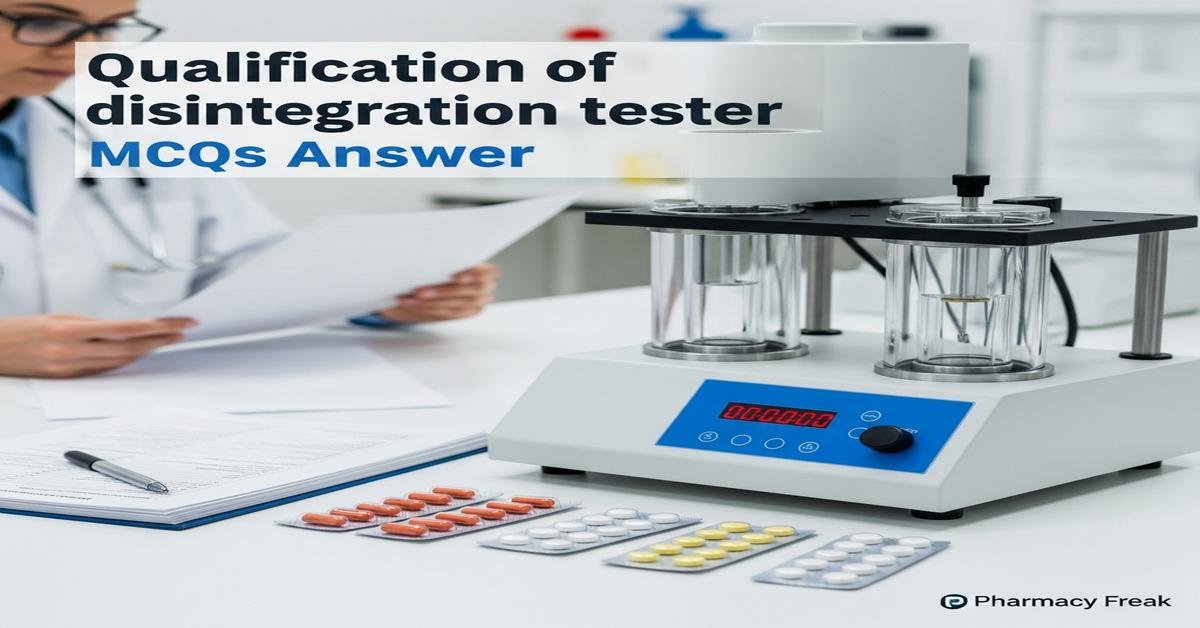
Qualification of Disintegration Tester MCQs With Answer
This quiz set targets M.Pharm students preparing for advanced courses in Pharmaceutical Validation. It focuses on qualification and performance verification of the disintegration tester — a critical instrument in determining dosage form performance. Questions range from design and installation qualification (DQ/IQ), operational and performance qualification (OQ/PQ), to practical aspects such as temperature control, stroke frequency, use of discs, documentation, calibration and routine maintenance. Answers include concise, authoritative choices reflecting regulatory expectations (USP/Ph. Eur.) and industry best practices. Use these MCQs to test understanding of protocol development, acceptance criteria, and troubleshooting during qualification and routine use of disintegration equipment.
Q1. What is the primary goal of Operational Qualification (OQ) for a disintegration tester?
- To verify that the instrument was built according to design specifications
- To ensure the instrument performs consistently within predetermined limits under simulated conditions
- To demonstrate consistent product performance in routine production
- To define user requirements and design features
Correct Answer: To ensure the instrument performs consistently within predetermined limits under simulated conditions
Q2. Which document typically contains acceptance criteria and specific test methods used during qualification?
- Instrument purchase order
- Maintenance logbook
- Monograph and the qualification/validation protocol
- Calibration certificate of unrelated equipment
Correct Answer: Monograph and the qualification/validation protocol
Q3. During Installation Qualification (IQ) of a disintegration tester, which of the following is essential to check?
- Reproducibility of disintegration times across multiple batches
- That the unit is installed per manufacturer instructions with proper utilities, space and documentation
- That production operators have adequate GMP training
- That product stability studies have been completed
Correct Answer: That the unit is installed per manufacturer instructions with proper utilities, space and documentation
Q4. What is the standard temperature range required for the disintegration test medium as per common pharmacopeial guidance?
- 25 ± 2 °C
- 37 ± 2 °C
- 50 ± 5 °C
- 4 ± 1 °C
Correct Answer: 37 ± 2 °C
Q5. Which performance parameter is commonly verified during OQ for a disintegration tester?
- Shelf life of reference standards
- Stroke frequency/stroke rate and stroke length
- Training level of the validation team
- Color of the apparatus housing
Correct Answer: Stroke frequency/stroke rate and stroke length
Q6. What is the typical stroke frequency (strokes per minute) specified for a standard disintegration tester?
- 5–10 cycles per minute
- 15–20 cycles per minute
- 29–32 cycles per minute
- 100–120 cycles per minute
Correct Answer: 29–32 cycles per minute
Q7. In Performance Qualification (PQ) for a disintegration tester, what is the principal activity?
- Verifying installation drawings and electrical wiring
- Running the actual product(s) under normal operating conditions to confirm reproducible results
- Ordering spare parts
- Drafting the Design Qualification (DQ)
Correct Answer: Running the actual product(s) under normal operating conditions to confirm reproducible results
Q8. What is the main purpose of using a disc (paddle) in the disintegration testing basket?
- To increase temperature of the medium
- To ensure tablets remain submerged and prevent floating during the test when allowed by monograph
- To change the pH of the medium
- To speed up the stroke frequency automatically
Correct Answer: To ensure tablets remain submerged and prevent floating during the test when allowed by monograph
Q9. Which of the following should be included in a disintegration OQ protocol acceptance checks?
- Verification of electrical features of unrelated lab instruments
- Verification of timer accuracy, temperature control, stroke rate and travel distance
- Assessment of packaging aesthetics
- Evaluation of tablet color uniformity
Correct Answer: Verification of timer accuracy, temperature control, stroke rate and travel distance
Q10. Which risk-based activity is recommended before qualification to identify critical components and controls of the disintegration tester?
- Full stability study of the product
- Failure Mode and Effects Analysis (FMEA) or similar risk assessment
- Market survey of competing instruments
- Random visual inspection
Correct Answer: Failure Mode and Effects Analysis (FMEA) or similar risk assessment
Q11. For calibration of the temperature sensor of a disintegration bath, what is a suitable approach during qualification?
- Compare against a calibrated reference thermometer at multiple points including 37 °C
- Trust the factory sticker indicating calibration date without verification
- Only calibrate at room temperature
- Use an uncalibrated lab thermometer
Correct Answer: Compare against a calibrated reference thermometer at multiple points including 37 °C
Q12. Which statement best describes Design Qualification (DQ) for a disintegration tester?
- DQ documents that the installed unit performs as intended in routine production
- DQ verifies the actual performance of product batches
- DQ confirms that the proposed design meets user requirements and regulatory expectations before purchase or manufacture
- DQ is unnecessary for off-the-shelf laboratory instruments
Correct Answer: DQ confirms that the proposed design meets user requirements and regulatory expectations before purchase or manufacture
Q13. Which of the following is an appropriate acceptance criterion for timer accuracy during OQ?
- The timer may vary by up to ±60 seconds for a 1 minute interval
- The timer should be accurate to within a small, pre-defined tolerance (e.g., ±1% or an agreed limit) as stated in the protocol
- Timer accuracy is irrelevant for disintegration testing
- The timer accuracy should be verified only once a year without defined limits
Correct Answer: The timer should be accurate to within a small, pre-defined tolerance (e.g., ±1% or an agreed limit) as stated in the protocol
Q14. How many tubes does a typical pharmacopoeial disintegration apparatus rack contain?
- 1–2 tubes
- 6 or 12 tubes depending on design
- 50 tubes
- Only one large vessel with no tubes
Correct Answer: 6 or 12 tubes depending on design
Q15. Which maintenance activity should be documented as part of routine qualification upkeep?
- Replacing laboratory safety signage
- Periodic verification/calibration of stroke rate, timers and temperature sensors, and cleaning records
- Changing staff uniforms
- Advertising the laboratory services
Correct Answer: Periodic verification/calibration of stroke rate, timers and temperature sensors, and cleaning records
Q16. What is an appropriate approach when a monograph specifies a disintegration time but qualification runs give marginally different results?
- Ignore the discrepancy and continue testing
- Investigate root cause, assess instrument performance, repeat tests and document findings; take corrective actions if required
- Immediately discard all affected product without investigation
- Alter the monograph to match lab results
Correct Answer: Investigate root cause, assess instrument performance, repeat tests and document findings; take corrective actions if required
Q17. During PQ, which samples are most appropriate to demonstrate reproducibility of disintegration performance?
- Non-pharmaceutical items such as metal coupons
- Representative production batches or retained samples of the actual product under normal operating conditions
- Random blanks without tablets
- Only the fastest-dissolving tablets available
Correct Answer: Representative production batches or retained samples of the actual product under normal operating conditions
Q18. Which regulatory or guidance source is commonly referenced for disintegration testing procedures and expectations?
- Local weather reports
- Pharmacopeial monographs and general chapters (e.g., USP <701> / Ph. Eur. chapter)
- Consumer product safety guidelines
- Cookbook recipes
Correct Answer: Pharmacopeial monographs and general chapters (e.g., USP <701> / Ph. Eur. chapter)
Q19. Which outcome indicates successful OQ completion for the disintegration tester?
- All operational parameters (temperature, stroke rate, travel distance, timer) meet the acceptance criteria defined in the OQ protocol
- The manufacturer issues a glowing marketing brochure
- The instrument looks clean on visual inspection only
- No documentation is necessary if the unit powers on
Correct Answer: All operational parameters (temperature, stroke rate, travel distance, timer) meet the acceptance criteria defined in the OQ protocol
Q20. Which element is least relevant when writing a disintegration qualification protocol?
- Defined acceptance criteria and test procedures
- Roles, responsibilities, and documentation requirements
- Detailed description of test media, temperature and apparatus settings
- Personal opinions about competing instrument brands
Correct Answer: Personal opinions about competing instrument brands

