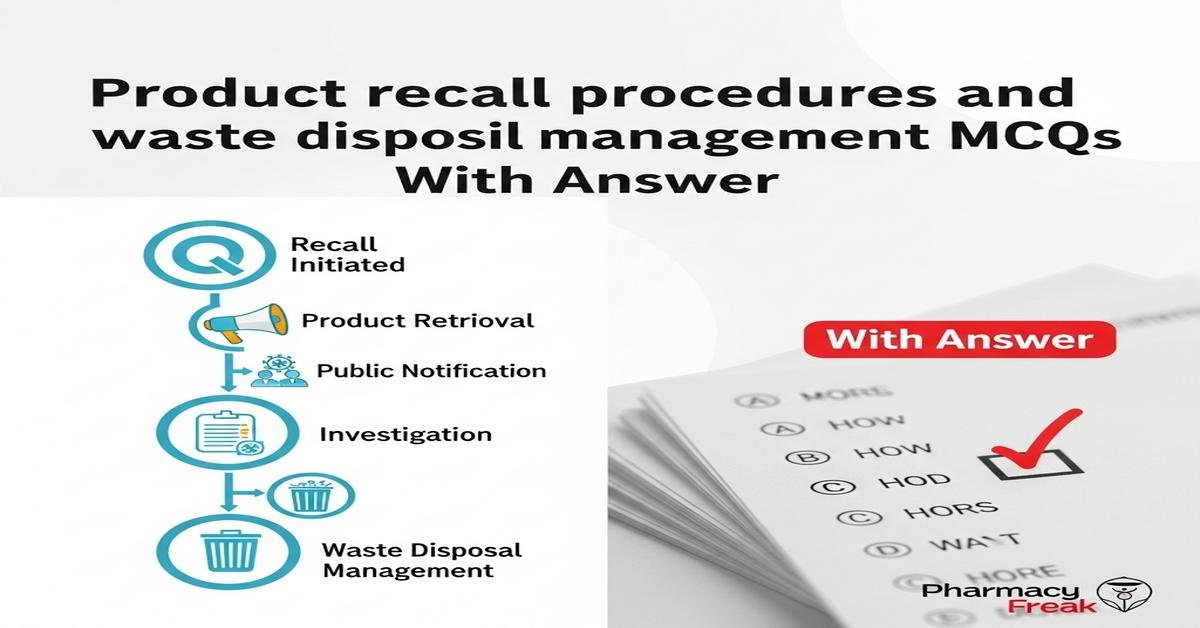
Product recall procedures and waste disposal management are essential topics for B.Pharm students, combining pharmaceutical quality assurance, regulatory compliance and environmental safety. This resource emphasizes recall classification, initiation steps, quarantine, traceability, communication, effectiveness checks and documentation alongside hazardous pharmaceutical waste segregation, cytotoxic handling, incineration, autoclaving, effluent treatment, reverse distribution and relevant regulations (GMP, WHO GDP, FDA, CDSCO, CPCB). Questions focus on practical decision-making, root-cause analysis, corrective and preventive actions (CAPA), chain of custody and safe disposal practices. Master these concepts to protect patients, staff and the environment. Now let’s test your knowledge with 30 MCQs on this topic.
Q1. Which recall classification indicates the highest risk when a product is likely to cause death or serious injury?
- Class I — product may cause death or serious adverse health consequences
- Class II — product may cause temporary or reversible adverse health consequences
- Class III — product is not likely to cause adverse health consequences
- Market withdrawal — minor violation not subject to legal action
Correct Answer: Class I — product may cause death or serious adverse health consequences
Q2. Who can initiate a pharmaceutical product recall?
- Manufacturer or marketing authorization holder
- Regulatory authority only
- Third‑party auditor only
- Retail pharmacist only
Correct Answer: Manufacturer or marketing authorization holder
Q3. What is the first operational step after identifying a suspect batch that may require recall?
- Quarantine the affected batch and suspend release
- Publicly announce the defect immediately
- Destroy all stock immediately without documentation
- Increase production of other batches
Correct Answer: Quarantine the affected batch and suspend release
Q4. What is the primary purpose of a recall effectiveness check?
- To verify that the affected product has been removed or corrected at all distribution levels
- To calculate financial loss due to the recall
- To test new manufacturing equipment
- To reassign recalled product to alternate markets
Correct Answer: To verify that the affected product has been removed or corrected at all distribution levels
Q5. Which document is most useful to identify distributors and customers who received a specific lot?
- Distribution list or shipping records tied to the lot number
- Certificate of analysis alone
- Stability study reports
- General marketing brochures
Correct Answer: Distribution list or shipping records tied to the lot number
Q6. In root‑cause analysis during a recall, what is the main objective?
- Identify underlying process failures to implement corrective and preventive actions (CAPA)
- Publicize the company’s recall response
- Reduce product prices to compensate customers
- Increase batch production to replace inventory
Correct Answer: Identify underlying process failures to implement corrective and preventive actions (CAPA)
Q7. Which entity typically classifies recalls into Class I, II and III?
- Regulatory authority (e.g., FDA, CDSCO)
- Any retail pharmacy
- Independent consumer groups
- Sales department of manufacturer
Correct Answer: Regulatory authority (e.g., FDA, CDSCO)
Q8. Which activity is generally NOT a direct part of an active product recall?
- Pharmacovigilance signal detection and routine safety monitoring (pre-recall activity)
- Quarantine and segregation of affected stock
- Notification to distributors and regulators
- Collection and disposition of returned product
Correct Answer: Pharmacovigilance signal detection and routine safety monitoring (pre-recall activity)
Q9. Which disposal method is preferred for cytotoxic pharmaceutical waste to minimize environmental harm?
- High‑temperature incineration in a licensed hazardous waste incinerator
- Landfill burial without treatment
- Flushing into the sewer system
- Composting with organic waste
Correct Answer: High‑temperature incineration in a licensed hazardous waste incinerator
Q10. What is the safest immediate containment for used sharps in a pharmacy or hospital?
- Puncture‑resistant, leak‑proof sharps container with appropriate labeling
- Regular plastic bag in the trash bin
- Open cardboard box
- Glass jar with screw lid
Correct Answer: Puncture‑resistant, leak‑proof sharps container with appropriate labeling
Q11. What does “reverse distribution” refer to in pharmaceutical waste management?
- Returning expired or unsold medicines to the manufacturer or licensed reverse distributor for proper disposition or credit
- Shipping new products backward along the supply chain to meet demand
- Recycling packaging materials into new drug containers
- Distributing recalled products to secondary markets
Correct Answer: Returning expired or unsold medicines to the manufacturer or licensed reverse distributor for proper disposition or credit
Q12. Which of the following is NOT a component of a recall communication?
- Unverified rumors on social media without official confirmation
- Description of the product and affected lot numbers
- Recommended action for customers and distributors
- Contact information and procedures for returns
Correct Answer: Unverified rumors on social media without official confirmation
Q13. In India, which authority is primarily responsible for issuing and enforcing biomedical and hazardous waste management rules?
- Central Pollution Control Board (CPCB)
- Reserve Bank of India (RBI)
- Food Safety and Standards Authority of India (FSSAI)
- Drug Controller General of India (DCGI)
Correct Answer: Central Pollution Control Board (CPCB)
Q14. What does “chain of custody” mean in the context of a product recall?
- Documented tracking of possession, transfer and location of recalled product from origin to final disposition
- A legal ownership document for a manufacturing plant
- An insurance certificate for product shipments
- A list of customers who purchased other products
Correct Answer: Documented tracking of possession, transfer and location of recalled product from origin to final disposition
Q15. Autoclaving is an appropriate treatment method for which type of pharmaceutical waste?
- Infectious biological waste such as contaminated cultures and biologic materials
- Cytotoxic tablets requiring chemical destruction
- Stock bottles of controlled narcotics
- Non‑hazardous intact tablet blisters
Correct Answer: Infectious biological waste such as contaminated cultures and biologic materials
Q16. Upon initiating a Class I recall, which stakeholder should be notified immediately?
- Relevant regulatory authority and affected distributors/consumers as per regulation
- Only the company’s marketing team
- Only the warehouse staff
- No notifications until the recall is complete
Correct Answer: Relevant regulatory authority and affected distributors/consumers as per regulation
Q17. Which records should be retained to demonstrate proper execution of a recall?
- Recall notifications, receipt confirmations, returned product reconciliation and final disposition records
- Only the initial recall notification email
- Only sales invoices unrelated to the affected lot
- Only marketing materials for the product
Correct Answer: Recall notifications, receipt confirmations, returned product reconciliation and final disposition records
Q18. Which operational parameter is most critical to achieve safe destruction of organic pharmaceutical waste by incineration?
- Incineration temperature and residence time to ensure complete destruction
- Packet color coding used for collection
- Ambient humidity in the storage room
- Manufacturer’s suggested retail price
Correct Answer: Incineration temperature and residence time to ensure complete destruction
Q19. Which international guideline specifically deals with Good Distribution Practices (GDP) for pharmaceutical products?
- WHO Good Distribution Practices (WHO GDP)
- ICH Q7 — Good Manufacturing Practice guide only
- ISO 9001 alone
- Pharmacopoeia monograph guidelines
Correct Answer: WHO Good Distribution Practices (WHO GDP)
Q20. For recalls involving controlled substances, what additional step is commonly required?
- Use of authorized reverse distributors or notification of narcotics control authorities for secure return or destruction
- Donating the product to charity without paperwork
- Shipping to any landfill without authorization
- Relabeling and reissuing the product
Correct Answer: Use of authorized reverse distributors or notification of narcotics control authorities for secure return or destruction
Q21. Which strategy most effectively reduces the volume of pharmaceutical waste generated at the source?
- Source reduction by optimizing inventory, packaging and processes
- Increasing production batches unnecessarily
- Mixing waste streams to simplify handling
- Expanding landfill capacity
Correct Answer: Source reduction by optimizing inventory, packaging and processes
Q22. What labeling is essential for quarantined product during a recall?
- Clear label stating “QUARANTINE — DO NOT RELEASE” with product and lot details
- Standard retail price tag only
- No label to avoid alarm
- Temporary generic label without details
Correct Answer: Clear label stating “QUARANTINE — DO NOT RELEASE” with product and lot details
Q23. Which methods are commonly used to verify successful removal of recalled product from distributors and retailers?
- Distributor confirmations, inventory audits and reconciliation of returned goods
- Advertising the product again
- Assuming removal without checks
- Transferring responsibility to customers without records
Correct Answer: Distributor confirmations, inventory audits and reconciliation of returned goods
Q24. Which environmental permit is typically required to operate an on‑site incinerator or effluent treatment system for pharmaceutical waste?
- Consent to Establish/Consent to Operate or equivalent environmental clearance from the competent authority (SPCB/CPCB or local EPA)
- Sales tax registration certificate
- Marketing authorization for the product
- No permit is ever required
Correct Answer: Consent to Establish/Consent to Operate or equivalent environmental clearance from the competent authority (SPCB/CPCB or local EPA)
Q25. What is the recommended action for expired non‑cytotoxic solid oral medications held in a pharmacy?
- Return to the manufacturer or licensed reverse distributor for proper disposal
- Flush into the sanitary sewer
- Place in regular municipal trash without segregation
- Sell at discount to recover costs
Correct Answer: Return to the manufacturer or licensed reverse distributor for proper disposal
Q26. Which identifier is most critical to trace and recall a specific manufactured batch?
- Batch or lot number printed on the product and packaging
- Brand logo color
- Retail display location in a shop
- Sales representative name
Correct Answer: Batch or lot number printed on the product and packaging
Q27. How can stability data assist during a product recall investigation?
- By determining whether degradation or storage conditions contributed to the quality failure
- By replacing distribution records
- By increasing the product’s marketing budget
- By changing the product’s formulation without testing
Correct Answer: By determining whether degradation or storage conditions contributed to the quality failure
Q28. Which disposal method is appropriate for returned cytotoxic tablets from a recall?
- Destruction by licensed high‑temperature incineration with emissions controls
- Incineration in a domestic fireplace
- Discarding in general municipal waste
- Donation to hospitals for reuse
Correct Answer: Destruction by licensed high‑temperature incineration with emissions controls
Q29. How often should a pharmaceutical company train and drill its recall team at minimum?
- At least annually and whenever procedures or regulations change
- Only once at hiring and never again
- Every decade without updates
- Only after a real recall occurs
Correct Answer: At least annually and whenever procedures or regulations change
Q30. What is the primary objective of segregating pharmaceutical waste at the point of generation?
- Prevent cross‑contamination and enable appropriate treatment and disposal routes
- Increase complexity of waste handling without benefit
- Mix hazardous and non‑hazardous waste to save space
- Reduce labeling requirements by combining streams
Correct Answer: Prevent cross‑contamination and enable appropriate treatment and disposal routes

