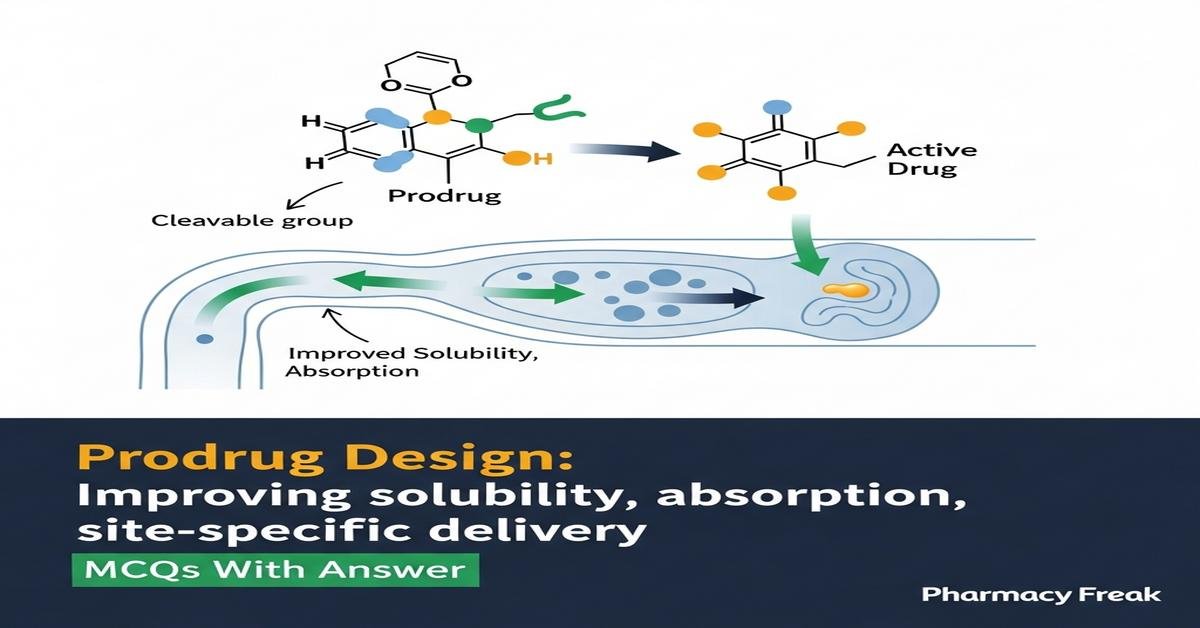
Introduction: Prodrug design is a pivotal strategy in advanced medicinal chemistry to optimize pharmacokinetic and pharmacodynamic properties of therapeutic agents. For M. Pharm students, understanding how chemical modification can improve aqueous solubility, membrane permeability, oral absorption, and achieve site-specific release is essential. This collection of MCQs focuses on mechanistic principles, common promoieties, enzymatic activation pathways, linker chemistry, transporter-targeted approaches, and examples such as phosphate esters, amino-acid esters, azo prodrugs, and self-immolative spacers. Questions emphasize rational selection of promoieties, factors affecting conversion rates, toxicity considerations and modern targeting strategies like ADEPT, GDEPT and hypoxia-activated prodrugs to prepare students for both theoretical exams and practical formulation problems.
Q1. What is the primary purpose of converting a parent drug to a phosphate ester prodrug?
- To increase lipophilicity and blood-brain barrier penetration
- To enhance aqueous solubility and enable parenteral administration
- To prevent enzymatic hydrolysis in the gut
- To promote renal excretion unchanged
Correct Answer: To enhance aqueous solubility and enable parenteral administration
Q2. Valacyclovir is a prodrug of acyclovir. Which strategy does it employ to improve oral absorption?
- Introduction of a phosphate promoiety cleaved by phosphatases
- Conversion to a lipophilic ester for passive diffusion
- Attachment of an L-valyl amino-acid promoiety to target peptide transporter PEPT1
- Linkage to a sugar moiety for uptake by GLUT transporters
Correct Answer: Attachment of an L-valyl amino-acid promoiety to target peptide transporter PEPT1
Q3. Which enzyme class is most commonly responsible for cleaving simple ester prodrugs in plasma and tissues?
- Cytochrome P450 monooxygenases
- Carboxylesterases
- Glucuronosyltransferases
- Aldehyde oxidases
Correct Answer: Carboxylesterases
Q4. A self-immolative linker (e.g., p-aminobenzyl alcohol spacer) is primarily used in prodrug design to:
- Increase lipophilicity of the prodrug
- Allow enzymatic cleavage at one site to trigger spontaneous release of the active drug
- Directly bind target receptors for site-specific action
- Prevent prodrug activation in target tissues
Correct Answer: Allow enzymatic cleavage at one site to trigger spontaneous release of the active drug
Q5. Which promoiety would most likely be chosen to improve intestinal absorption via carrier-mediated transport?
- Short-chain alkyl ester
- Phosphate group
- Amino acid or dipeptide moiety
- Bulky aromatic carbamate
Correct Answer: Amino acid or dipeptide moiety
Q6. Which prodrug approach is most suitable for colon-specific delivery of 5-aminosalicylic acid (5-ASA)?
- Lipophilic ester prodrugs absorbed in the small intestine
- Azo-bond linked prodrugs cleaved by colonic bacterial azoreductases
- Phosphate prodrugs activated by alkaline phosphatase in the stomach
- PEGylated prodrugs for systemic slow release
Correct Answer: Azo-bond linked prodrugs cleaved by colonic bacterial azoreductases
Q7. What is a major risk when selecting a promoiety for prodrug design?
- The promoiety always increases potency of the active drug
- The promoiety may cause immunogenicity, toxicity or interfere with activation
- The promoiety guarantees site-specific activation without optimization
- The promoiety prevents renal clearance entirely
Correct Answer: The promoiety may cause immunogenicity, toxicity or interfere with activation
Q8. Which statement best describes mutual prodrugs?
- Two pharmacologically inactive molecules joined to increase solubility only
- Conjugation of a drug with a carrier polymer for slow release
- Two synergistic active drugs linked together; both released in vivo after biotransformation
- Drug molecules formulated with surfactants for enhanced dissolution
Correct Answer: Two synergistic active drugs linked together; both released in vivo after biotransformation
Q9. A soft drug and a prodrug differ mainly because:
- Soft drugs are activated in target tissue, prodrugs are inactivated after action
- Soft drugs are designed to be metabolized to inactive metabolites after producing effect, while prodrugs are inactive precursors converted to active drugs
- Both are identical concepts with different names
- Prodrugs are always peptide-based whereas soft drugs are lipid-based
Correct Answer: Soft drugs are designed to be metabolized to inactive metabolites after producing effect, while prodrugs are inactive precursors converted to active drugs
Q10. Which chemical modification is commonly used to increase oral bioavailability by reducing first-pass metabolism?
- Adding a labile ester to increase liver metabolism
- Attachment of bulky groups to sterically hinder metabolic enzymes
- Incorporating a nitro group to increase reduction
- Introducing a highly polar sulfate group to increase biliary excretion
Correct Answer: Attachment of bulky groups to sterically hinder metabolic enzymes
Q11. In ADEPT (antibody-directed enzyme prodrug therapy), the role of the antibody-enzyme conjugate is to:
- Directly kill tumor cells by antibody-dependent cytotoxicity only
- Bind to tumor antigen and locally activate a systemically administered prodrug into cytotoxic drug
- Serve as a systemic detoxifying enzyme in circulation
- Prevent excretion of the prodrug through renal filtration
Correct Answer: Bind to tumor antigen and locally activate a systemically administered prodrug into cytotoxic drug
Q12. Hypoxia-activated prodrugs are designed to exploit which tumor microenvironment feature?
- Elevated extracellular pH compared to normal tissue
- High oxygen partial pressure in tumor cores
- Low oxygen (hypoxic) regions where reductive enzymes activate nitroaromatic prodrugs
- Abundant proteases that cleave ester bonds
Correct Answer: Low oxygen (hypoxic) regions where reductive enzymes activate nitroaromatic prodrugs
Q13. Which linker property is most important when designing a prodrug intended for rapid enzymatic activation?
- High steric hindrance around the cleavage site
- Strong electron-withdrawing groups to stabilize the bond
- Susceptibility of the linker to specific enzymes (e.g., esterases, peptidases)
- Permanent covalent attachment to prevent release
Correct Answer: Susceptibility of the linker to specific enzymes (e.g., esterases, peptidases)
Q14. Which promoiety would you choose to enhance central nervous system (CNS) penetration by increasing lipophilicity yet allow brain release?
- Polar phosphate group
- Short-chain alkyl ester that is cleaved by brain esterases
- Dipeptide targeting PEPT1
- Large PEG chain
Correct Answer: Short-chain alkyl ester that is cleaved by brain esterases
Q15. A prodrug that uses a glucuronide promoiety is most commonly activated by which enzyme in target tissues?
- β-Glucuronidase
- Esterase
- Monoamine oxidase
- Thiol-disulfide oxidoreductase
Correct Answer: β-Glucuronidase
Q16. PEGylation as a prodrug strategy primarily aims to:
- Increase enzymatic activation rates
- Improve aqueous solubility, circulation half-life and reduce immunogenicity
- Target drugs to bacterial enzymes in the gut
- Enhance passive diffusion across the BBB
Correct Answer: Improve aqueous solubility, circulation half-life and reduce immunogenicity
Q17. Which factor is least relevant when selecting a promoiety to tune prodrug hydrolysis rate?
- Electronic effects on the scissile bond
- Steric hindrance near the cleavage site
- pKa of the promoiety and resulting ionization at physiological pH
- The atomic weight of the active drug molecule
Correct Answer: The atomic weight of the active drug molecule
Q18. Capecitabine is an oral prodrug of 5-FU designed to be activated preferentially in tumors. Which activation cascade contributes to its tumor selectivity?
- Immediate chemical hydrolysis in stomach acid to 5-FU
- Sequential enzymatic conversions including carboxylesterase, cytidine deaminase, and thymidine phosphorylase which is elevated in tumors
- Activation solely by CYP450 enzymes in the liver
- Non-enzymatic oxidation by reactive oxygen species in plasma
Correct Answer: Sequential enzymatic conversions including carboxylesterase, cytidine deaminase, and thymidine phosphorylase which is elevated in tumors
Q19. When designing a transporter-targeted prodrug for oral delivery, which experimental evaluation is most informative?
- Measuring only aqueous solubility at pH 7.4
- In vitro uptake studies in cells expressing the target transporter and inhibition assays
- Measuring boiling point of the prodrug
- Determining color stability under light exposure
Correct Answer: In vitro uptake studies in cells expressing the target transporter and inhibition assays
Q20. Which statement best describes the role of pKa modulation in prodrug design for improved absorption?
- pKa changes are irrelevant to membrane permeability
- Altering pKa can shift ionization state at intestinal pH to favor the non-ionized form for better passive absorption
- Lowering pKa always decreases solubility which is desirable
- Raising pKa guarantees activation by plasma enzymes
Correct Answer: Altering pKa can shift ionization state at intestinal pH to favor the non-ionized form for better passive absorption

