Introduction:
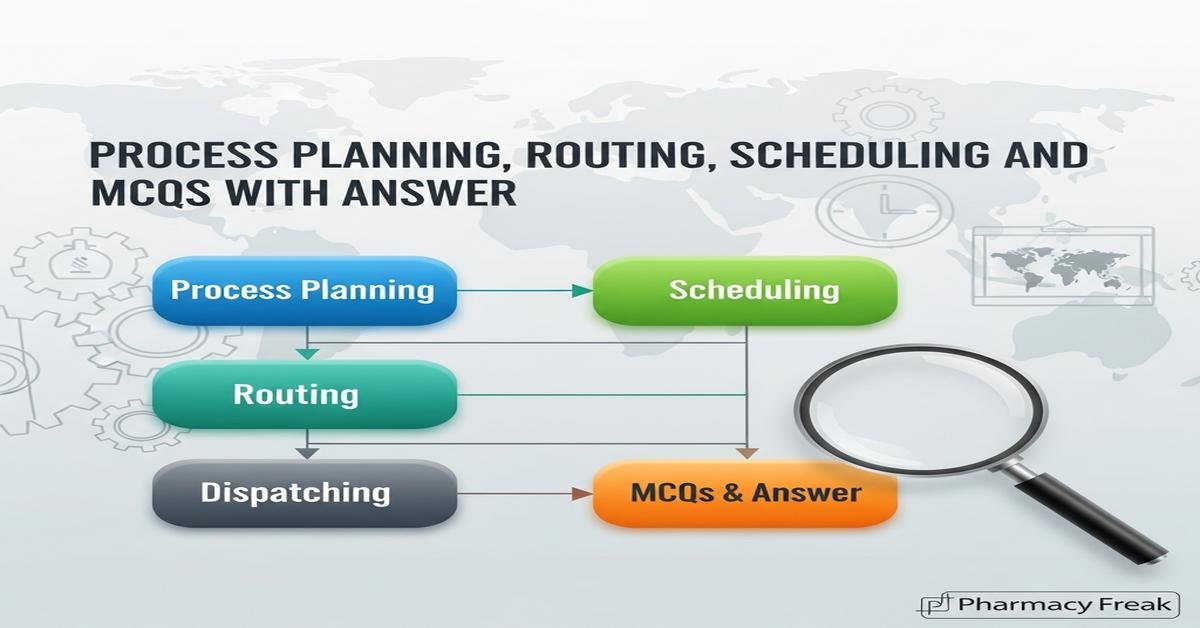
Process planning, routing, scheduling and dispatching are core elements of pharmaceutical manufacturing that link formulation concepts to practical production. For M.Pharm students, a firm grasp of these topics is essential to design efficient, compliant and cost-effective production systems for solid, liquid and sterile dosage forms. This blog-style MCQ set focuses on real-world applications: sequencing unit operations, selecting routing strategies, applying scheduling methods (Gantt, CPM/PERT), and executing dispatching on the shop floor. The questions emphasize decision-making, bottleneck management, capacity planning, lead time reduction and documentation — skills required for quality production, timely delivery, regulatory traceability and continuous improvement in the pharmaceutical industry.
Q1. Which activity best describes process planning in pharmaceutical manufacturing?
- Setting the final product price based on market demand
- Determining sequence of unit operations, equipment, and resources required to manufacture a product
- Designing the marketing strategy for a drug product
- Performing quality control tests on the finished batch
Correct Answer: Determining sequence of unit operations, equipment, and resources required to manufacture a product
Q2. What is meant by routing in the context of a pharmaceutical production facility?
- Choosing which suppliers provide raw materials
- Specifying the path and sequence that a job or batch follows through unit operations and workstations
- Selecting packaging artwork and labeling for distribution
- Assigning quality control personnel to testing tasks
Correct Answer: Specifying the path and sequence that a job or batch follows through unit operations and workstations
Q3. Scheduling primarily addresses which aspect of manufacturing control?
- How to source active pharmaceutical ingredients globally
- The timing and allocation of operations to machines and personnel to meet delivery dates
- Developing stability protocols for drug substances
- Designing product formulation and excipient selection
Correct Answer: The timing and allocation of operations to machines and personnel to meet delivery dates
Q4. What is dispatching in production management?
- Performing final product release testing in the QC lab
- Issuing work orders, authorizing the release of jobs to the shop floor and prioritizing tasks
- Calculating product shelf life and expiry dates
- Negotiating contracts with contract manufacturing organizations
Correct Answer: Issuing work orders, authorizing the release of jobs to the shop floor and prioritizing tasks
Q5. Which statement correctly contrasts batch and continuous production in pharmaceutical manufacture?
- Batch production is always cheaper than continuous production for large volumes
- Continuous production is intermittent and flexible; batch production is steady and fixed
- Batch production processes discrete lots with defined start/stop points; continuous production maintains steady flow without distinct batches
- Batch production eliminates need for cleaning and changeover; continuous requires frequent cleaning
Correct Answer: Batch production processes discrete lots with defined start/stop points; continuous production maintains steady flow without distinct batches
Q6. In project scheduling for a new product campaign, what does the Critical Path Method (CPM) determine?
- The resource that will be cheapest to expand
- The longest sequence of dependent activities that determines the minimum project completion time
- The number of QC tests required per batch
- The optimal inventory reorder point for raw materials
Correct Answer: The longest sequence of dependent activities that determines the minimum project completion time
Q7. What is the primary utility of a Gantt chart in plant scheduling?
- To illustrate supply chain cost drivers
- To visually display start and finish times of operations and monitor progress against schedule
- To replace quality assurance documentation
- To evaluate environmental impact of manufacturing
Correct Answer: To visually display start and finish times of operations and monitor progress against schedule
Q8. Which elements typically contribute to lead time in pharmaceutical order fulfillment?
- Only shipping time and sales forecasting
- Order processing, procurement, production setup, processing, inspection, packaging and shipping
- Advertising campaigns and physician detailing
- Only QC testing duration and batch release
Correct Answer: Order processing, procurement, production setup, processing, inspection, packaging and shipping
Q9. In Theory of Constraints (TOC), a bottleneck is best defined as:
- The machine with the lowest maintenance cost
- A resource whose capacity limits the throughput of the entire production system
- An operator who requires additional training
- A scheduling tool used to allocate raw materials
Correct Answer: A resource whose capacity limits the throughput of the entire production system
Q10. What is the difference between forward scheduling and backward scheduling?
- Forward scheduling schedules tasks from the due date backward; backward schedules from the release date forward
- Forward scheduling starts from job release date moving forward to estimate completion; backward scheduling plans from the due date backward to determine start times
- Forward scheduling ignores resource availability; backward scheduling ignores due dates
- There is no practical difference; both produce identical schedules
Correct Answer: Forward scheduling starts from job release date moving forward to estimate completion; backward scheduling plans from the due date backward to determine start times
Q11. Which dispatching priority rule is most effective at minimizing average flow time in a single-machine environment?
- First-Come-First-Served (FCFS)
- Shortest Processing Time (SPT)
- Longest Processing Time (LPT)
- Random selection
Correct Answer: Shortest Processing Time (SPT)
Q12. Which scheduling rule is known to minimize maximum lateness (or tardiness) for single-machine sequencing?
- Earliest Due Date (EDD)
- Shortest Processing Time (SPT)
- First-In-First-Out (FIFO)
- Critical Ratio (CR)
Correct Answer: Earliest Due Date (EDD)
Q13. What is the primary aim of load leveling (production smoothing) such as Heijunka in pharmaceutical operations?
- To maximize inventory holding for sales promotions
- To introduce frequent product changes to meet niche demands
- To smooth production flow, reduce variability and improve takt-time adherence
- To allow unlimited overtime for staff during demand peaks
Correct Answer: To smooth production flow, reduce variability and improve takt-time adherence
Q14. Which statement correctly distinguishes short-term from long-term capacity planning?
- Short-term capacity planning concerns factory location; long-term focuses on daily staffing
- Short-term adjusts workforce, shifts and machine hours; long-term involves facility expansion and major equipment investment decisions
- There is no difference — both deal only with product quality
- Short-term is only for marketing; long-term is only for R&D
Correct Answer: Short-term adjusts workforce, shifts and machine hours; long-term involves facility expansion and major equipment investment decisions
Q15. Which document is most commonly used on the shop floor to communicate routing, operation sequence and special instructions?
- Purchase order
- Route sheet or operation ticket
- Marketing brief
- Regulatory submission dossier
Correct Answer: Route sheet or operation ticket
Q16. Reducing setup and changeover times in pharmaceutical lines primarily leads to:
- Higher regulatory inspection frequency
- Increased lot sizes without operational benefit
- Increased flexibility, reduced lead times and improved overall throughput
- Reduced need for cleaning and validation activities
Correct Answer: Increased flexibility, reduced lead times and improved overall throughput
Q17. Overall Equipment Effectiveness (OEE) is a composite metric combining which three factors?
- Speed, warranty cost and advertising spend
- Availability, performance (speed) and quality (good output rate)
- Inventory turns, order size and batch number
- Lead time, cycle time and throughput only
Correct Answer: Availability, performance (speed) and quality (good output rate)
Q18. How does a Master Production Schedule (MPS) interact with Material Requirements Planning (MRP) in pharmaceutical manufacturing?
- MPS is derived from MRP outputs and focuses on procurement only
- MPS provides the planned production quantities and timing which serve as input to MRP for material planning
- MPS is unrelated to MRP and used only for sales forecasting
- MPS replaces quality assurance processes in batch release
Correct Answer: MPS provides the planned production quantities and timing which serve as input to MRP for material planning
Q19. PERT (Program Evaluation Review Technique) differs from deterministic CPM primarily because PERT:
- Uses fixed processing times for each operation
- Employs probabilistic time estimates (optimistic, most likely, pessimistic) to account for uncertainty
- Is only applicable to repetitive manufacturing lines
- Eliminates the need for resource leveling
Correct Answer: Employs probabilistic time estimates (optimistic, most likely, pessimistic) to account for uncertainty
Q20. Which characteristic best differentiates a job-shop from a flow-shop environment in pharmaceutical production?
- Job-shop uses a fixed sequence of operations for all products; flow-shop uses flexible routing per product
- Job-shop handles customized lots with flexible routing and varied sequences; flow-shop uses standardized sequence and higher volume continuous flow
- Job-shop eliminates need for quality control; flow-shop requires no maintenance
- There is no scheduling complexity in a job-shop compared to a flow-shop
Correct Answer: Job-shop handles customized lots with flexible routing and varied sequences; flow-shop uses standardized sequence and higher volume continuous flow

