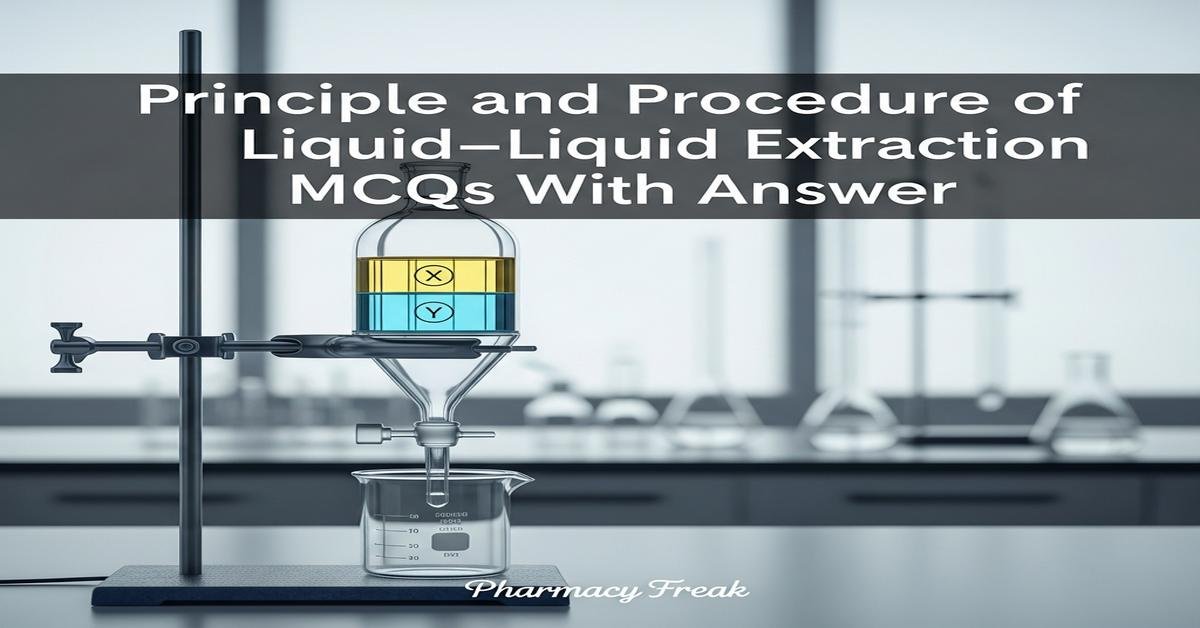
Introduction: Liquid-liquid extraction is a fundamental separation technique in pharmaceutical analysis and drug formulation, involving partitioning of solutes between two immiscible liquid phases. Key concepts include partition coefficient, distribution ratio, solvent selection, phase separation, extraction efficiency, and back-extraction. Practical procedure steps—choice of extraction solvent, pH adjustment for ionizable drugs, multiple-stage extraction, drying agents, and solvent removal (rotary evaporation)—determine yield and purity. Understanding factors such as polarity, density, temperature, emulsions, salting-out, and interfacial area is critical for B. Pharm students to design robust extraction protocols and troubleshoot problems in sample preparation and drug isolation. Now let’s test your knowledge with 30 MCQs on this topic.
Q1. What is the partition coefficient (K) in liquid-liquid extraction?
- The ratio of solute concentration in the organic phase to that in the aqueous phase at equilibrium
- The ratio of solvent densities
- The distribution of solvent volumes between phases
- The difference in pH between two phases
Correct Answer: The ratio of solute concentration in the organic phase to that in the aqueous phase at equilibrium
Q2. Which parameter describes the total concentration of all chemical forms of a solute in a phase?
- Partition coefficient (K)
- Distribution ratio (D)
- Dielectric constant
- Interfacial tension
Correct Answer: Distribution ratio (D)
Q3. For an ionizable drug, which approach increases extraction into an organic solvent?
- Adjusting pH to ionize the drug
- Adjusting pH to its unionized form
- Adding polar co-solvent to the organic phase
- Heating to 100°C
Correct Answer: Adjusting pH to its unionized form
Q4. Why are multiple small-volume extractions often better than a single large-volume extraction?
- They decrease the total solvent needed
- They increase overall extraction efficiency and recovery
- They reduce emulsification completely
- They change the partition coefficient
Correct Answer: They increase overall extraction efficiency and recovery
Q5. What is the main reason to add salt (salting-out) during aqueous extractions?
- To increase solubility of the solute in water
- To increase partitioning of solute into the organic phase by reducing solubility in water
- To neutralize pH
- To form emulsions
Correct Answer: To increase partitioning of solute into the organic phase by reducing solubility in water
Q6. Which solvent property is most critical when choosing an organic extraction solvent for nonpolar drugs?
- High dielectric constant
- High polarity
- Low polarity and immiscibility with water
- High hydrogen-bond donating ability
Correct Answer: Low polarity and immiscibility with water
Q7. In a separatory funnel, which phase is typically at the bottom when using diethyl ether and water?
- Diethyl ether
- Water
- They form a single phase
- Equal volumes of both
Correct Answer: Water
Q8. What is a common drying agent used to remove residual water from organic extracts?
- Sodium chloride
- Anhydrous sodium sulfate
- Hydrochloric acid
- Ethanol
Correct Answer: Anhydrous sodium sulfate
Q9. Which mathematical expression gives the fraction of solute extracted in one extraction step?
- 1 / (1 + (K * Vorg / Vaq))
- (K * Vorg) / (K * Vorg + Vaq)
- (Vaq) / (Vaq + Vorg)
- K / (K + 1)
Correct Answer: (K * Vorg) / (K * Vorg + Vaq)
Q10. What causes formation of stable emulsions during liquid-liquid extraction?
- Similar densities of phases only
- Presence of surfactants, fine suspended solids, or vigorous shaking
- Using a separatory funnel made of glass
- Insufficient temperature control only
Correct Answer: Presence of surfactants, fine suspended solids, or vigorous shaking
Q11. What is back-extraction (re-extraction) used for?
- To transfer solute from organic to aqueous phase for purification or further processing
- To dry the organic phase
- To measure partition coefficient
- To increase emulsification
Correct Answer: To transfer solute from organic to aqueous phase for purification or further processing
Q12. How does temperature generally affect the partition coefficient for most solutes?
- It always increases K with temperature
- It always decreases K with temperature
- Effect is solute- and solvent-dependent and may increase or decrease K
- Temperature has no effect on K
Correct Answer: Effect is solute- and solvent-dependent and may increase or decrease K
Q13. Which technique improves phase separation when emulsions persist?
- Vigorous shaking
- Adding small amount of electrolyte, centrifugation, or gentle stirring
- Adding more solvent without changing composition
- Increasing temperature to boiling
Correct Answer: Adding small amount of electrolyte, centrifugation, or gentle stirring
Q14. What does a distribution ratio (D) of less than 1 indicate?
- Solute prefers the organic phase
- Solute prefers the aqueous phase
- Complete extraction into organic phase
- Equal distribution between phases
Correct Answer: Solute prefers the aqueous phase
Q15. When extracting a weak base drug from water into organic solvent, which pH adjustment is appropriate?
- Lower pH to protonate the base
- Raise pH to deprotonate (neutralize) the base
- Keep pH at the drug’s pKa
- Adjust pH to extreme acidic conditions only
Correct Answer: Raise pH to deprotonate (neutralize) the base
Q16. Which of the following is a correct advantage of continuous liquid-liquid extraction over batch extraction?
- Lower solvent consumption for all systems
- Potential for higher overall recovery for difficult extractions with constant contact
- No need for phase separation
- Eliminates need to control pH
Correct Answer: Potential for higher overall recovery for difficult extractions with constant contact
Q17. How is the partition coefficient experimentally determined using shake-flask method?
- By measuring densities of two phases
- By equilibrating known volumes of solvent and aqueous solution, then measuring solute concentration in each phase
- By measuring pH only
- By titrating the organic solvent
Correct Answer: By equilibrating known volumes of solvent and aqueous solution, then measuring solute concentration in each phase
Q18. Which safety consideration is most important when choosing an extraction solvent in a pharmaceutical lab?
- Color of the solvent
- Hazard classification: flammability, toxicity, and volatility
- Manufacturer brand
- Molecular weight only
Correct Answer: Hazard classification: flammability, toxicity, and volatility
Q19. What role does interfacial area play in extraction kinetics?
- Smaller interfacial area speeds up extraction
- Larger interfacial area increases mass transfer rate and speeds equilibration
- Interfacial area affects only thermodynamics, not kinetics
- It changes the distribution ratio D directly
Correct Answer: Larger interfacial area increases mass transfer rate and speeds equilibration
Q20. Which analytical application commonly uses liquid-liquid extraction in pharmaceutical analysis?
- Sample preparation for HPLC or GC analysis of drugs and metabolites
- Measurement of tablet hardness
- Infrared spectroscopy baseline correction
- Calibration of pH meters
Correct Answer: Sample preparation for HPLC or GC analysis of drugs and metabolites
Q21. What is the first procedural step before performing an extraction of a biological sample?
- Rotary evaporation
- Adjusting sample pH and possibly protein precipitation
- Adding drying agent
- Chromatographic separation
Correct Answer: Adjusting sample pH and possibly protein precipitation
Q22. Which organic solvent is commonly used for mid-polarity drug extraction and is relatively dense than water?
- Hexane
- Chloroform
- Diethyl ether
- Acetone
Correct Answer: Chloroform
Q23. What is the effect of adding a cosolvent (e.g., methanol) to the organic phase?
- It always improves extraction selectivity
- It can change solvent polarity, potentially increasing solute solubility but may increase miscibility with water
- It decreases solute solubility in organic phase
- It prevents phase separation completely
Correct Answer: It can change solvent polarity, potentially increasing solute solubility but may increase miscibility with water
Q24. Which of the following best describes “wash” steps in extraction procedure?
- Adding solvent to extract the desired compound directly
- Using small-volume solvent to remove impurities from the desired phase without removing the product
- Heating to evaporate solvent
- Combining all extracts into one phase
Correct Answer: Using small-volume solvent to remove impurities from the desired phase without removing the product
Q25. Why is rotary evaporation commonly used after extraction?
- To dry the organic extract using salts
- To concentrate and remove volatile extraction solvent under reduced pressure without overheating the analyte
- To neutralize pH
- To increase partition coefficient
Correct Answer: To concentrate and remove volatile extraction solvent under reduced pressure without overheating the analyte
Q26. Which of the following will NOT improve extraction of a hydrophobic drug into an organic phase?
- Choosing a nonpolar organic solvent
- Lowering the aqueous pH to neutralize an acidic drug
- Adding a large amount of miscible organic cosolvent to the aqueous phase
- Performing multiple extractions with small volumes
Correct Answer: Adding a large amount of miscible organic cosolvent to the aqueous phase
Q27. In context of ionizable compounds, which equation is important to predict fraction unionized at a given pH?
- Van’t Hoff equation
- Henderson–Hasselbalch equation
- Beer-Lambert law
- Arrhenius equation
Correct Answer: Henderson–Hasselbalch equation
Q28. What is the main disadvantage of chlorinated solvents despite good extraction power?
- They are too polar for most drugs
- Health, environmental hazards and toxicity concerns
- They form no emulsions
- They cannot dissolve organic solutes
Correct Answer: Health, environmental hazards and toxicity concerns
Q29. How does ionic strength of an aqueous phase influence liquid-liquid extraction?
- Increasing ionic strength typically increases solute solubility in organic phase by salting-out
- Ionic strength has no effect
- Higher ionic strength always decreases extraction into organic phase
- Ionic strength only affects boiling point
Correct Answer: Increasing ionic strength typically increases solute solubility in organic phase by salting-out
Q30. During method validation for extraction procedure, which parameter is essential to evaluate?
- Extraction recovery, reproducibility, matrix effects, and selectivity
- Only solvent color
- Only density of solvents
- Only the rotation speed of mixer
Correct Answer: Extraction recovery, reproducibility, matrix effects, and selectivity


