Introduction
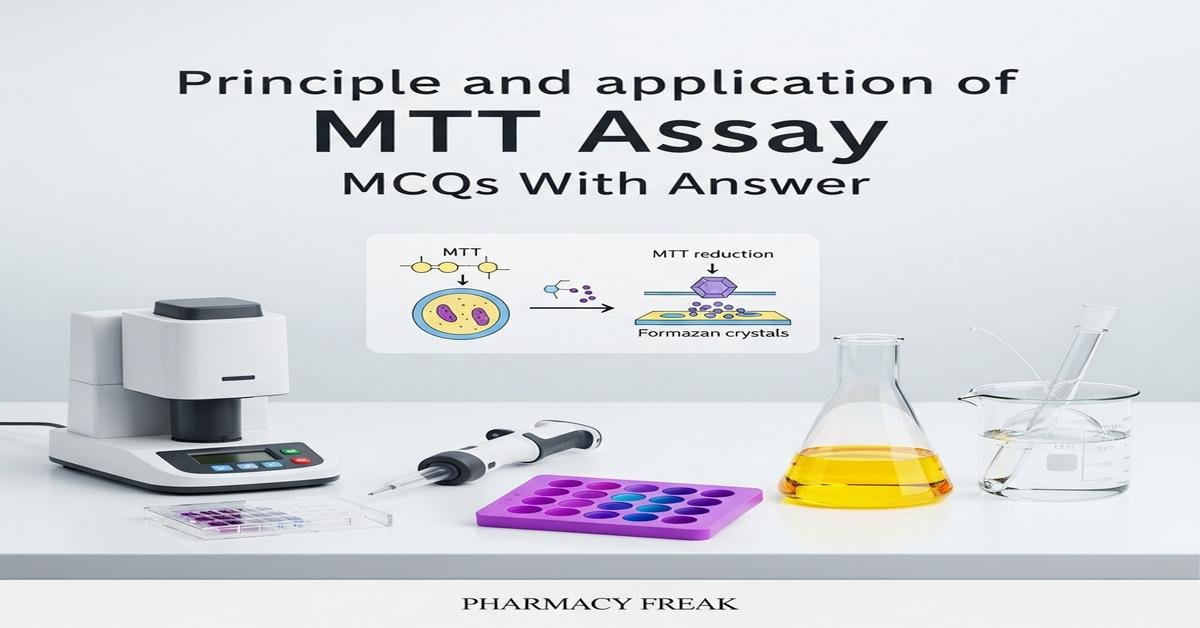
The MTT assay is a cornerstone bioanalytical technique used in M.Pharm programs to evaluate cell viability, cytotoxicity, and metabolic activity of cultured cells. Based on the reduction of the yellow tetrazolium salt MTT to an insoluble purple formazan by cellular NAD(P)H-dependent oxidoreductases, it provides a rapid, cost-effective colorimetric readout compatible with microplate formats. This quiz collection focuses on the principle, critical experimental parameters, interpretation nuances, troubleshooting, and comparisons with alternative tetrazolium assays. It is designed to deepen conceptual understanding and practical application skills for students planning in vitro cytotoxicity studies, formulation screening, or pharmacological evaluations in research and industrial settings.
Q1. What is the primary biochemical principle underlying the MTT assay?
- Reduction of MTT to purple formazan by cellular NAD(P)H-dependent oxidoreductases
- Hydrolysis of MTT by membrane-bound esterases
- Oxidation of cellular proteins producing a color change
- Fluorescent emission following MTT phosphorylation
Correct Answer: Reduction of MTT to purple formazan by cellular NAD(P)H-dependent oxidoreductases
Q2. In most cells, where does the enzymatic reduction of MTT predominantly occur?
- Mitochondria
- Golgi apparatus
- Cell nucleus
- Extracellular medium
Correct Answer: Mitochondria
Q3. Which solvent is most commonly used to solubilize MTT formazan crystals for spectrophotometric reading?
- Dimethyl sulfoxide (DMSO)
- Phosphate buffered saline (PBS)
- Deionized water
- Ethidium bromide solution
Correct Answer: Dimethyl sulfoxide (DMSO)
Q4. What is the typical primary wavelength used to read absorbance in the MTT assay?
- 570 nm
- 450 nm
- 650 nm
- 340 nm
Correct Answer: 570 nm
Q5. The MTT assay is most directly a measure of which cellular property?
- Metabolic activity (as a proxy for cell viability)
- Cell membrane permeability
- DNA fragmentation (apoptosis)
- Mitochondrial DNA copy number
Correct Answer: Metabolic activity (as a proxy for cell viability)
Q6. Which is a known limitation of the MTT assay when interpreting results?
- It may not distinguish between reduced metabolic activity and actual cell death
- It directly quantifies cell number with no interference
- It selectively measures necrotic cell death only
- It gives real-time continuous viability readings without endpoint processing
Correct Answer: It may not distinguish between reduced metabolic activity and actual cell death
Q7. How does the MTT assay differ from XTT/WST assays in terms of formazan product?
- MTT produces an insoluble formazan requiring solubilization, while XTT/WST produce water-soluble formazans
- MTT produces a fluorescent product but XTT/WST produce colorless products
- Both MTT and XTT produce identical soluble formazan products
- XTT/WST produce insoluble crystals while MTT produces soluble dye
Correct Answer: MTT produces an insoluble formazan requiring solubilization, while XTT/WST produce water-soluble formazans
Q8. Which culture medium component can interfere with colorimetric reading in MTT assays if not appropriately controlled?
- Phenol red
- Penicillin
- HEPES buffer
- Non-essential amino acids
Correct Answer: Phenol red
Q9. What constitutes an appropriate blank control for an MTT experiment?
- Medium plus MTT but without cells
- Cells without medium or MTT
- Untreated cells with no MTT added
- Only the test compound diluted in water
Correct Answer: Medium plus MTT but without cells
Q10. For a 96-well plate assay, which cell seeding density range commonly preserves linearity between cell number and MTT signal?
- 5,000–20,000 cells per well
- 50–200 cells per well
- 100,000–500,000 cells per well
- 1–10 cells per well
Correct Answer: 5,000–20,000 cells per well
Q11. Typical incubation time with MTT reagent to allow measurable formazan formation is:
- 1–4 hours
- 5–10 minutes
- 30–45 seconds
- 48–72 hours
Correct Answer: 1–4 hours
Q12. If a tested drug is a mitochondrial complex I inhibitor and MTT reduction falls, how should this be interpreted?
- Decreased MTT signal may reflect impaired mitochondrial activity rather than immediate cell death
- It unequivocally proves all cells are dead
- It indicates enhanced proliferation
- MTT reduction is unaffected by mitochondrial inhibitors
Correct Answer: Decreased MTT signal may reflect impaired mitochondrial activity rather than immediate cell death
Q13. Why are solubilization agents such as SDS-HCl or isopropanol used after MTT incubation in adherent cells?
- To dissolve insoluble formazan crystals and release the pigment for uniform reading
- To further reduce MTT to a fluorescent product
- To fix cells for microscopy
- To neutralize the MTT reagent and stop color development
Correct Answer: To dissolve insoluble formazan crystals and release the pigment for uniform reading
Q14. Which formula is correct for calculating percent cell viability from MTT absorbance readings?
- (Abs_sample − Abs_blank) / (Abs_control − Abs_blank) × 100
- (Abs_control − Abs_sample) / Abs_blank × 100
- Abs_sample × Abs_control × 100
- (Abs_blank − Abs_sample) / Abs_control × 100
Correct Answer: (Abs_sample − Abs_blank) / (Abs_control − Abs_blank) × 100
Q15. Which tetrazolium-derived assay generates a water-soluble formazan suitable for direct reading without a solubilization step?
- WST-1
- MTT
- Traditional MTT with DMSO
- Crystal violet
Correct Answer: WST-1
Q16. How can serum in the culture medium influence the outcome of an MTT cytotoxicity test with a lipophilic drug?
- Serum proteins can bind the drug, reducing free drug concentration and apparent cytotoxicity
- Serum increases MTT reduction independently of cell number
- Serum causes immediate precipitation of MTT
- Serum converts MTT into a fluorescent dye
Correct Answer: Serum proteins can bind the drug, reducing free drug concentration and apparent cytotoxicity
Q17. Can the MTT assay be used for continuous, real-time monitoring of cell viability in the same wells?
- No — MTT is an endpoint assay because formazan formation and solubilization are destructive
- Yes — MTT provides continuous kinetic fluorescence without disturbance
- Yes — MTT measures oxygen consumption in real time
- No — because MTT requires live-cell imaging equipment
Correct Answer: No — MTT is an endpoint assay because formazan formation and solubilization are destructive
Q18. What are recommended storage conditions for prepared MTT stock solutions to preserve activity?
- Store protected from light at 4 °C
- Store at 37 °C in direct light
- Freeze-thaw repeatedly at −80 °C
- Keep at room temperature on the bench
Correct Answer: Store protected from light at 4 °C
Q19. Which situation can cause a false-high absorbance reading in an MTT assay?
- Test compounds that are colored and absorb at the measurement wavelength
- Using sterile filtered medium
- Removing phenol red from medium before reading
- Using appropriate blank subtraction
Correct Answer: Test compounds that are colored and absorb at the measurement wavelength
Q20. What is a commonly used final concentration of MTT in the culture medium for a standard 96-well assay?
- 0.5 mg/mL
- 0.005 mg/mL
- 5 mg/mL
- 50 mg/mL
Correct Answer: 0.5 mg/mL

