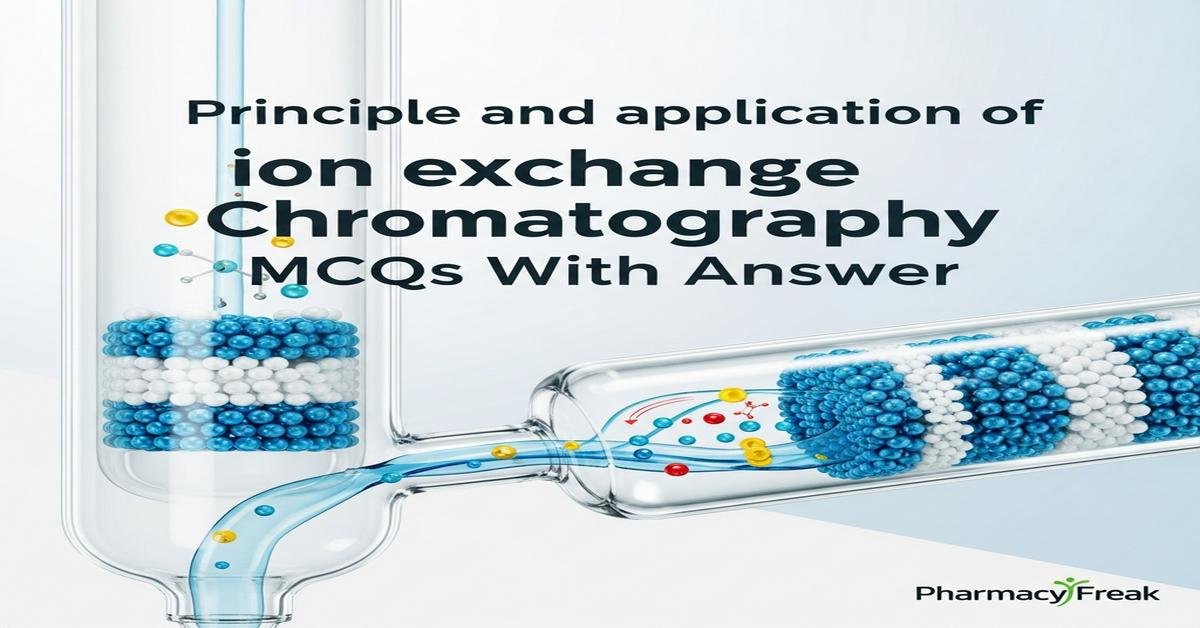
Principle and application of ion exchange chromatography MCQs With Answer is designed to help M. Pharm students strengthen conceptual understanding and practical insight in Modern Pharmaceutical Analytical Techniques. Ion-exchange chromatography (IEC) exploits electrostatic interactions between charged analytes and oppositely charged functional groups on a stationary phase. It is a cornerstone technique for separating inorganic ions, amino acids, peptides, and biomolecules, and is widely used in pharmaceutical analysis for impurity profiling, counter-ion determination, desalting, and sample clean-up. This quiz emphasizes fundamentals such as resin chemistry, capacity, selectivity, elution strategies, and detector choices, along with method development variables like pH and ionic strength. Work through these questions to reinforce both theoretical knowledge and analytical decision-making for research and quality control contexts.
Q1. What is the fundamental principle of ion-exchange chromatography?
- Reversible exchange between analyte ions in solution and counter-ions on oppositely charged stationary phase groups
- Partitioning based on hydrophobicity between two immiscible phases
- Separation based solely on molecular size through porous beads
- Fractionation based on differential vapor pressures
Correct Answer: Reversible exchange between analyte ions in solution and counter-ions on oppositely charged stationary phase groups
Q2. Which functional group characterizes a strong cation-exchange (SCX) resin commonly used in HPLC?
- Sulfonic acid (–SO3H)
- Carboxylic acid (–COOH)
- Quaternary ammonium (–NR4+)
- Diethylaminoethyl (–CH2CH2N+(C2H5)2H)
Correct Answer: Sulfonic acid (–SO3H)
Q3. Ion-exchange capacity of a resin is most appropriately expressed in which units?
- Milliequivalents per gram (meq/g) of dry resin
- Milligrams per milliliter (mg/mL)
- Percent weight/weight (% w/w)
- Molarity (mol/L) of the mobile phase
Correct Answer: Milliequivalents per gram (meq/g) of dry resin
Q4. Which factor generally increases retention of cations on a cation-exchange resin?
- Lower ionic charge and larger hydrated radius
- Higher charge and smaller hydrated radius
- Higher mobile-phase ionic strength
- Higher percentage of organic modifier
Correct Answer: Higher charge and smaller hydrated radius
Q5. How does increasing mobile-phase ionic strength typically affect analyte retention in ion-exchange chromatography?
- Decreases retention due to competition of eluent ions for binding sites
- Increases retention by stabilizing analyte–resin interactions
- No effect on retention, only improves peak shape
- Causes irreversible binding of analytes
Correct Answer: Decreases retention due to competition of eluent ions for binding sites
Q6. Donnan exclusion in ion-exchange systems refers to:
- Exclusion of co-ions from the resin phase due to electrostatic repulsion
- Complete exclusion of all ions from resin pores
- Selective retention of neutral molecules only
- Elimination of analytes during sample filtration
Correct Answer: Exclusion of co-ions from the resin phase due to electrostatic repulsion
Q7. A weak anion-exchange (WAX) stationary phase commonly contains which functional group?
- Diethylaminoethyl (DEAE)
- Quaternary ammonium
- Sulfonic acid
- Carboxymethyl
Correct Answer: Diethylaminoethyl (DEAE)
Q8. Which elution strategy is most effective for resolving strongly bound proteins in ion-exchange chromatography?
- Gradient increase in salt concentration
- Decreasing flow rate at constant conditions
- Increasing column length without changing mobile phase
- Adding high percentages of organic solvent only
Correct Answer: Gradient increase in salt concentration
Q9. To regenerate a cation-exchange column to the H+ form, which solution would you typically use?
- 0.5–1 M HCl
- 1 M NaOH
- 1 M NaCl
- Acetonitrile:water (50:50)
Correct Answer: 0.5–1 M HCl
Q10. What is the most likely chromatographic consequence of injecting a sample amount that exceeds the ion-exchange capacity?
- Early breakthrough and peak fronting
- Symmetric peaks with increased efficiency
- Marked increase in retention time
- Detector saturation without affecting peak shape
Correct Answer: Early breakthrough and peak fronting
Q11. In ion chromatography with suppressed conductivity detection, the suppressor primarily:
- Chemically converts eluent ions to weakly conducting species to reduce background
- Derivatizes analytes for UV detection
- Filters particulates from the eluent
- Increases column temperature for faster elution
Correct Answer: Chemically converts eluent ions to weakly conducting species to reduce background
Q12. Which detector is most commonly used for inorganic anions and cations in modern ion chromatography?
- Conductivity detector
- UV detector at 254 nm
- Fluorescence detector
- Mass spectrometer exclusively
Correct Answer: Conductivity detector
Q13. Which statement best differentiates strong and weak ion exchangers?
- Strong exchangers remain ionized over a wide pH range; weak exchangers show pH-dependent ionization
- Weak exchangers remain fully ionized; strong exchangers are pH dependent
- Both types behave identically across pH
- Only weak exchangers can operate above pH 10
Correct Answer: Strong exchangers remain ionized over a wide pH range; weak exchangers show pH-dependent ionization
Q14. Determination of counter-ions (e.g., chloride, sulfate) in API salts is best performed by:
- Ion chromatography with an anion-exchange column
- Gas chromatography with flame ionization detector
- Size-exclusion chromatography
- Reversed-phase HPLC without ion-pairing
Correct Answer: Ion chromatography with an anion-exchange column
Q15. The counter-ion of a cation-exchange resin in the Na+ form is:
- Na+
- Cl−
- SO4^2−
- H+
Correct Answer: Na+
Q16. In protein ion-exchange chromatography, selectivity at constant ionic strength is most strongly governed by:
- Mobile-phase pH relative to the protein’s isoelectric point (pI)
- Percentage of organic modifier
- Column temperature
- Detector wavelength
Correct Answer: Mobile-phase pH relative to the protein’s isoelectric point (pI)
Q17. Compared with ion-pair chromatography, ion-exchange chromatography:
- Uses a permanently charged stationary phase and salt-based eluents; ion-pair uses a neutral reversed-phase column with ionic pairing agents in the mobile phase
- Uses a neutral stationary phase and ionic pairing reagents; ion-pair uses permanently charged stationary phases
- Is identical in mechanism and setup
- Requires organic solvents exclusively for elution
Correct Answer: Uses a permanently charged stationary phase and salt-based eluents; ion-pair uses a neutral reversed-phase column with ionic pairing agents in the mobile phase
Q18. For solid-phase extraction using a mixed-mode cation-exchange sorbent, analytes are best retained when they are:
- Positively charged (protonated)
- Neutral
- Negatively charged
- Zwitterionic at their isoelectric point
Correct Answer: Positively charged (protonated)
Q19. In suppressed ion chromatography for anions, a commonly used eluent to maintain low background conductivity after suppression is:
- Carbonate/bicarbonate buffer
- High-ionic-strength phosphate buffer
- Sodium chloride solution
- Trifluoroacetic acid in acetonitrile
Correct Answer: Carbonate/bicarbonate buffer
Q20. Which sequence correctly represents the typical steps in an ion-exchange chromatography run?
- Equilibration → Sample loading → Wash → Elution → Regeneration
- Sample loading → Equilibration → Elution → Wash
- Regeneration → Elution → Sample loading → Equilibration
- Equilibration → Regeneration → Elution → Sample loading
Correct Answer: Equilibration → Sample loading → Wash → Elution → Regeneration


I am a Registered Pharmacist under the Pharmacy Act, 1948, and the founder of PharmacyFreak.com. I hold a Bachelor of Pharmacy degree from Rungta College of Pharmaceutical Science and Research. With a strong academic foundation and practical knowledge, I am committed to providing accurate, easy-to-understand content to support pharmacy students and professionals. My aim is to make complex pharmaceutical concepts accessible and useful for real-world application.
Mail- Sachin@pharmacyfreak.com