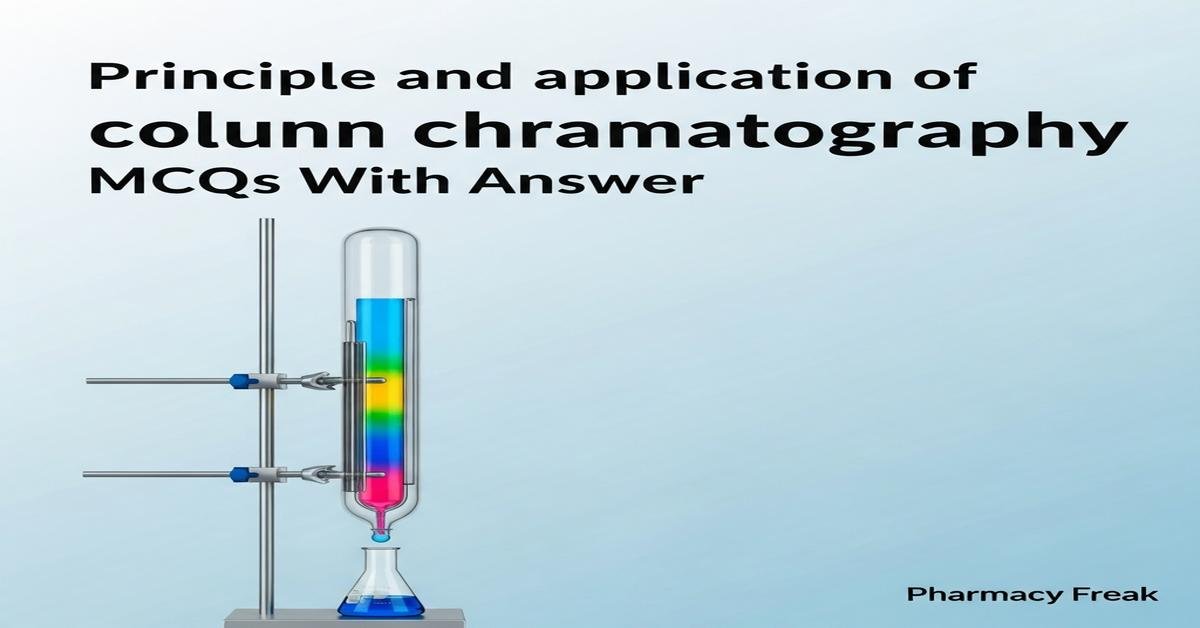
Principle and application of column chromatography MCQs With Answer is designed to help M. Pharm students master both the theoretical foundations and practical decision-making involved in column-based separations. Column chromatography underpins many modern pharmaceutical analytical techniques—from rapid flash separations to preparative purification of APIs and natural products. This quiz blends core principles (adsorption/partition equilibria, normal- vs reverse-phase, selectivity, plate theory, van Deemter behavior) with hands-on considerations (solvent choice, modifiers, sample loading, gradient design, scale-up). Each question is curated to reflect real-world lab choices, interpretation of chromatographic parameters, and method optimization strategies essential for pharmaceutical R&D and QC.
Q1. What is the fundamental principle governing separation in column chromatography?
- Differential distribution of solute between stationary and mobile phases leading to different migration rates
- Only diffusion-driven mass transfer in a single phase
- Electrophoretic mobility differences under an electric field
- Crystallization based on temperature gradients
Correct Answer: Differential distribution of solute between stationary and mobile phases leading to different migration rates
Q2. In normal-phase column chromatography, which statement is most accurate?
- Polar stationary phase with nonpolar mobile phase
- Nonpolar stationary phase with aqueous mobile phase
- Both stationary and mobile phases are strongly aqueous
- Nonpolar stationary phase with nonpolar mobile phase
Correct Answer: Polar stationary phase with nonpolar mobile phase
Q3. On silica gel, which solvent will generally elute compounds most strongly in an eluotropic series?
- Hexane
- Toluene
- Ethyl acetate
- Methanol
Correct Answer: Methanol
Q4. How does decreasing stationary-phase particle size typically affect a packed column separation?
- Increases efficiency and resolution but raises backpressure requirements
- Decreases efficiency and reduces backpressure
- No change in efficiency; only reduces analysis time
- Increases peak tailing without affecting efficiency
Correct Answer: Increases efficiency and resolution but raises backpressure requirements
Q5. In reverse-phase column chromatography (e.g., C18), which statement is correct regarding gradient elution?
- Increasing the percentage of organic modifier (e.g., acetonitrile) decreases retention time of hydrophobic analytes
- Increasing water content decreases retention time of hydrophobic analytes
- Increasing organic modifier always increases retention for all analytes
- Retention is unaffected by solvent strength in reverse-phase
Correct Answer: Increasing the percentage of organic modifier (e.g., acetonitrile) decreases retention time of hydrophobic analytes
Q6. Which stationary phase most strongly retains basic drugs in normal-phase chromatography?
- Acidic silica gel
- Neutral alumina
- C18-bonded silica
- Polystyrene-divinylbenzene resin
Correct Answer: Acidic silica gel
Q7. What is a common chromatographic consequence of overloading a silica gel column?
- Band broadening with fronting/streaking and poor resolution
- Sharper peaks and improved resolution
- No effect on band shape; only faster elution
- Complete baseline separation of all components
Correct Answer: Band broadening with fronting/streaking and poor resolution
Q8. In preparative open-column or flash chromatography, how are collected fractions most commonly monitored in a lab setting?
- Collect fractions and analyze by TLC
- By mass spectrometry in real time for every fraction
- By conductivity measurements only
- By differential scanning calorimetry
Correct Answer: Collect fractions and analyze by TLC
Q9. What is the primary retention mechanism in ion-exchange column chromatography?
- Electrostatic interactions between oppositely charged analytes and stationary phase
- Size-based exclusion from pores
- Partition into a hydrophobic bonded layer
- Hydrogen-bonding with neutral ligands
Correct Answer: Electrostatic interactions between oppositely charged analytes and stationary phase
Q10. In size-exclusion (gel filtration) column chromatography, which statement is true?
- Larger molecules elute first because they are excluded from the pores
- Smaller molecules elute first because they diffuse faster
- Elution order depends only on charge
- All analytes have identical retention regardless of size
Correct Answer: Larger molecules elute first because they are excluded from the pores
Q11. For silica-based reverse-phase columns, what is the typical mobile-phase pH range recommended to avoid silica dissolution?
- Approximately pH 2–8
- Approximately pH 8–12
- Approximately pH 0–2
- Approximately pH 10–14
Correct Answer: Approximately pH 2–8
Q12. Which adjustment most effectively increases resolution of two closely eluting peaks without excessively increasing analysis time?
- Changing mobile-phase composition to alter selectivity (α)
- Doubling the column length
- Decreasing flow rate far below the optimum
- Increasing injection volume
Correct Answer: Changing mobile-phase composition to alter selectivity (α)
Q13. What is a key advantage of flash chromatography over gravity-packed column chromatography?
- Use of pressurized gas allows smaller particles and faster, higher-resolution separations
- Eliminates the need for solvents
- Works only for proteins and not small molecules
- Requires no fraction collection
Correct Answer: Use of pressurized gas allows smaller particles and faster, higher-resolution separations
Q14. To reduce tailing or irreversible adsorption of basic amines on silica, which mobile-phase modifier is commonly added?
- 0.1–1% triethylamine
- 10% hydrochloric acid
- Sodium dodecyl sulfate
- Ammonium sulfate salt at high ionic strength
Correct Answer: 0.1–1% triethylamine
Q15. In liquid chromatography, the capacity factor k’ is defined as:
- (tR − t0) / t0
- t0 / (tR − t0)
- tR / t0
- tR − t0
Correct Answer: (tR − t0) / t0
Q16. According to the Van Deemter equation, which statement best describes the effect of increasing linear velocity?
- It decreases longitudinal diffusion (B/u term) but increases mass transfer resistance (C·u term)
- It increases the A term (eddy diffusion) only
- It decreases both B and C terms simultaneously to zero
- It has no effect on plate height
Correct Answer: It decreases longitudinal diffusion (B/u term) but increases mass transfer resistance (C·u term)
Q17. Which compound would likely show the longest retention on a C18 column using water/acetonitrile at pH 3 (assuming comparable concentrations)?
- Naphthalene
- Toluene
- Phenol
- Aniline
Correct Answer: Naphthalene
Q18. What is the primary purpose of using a guard column in LC systems?
- To protect the analytical column from particulates and strongly retained contaminants
- To increase the system backpressure
- To serve as the main separation column
- To eliminate the need for filtration of samples
Correct Answer: To protect the analytical column from particulates and strongly retained contaminants
Q19. When scaling a method from an analytical column to a preparative column, how should flow rate be adjusted to maintain similar linear velocity?
- F2 = F1 × (d2/d1)^2
- F2 = F1 × (d2/d1)
- F2 = F1 × (d1/d2)^2
- Flow rate should remain unchanged regardless of diameter
Correct Answer: F2 = F1 × (d2/d1)^2
Q20. In which scenario is normal-phase column chromatography generally preferred over reverse-phase?
- Separation of very nonpolar compounds (e.g., lipid classes) using nonpolar eluents
- Analysis of highly polar peptides in aqueous buffers
- Ionizable drug assays requiring pH control in water
- Routine separations requiring MS-compatible aqueous mobile phases
Correct Answer: Separation of very nonpolar compounds (e.g., lipid classes) using nonpolar eluents

