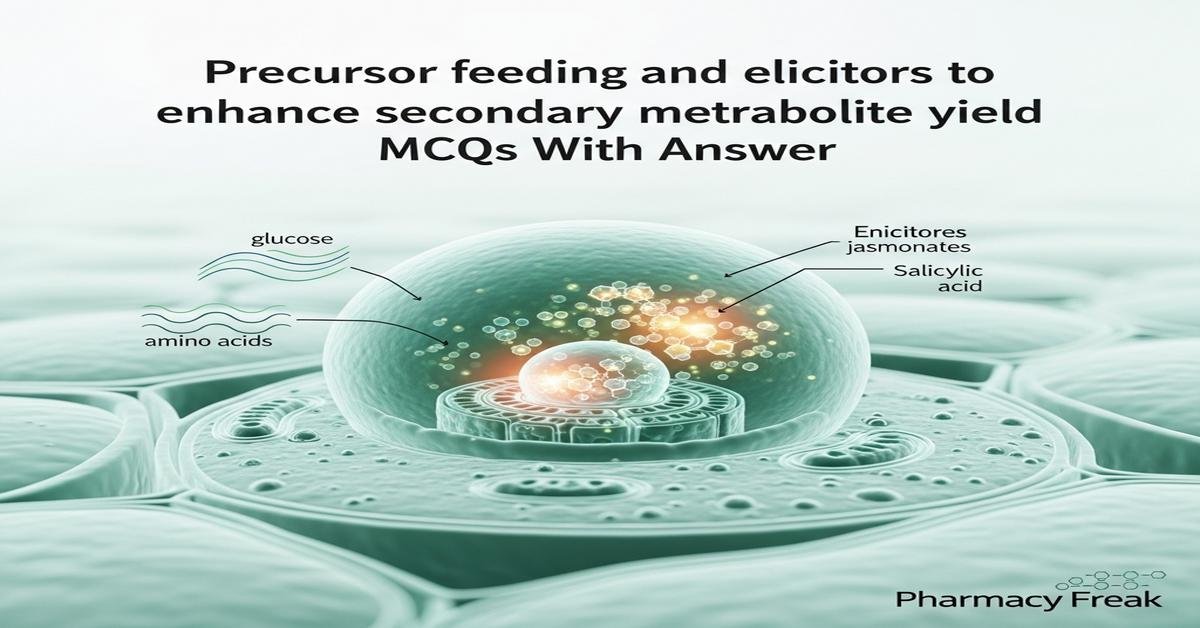
Introduction: This quiz set covers precursor feeding and elicitor strategies used to enhance secondary metabolite production in plant cell, tissue and organ cultures — a core topic in Medicinal Plant Biotechnology for M.Pharm students. The questions focus on mechanisms, types of precursors and elicitors, experimental design (timing, concentration, pulse vs continuous feeding), analytical tracing, culture systems (e.g., hairy roots), and scale-up considerations. Emphasis is on applied understanding: how precursors enter biosynthetic pathways, how elicitors trigger signaling cascades (jasmonate, salicylate, ethylene), and how combined approaches and metabolic insights optimize yields. Use these MCQs to test and deepen practical and theoretical knowledge relevant to research and industry.
Q1. What is the primary concept of “precursor feeding” in plant in vitro cultures?
- Supplying specific metabolic intermediates to cultures to boost a target secondary metabolite
- Adding antibiotics to prevent contamination during metabolite production
- Feeding extra carbon as sucrose to increase biomass only
- Introducing genes to overexpress biosynthetic enzymes
Correct Answer: Supplying specific metabolic intermediates to cultures to boost a target secondary metabolite
Q2. Which statement best defines an “elicitor” in the context of secondary metabolite enhancement?
- A substrate that is directly converted into the final secondary metabolite
- A signal molecule that triggers plant defense pathways leading to increased secondary metabolism
- An enzyme added exogenously to accelerate biosynthesis
- A nutrient that promotes primary growth at the expense of secondary metabolism
Correct Answer: A signal molecule that triggers plant defense pathways leading to increased secondary metabolism
Q3. Which precursor is commonly fed to increase phenylpropanoid and flavonoid synthesis?
- L-lysine
- L-phenylalanine
- Mevalonic acid
Correct Answer: L-phenylalanine
Q4. Which elicitor is most directly associated with activating jasmonate-mediated pathways?
- Salicylic acid
- Methyl jasmonate (MeJA)
- Chitosan
- Ultraviolet-B light
Correct Answer: Methyl jasmonate (MeJA)
Q5. What is the principal cellular mechanism by which elicitors enhance secondary metabolite production?
- Direct chemical conversion of substrates into secondary metabolites
- Induction of specific gene expression leading to increased levels of pathway enzymes
- Permanent integration of new biosynthetic genes into the genome
- Physical disruption of cells releasing stored secondary metabolites
Correct Answer: Induction of specific gene expression leading to increased levels of pathway enzymes
Q6. Why are hairy root cultures particularly responsive to precursor feeding strategies?
- They lack secondary metabolic pathways so precursors accumulate
- They are genetically unstable and mutate to produce more metabolites
- They often have high and stable biosynthetic capacity and root-specific pathways are active
- They grow in suspension making feeding easier than other culture types
Correct Answer: They often have high and stable biosynthetic capacity and root-specific pathways are active
Q7. What is a common negative outcome when precursor concentration is too high in culture medium?
- Complete conversion of precursor to desired metabolite without side products
- Feedback inhibition, metabolic imbalances or precursor toxicity reducing yield
- Immediate differentiation of cells into new organ types
- Increased culture pH that stabilizes secondary metabolism
Correct Answer: Feedback inhibition, metabolic imbalances or precursor toxicity reducing yield
Q8. Compared to continuous feeding, what is a major advantage of pulse feeding of precursors?
- It guarantees complete precursor uptake immediately
- It prevents any incorporation into the target pathway
- It reduces accumulation-related toxicity and can minimize feedback inhibition
- It eliminates the need for elicitors entirely
Correct Answer: It reduces accumulation-related toxicity and can minimize feedback inhibition
Q9. What is the purpose of using isotope-labeled precursors in precursor feeding experiments?
- To increase the chemical stability of the precursor in medium
- To trace incorporation pathways and quantify flux into specific metabolites
- To inhibit competing primary metabolic pathways
- To act as a stronger elicitor than unlabeled forms
Correct Answer: To trace incorporation pathways and quantify flux into specific metabolites
Q10. Which of the following is an abiotic elicitor commonly used to enhance secondary metabolites?
- Chitosan
- Yeast extract
- Ultraviolet (UV) light
- Bacterial flagellin peptide
Correct Answer: Ultraviolet (UV) light
Q11. At what growth phase is precursor addition generally most effective for enhancing secondary metabolite accumulation?
- Lag phase only
- Early exponential phase always
- Late exponential to early stationary phase when secondary pathways are active
- After complete senescence of the culture
Correct Answer: Late exponential to early stationary phase when secondary pathways are active
Q12. What is the expected result of combining precursor feeding with an elicitor in a designed experiment?
- No change compared to control because pathways are independent
- Synergistic or additive enhancement of the target secondary metabolite yield
- Universal toxicity that stops metabolite production
- Complete redirection to primary metabolism
Correct Answer: Synergistic or additive enhancement of the target secondary metabolite yield
Q13. What does “metabolic channeling” refer to in the context of precursor feeding?
- Random diffusion of intermediates across cell compartments
- Organization of sequential enzymes into complexes that pass intermediates directly between enzymes
- External filtration of precursors to improve uptake
- Conversion of secondary metabolites back into primary metabolites
Correct Answer: Organization of sequential enzymes into complexes that pass intermediates directly between enzymes
Q14. Which factor can cause added precursor to be diverted away from secondary metabolism?
- Specific induction of pathway-specific enzymes only
- Preferential consumption by primary metabolism for growth and maintenance
- Complete lack of transporters for the precursor
- Excessive elicitor-induced transcription of biosynthetic genes
Correct Answer: Preferential consumption by primary metabolism for growth and maintenance
Q15. Which analytical technique is most suitable for detecting incorporation of isotope-labeled precursors into target secondary metabolites?
- Paper chromatography
- LC-MS/MS with isotopic resolution
- Simple UV spectrophotometry without separation
- Light microscopy
Correct Answer: LC-MS/MS with isotopic resolution
Q16. Which elicitor predominantly activates salicylic-acid-dependent defense pathways?
- Chitosan
- Benzoic acid or salicylic acid
- Methyl jasmonate
- Ultraviolet-C light
Correct Answer: Benzoic acid or salicylic acid
Q17. For enhancing terpenoid biosynthesis via precursor feeding, which precursor is commonly used for the mevalonate pathway?
- Shikimic acid
- Mevalonic acid (MVA)
- L-phenylalanine
- Glutamine
Correct Answer: Mevalonic acid (MVA)
Q18. What is a major practical limitation of precursor feeding strategies when scaling up to industrial production?
- They are universally cheaper at large scale
- Precursor cost, availability, and metabolic complexity can impede economic feasibility
- They always eliminate the need for downstream purification
- They make cultures immune to contamination
Correct Answer: Precursor cost, availability, and metabolic complexity can impede economic feasibility
Q19. Which of the following is an example of a biotic elicitor used to boost secondary metabolites?
- Heavy metal salts
- Chitosan (derived from fungal cell wall)
- High-intensity light
- High temperature shock
Correct Answer: Chitosan (derived from fungal cell wall)
Q20. After elicitor application, what is the typical time frame for observable increases in secondary metabolite accumulation?
- Seconds to minutes only
- Immediately within less than one second
- Hours to days, depending on transcriptional and enzymatic induction
- Years, as the culture evolves genetically
Correct Answer: Hours to days, depending on transcriptional and enzymatic induction


I am a Registered Pharmacist under the Pharmacy Act, 1948, and the founder of PharmacyFreak.com. I hold a Bachelor of Pharmacy degree from Rungta College of Pharmaceutical Science and Research. With a strong academic foundation and practical knowledge, I am committed to providing accurate, easy-to-understand content to support pharmacy students and professionals. My aim is to make complex pharmaceutical concepts accessible and useful for real-world application.
Mail- Sachin@pharmacyfreak.com