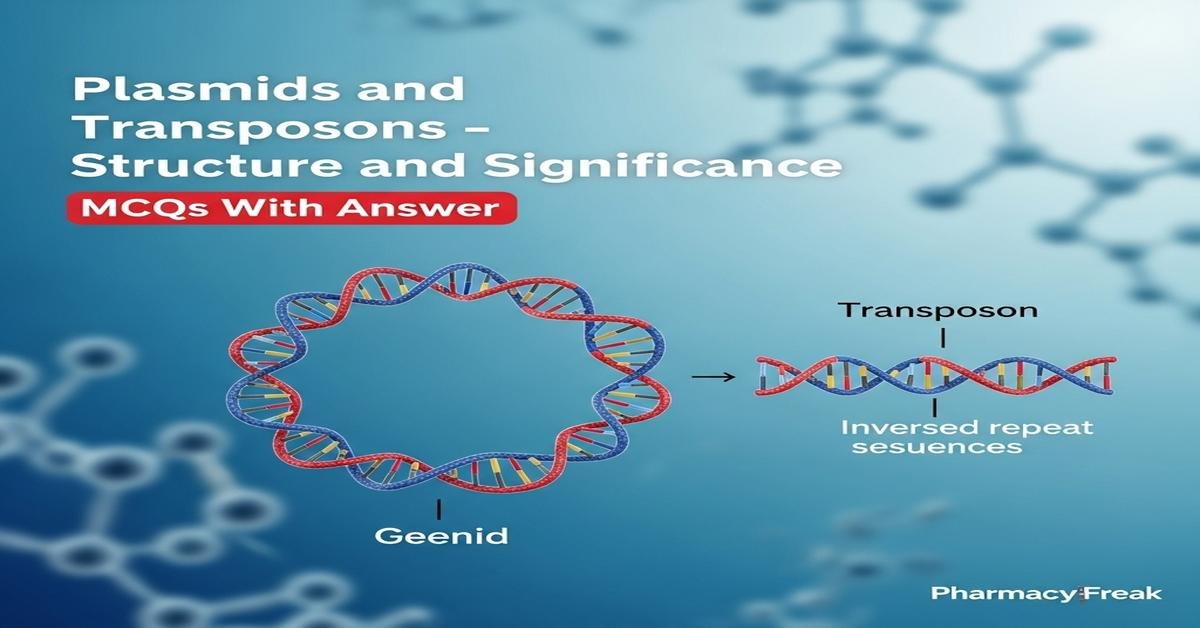
Plasmids and transposons – structure and significance MCQs With Answer
Plasmids and transposons are mobile genetic elements central to microbial genetics, antibiotic resistance, and biotechnology. Plasmids are autonomously replicating circular DNA molecules with origins of replication (oriV, oriT), copy number control, partitioning systems, and conjugation genes. Transposons (including insertion sequences, composite transposons, and Tn3 family) carry transposase and sometimes resistance or virulence genes, moving via cut-and-paste or replicative mechanisms and creating target site duplications. Understanding replication, conjugation, incompatibility groups, transposition mechanisms, and roles in horizontal gene transfer is essential for B.Pharm students studying drug resistance, gene cloning, vector design, and transposon mutagenesis. Now let’s test your knowledge with 30 MCQs on this topic.
Q1. What is the defining structural feature of a typical bacterial plasmid?
- Linear double-stranded DNA with telomeres
- Circular double-stranded DNA capable of autonomous replication
- RNA molecule with reverse transcriptase
- Chromosomal segment integrated into the bacterial chromosome
Correct Answer: Circular double-stranded DNA capable of autonomous replication
Q2. Which gene is essential for conjugative transfer of an F plasmid?
- oriV
- tra gene cluster
- lacZ
- par locus
Correct Answer: tra gene cluster
Q3. What does “oriT” on a plasmid denote?
- Origin of transcription
- Origin of transfer for conjugation
- Origin of translation
- Origin of viral packaging
Correct Answer: Origin of transfer for conjugation
Q4. Which mechanism describes replicative transposition?
- Transposon excises and is lost from the donor
- Transposon duplicates and inserts copy at a new site
- Transposon integrates only at specific att sites
- Transposon uses host recombination to circularize plasmids
Correct Answer: Transposon duplicates and inserts copy at a new site
Q5. Which enzyme is directly responsible for catalyzing transposition?
- DNA polymerase I
- Transposase
- Integrase of bacteriophage lambda
- Topoisomerase IV
Correct Answer: Transposase
Q6. What is a composite transposon?
- A transposon flanked by insertion sequences carrying accessory genes
- A transposon that only inserts into plasmids
- A plasmid integrated into the chromosome via recombination
- A transposon that cannot transpose without integrase
Correct Answer: A transposon flanked by insertion sequences carrying accessory genes
Q7. Which feature determines plasmid incompatibility groups?
- Antibiotic resistance genes present
- Sequence and control of replication origin and partitioning systems
- Size of plasmid only
- Presence of transposons
Correct Answer: Sequence and control of replication origin and partitioning systems
Q8. How do insertion sequences (IS elements) typically affect nearby gene expression?
- They always delete adjacent genes
- They may introduce promoters or disrupt coding sequences
- They convert DNA into RNA
- They replicate autonomously like plasmids
Correct Answer: They may introduce promoters or disrupt coding sequences
Q9. Which plasmid type commonly carries multiple antibiotic resistance genes in clinical isolates?
- Col plasmids
- R plasmids (resistance plasmids)
- pBR322-derived cloning plasmids
- Metabolic plasmids only involved in carbon source utilization
Correct Answer: R plasmids (resistance plasmids)
Q10. What is the role of the par (partition) system on plasmids?
- To synthesize antibiotic-degrading enzymes
- To ensure stable plasmid segregation during cell division
- To promote plasmid degradation
- To initiate transposition events
Correct Answer: To ensure stable plasmid segregation during cell division
Q11. Which of the following is a common outcome after transposon insertion into the host genome?
- Creation of target site duplications flanking the insertion
- Formation of telomeric repeats at the insertion site
- Immediate excision of the transposon during replication
- Conversion of DNA to single-stranded RNA
Correct Answer: Creation of target site duplications flanking the insertion
Q12. Which experimental tool uses transposons for random mutagenesis?
- Southern blotting
- Transposon-tagging mutagenesis
- CRISPR base editing without guide RNA
- Restriction fragment length polymorphism
Correct Answer: Transposon-tagging mutagenesis
Q13. Which plasmid replication mode is associated with the ColE1-type plasmids?
- Theta replication controlled by RNA I–RNA II interaction
- Rolling-circle replication with rep protein only
- Tandem repeat replication via transposase
- Linear replication with telomerase
Correct Answer: Theta replication controlled by RNA I–RNA II interaction
Q14. What distinguishes conjugative plasmids from mobilizable plasmids?
- Conjugative plasmids encode complete tra genes for transfer; mobilizable plasmids require help
- Mobilizable plasmids are larger than conjugative plasmids by definition
- Conjugative plasmids cannot replicate autonomously
- Mobilizable plasmids carry no selectable markers
Correct Answer: Conjugative plasmids encode complete tra genes for transfer; mobilizable plasmids require help
Q15. In the Tn3 family of transposons, what enzyme resolves cointegrates during replicative transposition?
- Resolvase (or site-specific recombinase)
- DNA ligase only
- RNA polymerase
- DNA gyrase
Correct Answer: Resolvase (or site-specific recombinase)
Q16. Which laboratory method is commonly used to isolate plasmid DNA from bacterial cells?
- Phenol–chloroform extraction of total proteins
- Alkaline lysis miniprep followed by purification
- Gram staining
- Flow cytometry
Correct Answer: Alkaline lysis miniprep followed by purification
Q17. What is a shuttle vector?
- A vector that can replicate in two different host species due to dual origins
- A plasmid that cannot be transferred between cells
- A plasmid carrying only antibiotic resistance genes
- A viral vector that cannot integrate into genomes
Correct Answer: A vector that can replicate in two different host species due to dual origins
Q18. How do transposons contribute to the spread of antibiotic resistance?
- They synthesize antibiotics within bacteria
- They mobilize and transfer resistance genes between plasmids and chromosomes
- They prevent horizontal gene transfer
- They only act on viral genomes
Correct Answer: They mobilize and transfer resistance genes between plasmids and chromosomes
Q19. What defines an insertion sequence (IS) element?
- A large plasmid carrying multiple resistance genes
- The simplest transposable element containing only transposase and terminal repeats
- A bacteriophage integrative unit with integrase and att sites
- A mitochondrial DNA fragment
Correct Answer: The simplest transposable element containing only transposase and terminal repeats
Q20. Which characteristic is typical of low-copy-number plasmids?
- They lack partitioning systems and are unstable
- They possess partitioning (par) systems for stable segregation
- They replicate via rolling-circle and have extremely high copy numbers
- They always integrate into the chromosome
Correct Answer: They possess partitioning (par) systems for stable segregation
Q21. What is plasmid curing?
- Sequencing a plasmid to determine its sequence
- Deliberate or spontaneous loss of a plasmid from a bacterial cell
- Integration of a plasmid into the chromosome
- Conjugative transfer of a plasmid to another cell
Correct Answer: Deliberate or spontaneous loss of a plasmid from a bacterial cell
Q22. Which term describes plasmids that confer enhanced virulence to bacteria?
- Col plasmids
- Resistance (R) plasmids
- Virulence (vir) plasmids
- Shuttle vectors
Correct Answer: Virulence (vir) plasmids
Q23. What is a common molecular signature left behind after cut-and-paste transposition?
- Poly-A tail at the insertion site
- Target site duplications and sometimes small deletions at donor site
- Large inversions flanking the element
- No change to donor or target sequences
Correct Answer: Target site duplications and sometimes small deletions at donor site
Q24. How can plasmids be used as cloning vectors in B.Pharm labs?
- By integrating them into the host chromosome only
- By inserting foreign DNA into multiple cloning sites and selecting transformants
- By using plasmids to destroy host DNA
- By relying on spontaneous transposition to clone genes
Correct Answer: By inserting foreign DNA into multiple cloning sites and selecting transformants
Q25. Which feature allows a mobilizable plasmid to be transferred in the presence of a conjugative helper plasmid?
- Presence of oriV only
- Presence of a mobilization (mob) site and relaxase recognition sequence
- Large size greater than 200 kb
- Absence of any origin of replication
Correct Answer: Presence of a mobilization (mob) site and relaxase recognition sequence
Q26. Which transposon is historically associated with tetracycline resistance and has been well-studied?
- Tn5
- Tn10
- Tn9
- IS1
Correct Answer: Tn10
Q27. What is horizontal gene transfer (HGT) in bacteria?
- Transmission of genes only from parent to offspring
- Movement of genetic material between unrelated organisms via transformation, transduction, or conjugation
- Synthesizing new genes de novo from nucleotides
- Only phage-mediated gene transfers
Correct Answer: Movement of genetic material between unrelated organisms via transformation, transduction, or conjugation
Q28. In designing a plasmid-based expression vector, which element is critical for controlled high-level expression in bacteria?
- Origin of transfer (oriT)
- Strong promoter and ribosome-binding site upstream of the gene
- Transposase gene within the vector
- par partitioning locus only
Correct Answer: Strong promoter and ribosome-binding site upstream of the gene
Q29. Which strategy can reduce the spread of resistance genes carried on plasmids in clinical settings?
- Excessive use of broad-spectrum antibiotics
- Antibiotic stewardship and infection control to limit selection and transfer
- Promotion of conjugation via co-infection
- Encouraging transposon mobilization
Correct Answer: Antibiotic stewardship and infection control to limit selection and transfer
Q30. What is the main difference between integrons and transposons regarding gene capture?
- Integrons capture gene cassettes via site-specific recombination; transposons mobilize DNA via transposase-mediated movement
- Integrons are always plasmids; transposons are always chromosomal
- Transposons capture gene cassettes via integrase; integrons move via transposase
- There is no difference; both function identically
Correct Answer: Integrons capture gene cassettes via site-specific recombination; transposons mobilize DNA via transposase-mediated movement

