Introduction
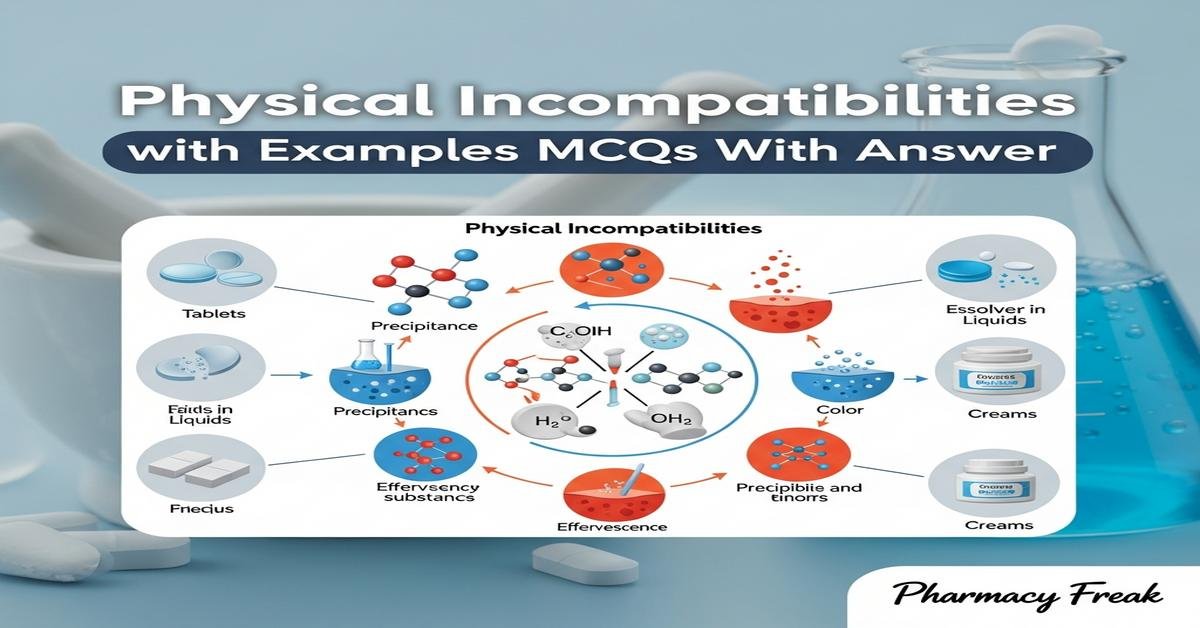
Physical incompatibilities in pharmaceutics occur when ingredients interact without chemical change but still compromise quality—through precipitation, immiscibility, caking, creaming, eutectic formation, sorption/adsorption, and phase separation. Understanding mechanisms like co-solvent dilution precipitation, pH-induced insolubility, salting out, Ostwald ripening, and deliquescence is essential for B. Pharm students involved in extemporaneous compounding, IV admixtures, and formulation stability. Key examples include diazepam precipitation on dilution, eutectic mixtures (camphor–menthol), and nitroglycerin adsorption to PVC tubing. Prevention strategies include proper order of mixing, using appropriate emulsifiers and wetting agents, selecting non-PVC sets, controlling pH and ionic strength, and employing adsorbent diluents. Now let’s test your knowledge with 30 MCQs on this topic.
Q1. Which statement best defines a physical incompatibility in pharmaceutics?
- Undesirable interaction that forms new covalent products and degrades the drug
- Undesirable effect due to opposing pharmacologic actions in a patient
- Undesirable change like precipitation or phase separation without chemical decomposition
- Beneficial change in bioavailability due to excipient–drug complexation
Correct Answer: Undesirable change like precipitation or phase separation without chemical decomposition
Q2. Which is an example of a physical incompatibility?
- Hydrolysis of aspirin in aqueous solution
- Precipitation of diazepam injection upon dilution with aqueous fluids
- Oxidation of epinephrine in light
- Antagonism between beta-blockers and beta-agonists
Correct Answer: Precipitation of diazepam injection upon dilution with aqueous fluids
Q3. Phenytoin sodium injection is most likely to precipitate when mixed with which diluent?
- 0.9% Sodium chloride (normal saline)
- 5% Dextrose injection (D5W)
- Sterile water for injection
- 0.45% Sodium chloride
Correct Answer: 5% Dextrose injection (D5W)
Q4. Which pair commonly forms a eutectic mixture that liquefies on trituration?
- Lactose and sucrose
- Camphor and menthol
- Talc and starch
- Magnesium oxide and kaolin
Correct Answer: Camphor and menthol
Q5. Best practice to compound two eutectic-forming powders is to:
- Triturate them together vigorously without any diluent
- Moisten them with water and then mix quickly
- Mix each with an inert adsorbent (e.g., magnesium carbonate) separately, then blend
- Heat the mortar to evaporate moisture while mixing
Correct Answer: Mix each with an inert adsorbent (e.g., magnesium carbonate) separately, then blend
Q6. The reduction in solubility of a nonelectrolyte by high electrolyte concentration is termed:
- Salting in
- Salting out
- Common ion effect
- Ion pairing
Correct Answer: Salting out
Q7. Why do drugs in co-solvent systems often precipitate upon dilution with water?
- Increase in pH increases ionization and crystallization
- Decrease in dielectric constant improves solubility
- Decreased solvent capacity as co-solvent fraction drops
- Formation of covalent dimers reduces solubility
Correct Answer: Decreased solvent capacity as co-solvent fraction drops
Q8. Which drug is well-known to adsorb to PVC infusion sets, leading to dose loss?
- Amoxicillin
- Nitroglycerin
- Metformin
- Cefazolin
Correct Answer: Nitroglycerin
Q9. Which strategy best minimizes sorption of drug onto infusion tubing?
- Use non-PVC tubing or glass containers
- Add sodium chloride to increase ionic strength
- Refrigerate the infusion during delivery
- Run the infusion at very high flow rates
Correct Answer: Use non-PVC tubing or glass containers
Q10. In suspensions, which phenomenon is generally reversible by gentle shaking?
- Caking
- Creaming
- Breaking
- Irreversible aggregation
Correct Answer: Creaming
Q11. Which suspension system is more easily redispersed after settling?
- Deflocculated suspension
- Flocculated suspension
- Highly crystalline suspension with needle crystals
- Supersaturated solution
Correct Answer: Flocculated suspension
Q12. A substance that loses water of crystallization on exposure to air is called:
- Hygroscopic
- Deliquescent
- Efflorescent
- Lyophilic
Correct Answer: Efflorescent
Q13. Which of the following is deliquescent and can cause liquefaction in powders?
- Calcium chloride
- Sodium chloride
- Dextrose
- Silica gel
Correct Answer: Calcium chloride
Q14. The best packaging to prevent deliquescence of hygroscopic powders is:
- Wide-mouthed bottle with cotton plug
- Tight, moisture-resistant container with desiccant
- Paper envelope for air circulation
- Amber glass without closure
Correct Answer: Tight, moisture-resistant container with desiccant
Q15. Which visual change most strongly indicates a physical incompatibility in an IV admixture?
- Gradual loss of potency on assay
- Turbidity, haze, or visible precipitate after mixing
- Change in therapeutic effect
- Increase in pH by 0.1 unit
Correct Answer: Turbidity, haze, or visible precipitate after mixing
Q16. Which emulsion instability is typically irreversible?
- Creaming
- Flocculation
- Coalescence and breaking
- Phase volume change
Correct Answer: Coalescence and breaking
Q17. Ostwald ripening in suspensions refers to:
- Conversion to a different polymorph by heat
- Growth of larger crystals at the expense of smaller ones
- Aggregation due to charge neutralization
- Solvent evaporation during storage
Correct Answer: Growth of larger crystals at the expense of smaller ones
Q18. How can Ostwald ripening be reduced in a suspension?
- Use high-ionic-strength medium to salt out the drug
- Use polymeric ripening inhibitors and increase continuous-phase viscosity
- Store at high temperatures to increase solubility
- Add strong acids to reduce pH drastically
Correct Answer: Use polymeric ripening inhibitors and increase continuous-phase viscosity
Q19. For an oil-in-water emulsion, which surfactant characteristic is generally preferred?
- Low HLB surfactant (HLB 3–6)
- High HLB surfactant (HLB 8–18)
- No surfactant is needed
- Cationic surfactant only
Correct Answer: High HLB surfactant (HLB 8–18)
Q20. Diluting an alcoholic elixir with water may cause:
- Improved solubility of resinous drugs
- Precipitation of dissolved gums/resins due to reduced alcohol content
- Increased antimicrobial preservation
- Formation of new chemical entities
Correct Answer: Precipitation of dissolved gums/resins due to reduced alcohol content
Q21. To minimize precipitation when combining aqueous and alcoholic solutions containing a poorly water-soluble drug, the best mixing order is:
- Add alcohol rapidly to water
- Add aqueous phase slowly into the alcoholic drug solution with vigorous stirring
- Combine both phases rapidly without stirring
- Chill both liquids before mixing
Correct Answer: Add aqueous phase slowly into the alcoholic drug solution with vigorous stirring
Q22. Which membrane filter is considered low protein-binding and helps reduce adsorption losses?
- Cellulose nitrate
- Nylon
- Polyethersulfone (PES)
- Polytetrafluoroethylene (PTFE)
Correct Answer: Polyethersulfone (PES)
Q23. In the presence of nonionic surfactants, parabens and other preservatives may show reduced activity due to:
- Chemical hydrolysis
- Micellar solubilization lowering free preservative concentration
- Oxidation by peroxides
- Ionic complex formation
Correct Answer: Micellar solubilization lowering free preservative concentration
Q24. Which pair is immiscible and requires an emulsifier to formulate a stable system?
- Ethanol and water
- Mineral oil and water
- Glycerin and water
- Propylene glycol and water
Correct Answer: Mineral oil and water
Q25. Best practice for compounding hygroscopic powders is to:
- Work in high humidity and leave containers open
- Work quickly in low humidity and use airtight packaging with desiccant
- Add excess water to prevent drying
- Store in paper sachets for ventilation
Correct Answer: Work quickly in low humidity and use airtight packaging with desiccant
Q26. Risk of calcium phosphate precipitation in parenteral nutrition increases with:
- Low pH and low temperature
- High pH and high concentrations of calcium and phosphate
- Use of calcium gluconate instead of calcium chloride
- Slow mixing under refrigeration
Correct Answer: High pH and high concentrations of calcium and phosphate
Q27. Mannitol infusion may crystallize at low temperatures. The appropriate action is to:
- Administer without inspection to avoid delay
- Warm to dissolve crystals, ensure complete clarity, then use
- Add sodium chloride to dissolve crystals
- Shake vigorously and infuse immediately
Correct Answer: Warm to dissolve crystals, ensure complete clarity, then use
Q28. To wet hydrophobic powders when preparing an aqueous suspension, a suitable agent is:
- Polysorbate 80 (Tween 80)
- Paraffin oil only
- Hydrophobic fumed silica
- Liquid paraffin with no surfactant
Correct Answer: Polysorbate 80 (Tween 80)
Q29. To reduce initial adsorption losses of drug to infusion sets, a practical step is to:
- Prime the tubing with drug solution before starting the infusion
- Use the longest possible tubing
- Add activated charcoal to the infusion
- Deliver the infusion as a rapid bolus
Correct Answer: Prime the tubing with drug solution before starting the infusion
Q30. Which of the following is NOT a physical incompatibility?
- Precipitation of diazepam on dilution
- Adsorption of nitroglycerin to PVC tubing
- Hydrolysis of aspirin in solution
- Creaming of an emulsion
Correct Answer: Hydrolysis of aspirin in solution


I am a Registered Pharmacist under the Pharmacy Act, 1948, and the founder of PharmacyFreak.com. I hold a Bachelor of Pharmacy degree from Rungta College of Pharmaceutical Science and Research. With a strong academic foundation and practical knowledge, I am committed to providing accurate, easy-to-understand content to support pharmacy students and professionals. My aim is to make complex pharmaceutical concepts accessible and useful for real-world application.
Mail- Sachin@pharmacyfreak.com