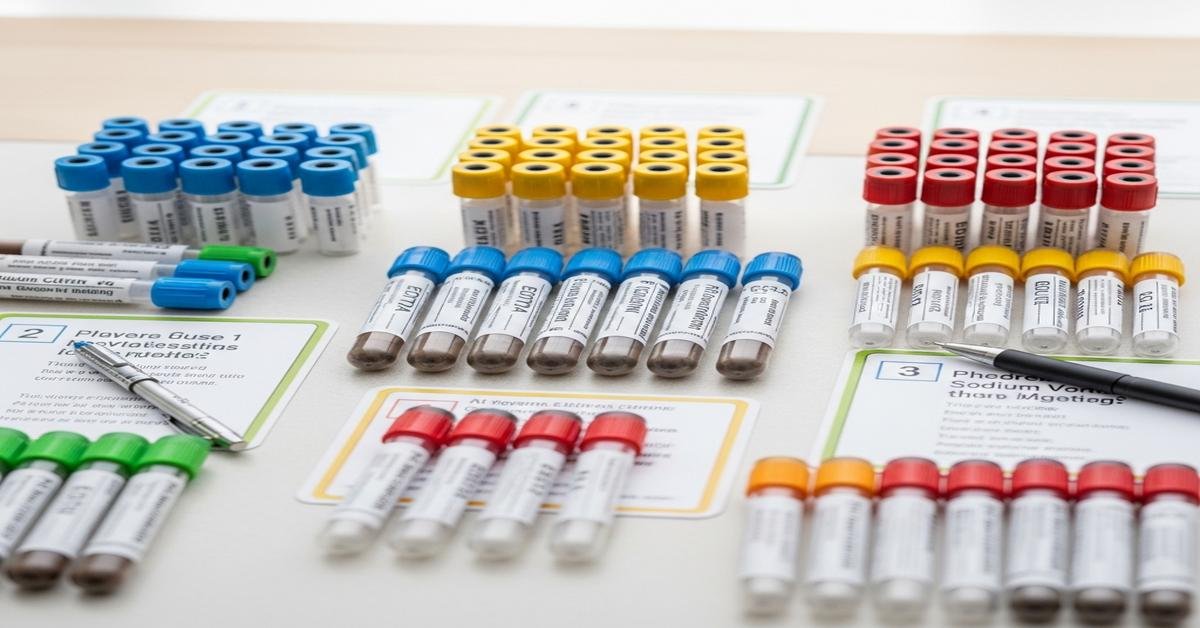
Tube colors and additives are the heart of phlebotomy exams. They decide whether a test is valid, whether a specimen clots, and whether a result is believable. If you can answer these 50 questions quickly—and understand the “why”—you’ll walk into your CPT confident and ready.
Core rules you must know before the exam
- Order of draw matters. It prevents additive carryover that can ruin results (for example, EDTA carrying potassium into a serum tube).
- Fill to the line when required. Especially light blue (sodium citrate). The 9:1 ratio is critical for coagulation tests.
- Invert gently and correctly. No shaking. Citrate 3–4 times; serum tubes with clot activator about 5 times; anticoagulant tubes (heparin, EDTA, gray) 8–10 times. This dissolves additives and prevents microclots.
- Serum vs plasma. Serum tubes clot first, then separate. Plasma tubes have anticoagulants and can be centrifuged immediately for faster results.
- Special handling saves analytes. Examples: ammonia on ice; bilirubin protected from light; lactic acid on ice; cold agglutinin kept warm.
The top 50 questions on tube colors and additives
What is the correct order of draw for venipuncture tubes? Blood culture/SPS → light blue (citrate) → serum (red/gold/orange) → green (heparin) → lavender/pink (EDTA) → gray (fluoride). This avoids additive carryover that alters results.
Why does order of draw matter? Additives carry over on the needle. EDTA can falsely raise potassium and lower calcium if drawn before serum. Drawing in the right order protects accuracy.
What’s in the light blue tube, and what’s the ratio? 3.2% sodium citrate at a 9:1 blood-to-additive ratio. Citrate binds calcium reversibly, which is needed for coagulation testing.
Why must the light blue tube be completely full? Underfilling dilutes plasma with too much citrate, prolonging clot times. Results like PT/INR and aPTT become invalid.
How many inversions for a light blue tube? 3–4 gentle inversions. Enough to mix without frothing. Over-mixing can hemolyze; under-mixing creates clots.
Which tube do you use for PT/INR? Light blue. Coag tests require citrate to preserve clotting factors and allow lab reagents to re-calcify.
Which tube is used for D-dimer? Light blue. D-dimer is a coag test that needs proper citrate ratio to avoid false elevation or suppression.
Do coagulation tubes have gel separators? No. Gel traps factors and interferes with assays. Coag specimens must be plasma with intact factors.
When do you need a discard tube before a light blue draw? When using a winged set and the light blue is first. The discard primes the tubing so the citrate tube fills to the line.
Red glass vs red plastic—what’s the difference? Glass red has no additive and is not inverted. Plastic red has a clot activator (silica) and must be inverted ~5 times for proper clotting.
What’s inside an SST (gold or tiger-top) tube? A clot activator and a gel separator. The gel forms a barrier after centrifugation to keep serum off cells.
When should you avoid SST tubes? For blood bank tests and some drug levels. Gel can adsorb certain drugs and interfere with antibody screens.
What is the orange “RST” tube used for? Rapid serum (thrombin-based). It clots fast for STAT chemistry when time is critical.
What’s in green tubes? Heparin (lithium, sodium, or ammonium). Heparin accelerates antithrombin to prevent thrombin formation and clotting.
When should you avoid lithium heparin? For lithium levels. Use a serum red tube so the additive doesn’t contaminate the test.
When is PST (light green) better than SST (gold)? When you need rapid plasma results (no clot wait), like STAT potassium. PST can be spun immediately.
What’s the primary use for lavender (purple) tubes? Hematology tests like CBC, A1c, reticulocyte count. EDTA preserves cellular morphology.
How does EDTA prevent clotting? It chelates calcium. Without available calcium, the clotting cascade cannot proceed.
How does EDTA contamination show up in results? High potassium (from K2/K3 EDTA) and low calcium. Think “K up, Ca down” when EDTA carryover happens.
What’s the pink-top tube for? Blood bank testing (type and screen, crossmatch). It’s EDTA, but with labeling and specs required by transfusion services.
What’s in the white/pearl PPT? K2EDTA with a plasma gel. Used for molecular/virology (e.g., HIV viral load) to keep leukocyte enzymes away from analytes.
What’s in the gray tube, and why is it used? Sodium fluoride (antiglycolytic) and potassium oxalate (anticoagulant). It preserves glucose and lactate by stopping glycolysis.
How should lactic acid be collected? Often in a gray tube, without fist clenching, placed on ice, and rushed to the lab. Metabolism raises lactate if warm.
How should ethanol levels be collected? In a gray tube; clean with non-alcohol antiseptic. Alcohol swabs can contaminate the sample.
What are yellow SPS tubes for? Blood cultures. SPS preserves bacteria by inhibiting complement and phagocytes so organisms stay viable.
Where do blood culture bottles fit in the order of draw? First. Sterile collections come before any other tubes to avoid contamination.
What’s the difference between yellow SPS and yellow ACD? SPS = cultures. ACD = genetics/HLA and specialized tests. Different additives for different goals.
What’s in black-top ESR tubes? Sodium citrate formulated for Westergren ESR with a specific ratio. Fill exactly to the line for valid sedimentation results.
What are royal blue tubes used for? Trace elements (lead, zinc, copper) and heavy metals. They’re low-trace to prevent contamination; additives vary (no additive, EDTA, or heparin).
Where do royal blue tubes go in the order of draw? It depends on the additive. Serum RB after other serum; heparin RB after greens; EDTA RB after lavender.
What’s a tan-top tube for? Lead testing. It’s EDTA and certified low in lead to avoid contamination.
How should bilirubin be handled? Protect from light (wrap or use amber container). Light breaks down bilirubin, falsely lowering results.
What tube and handling for ammonia? Commonly lavender EDTA on ice to the lab quickly. Cold slows metabolism that would raise ammonia.
What about cold agglutinins and cryoglobulins? Keep warm (around 37°C) from collection to testing. Cold causes them to precipitate and alter results.
How many inversions for common tubes? Citrate 3–4; serum with activator 5; anticoagulants (green, lavender, gray, pink) 8–10. This ensures complete mixing.
What happens if you don’t invert properly? Microclots form. They plug analyzers, wreck CBCs, and invalidate coag tests.
What’s the core difference between serum and plasma tubes? Serum tubes clot and yield serum without clotting factors. Plasma tubes use anticoagulants so factors stay in solution.
What’s the capillary (dermal) order of draw? Blood gases → EDTA microtainer → other additive tubes → serum last. EDTA first prevents clots in hematology tests.
What’s the problem with underfilled EDTA tubes? Too much EDTA relative to blood shrinks cells and lowers hematocrit. It can also cause platelet clumping.
How does hemolysis affect tube-based results? It releases intracellular potassium, LDH, and AST, falsely elevating them. Using the right gauge and gentle handling reduces hemolysis.
What’s a classic example of additive carryover? EDTA into a serum chemistry tube. Potassium spikes and calcium drops; both are misleading.
How can a serum tube affect a subsequent blue-top? Silica clot activator carryover can shorten clotting times. That’s why serum tubes come after citrate.
Why avoid heparin for molecular tests? Heparin can inhibit polymerase enzymes. EDTA or special PPT tubes are preferred for PCR-based assays.
Best tube for a STAT potassium? Light green PST (lithium heparin). It provides plasma fast without clot wait, reducing turnaround time.
Which tube preserves cells best for smears and morphology? Lavender EDTA. Heparin can cause clumping and poor staining.
Which tube for a type and screen? Pink EDTA. It meets blood bank labeling and volume requirements for crossmatch testing.
Which trace-element tube for zinc or copper? Royal blue trace-element (additive depends on test). It prevents contamination that regular tubes can introduce.
How long should an SST clot before centrifuging? About 30 minutes (15–30 with activator). Spinning too soon leaves fibrin strands that clog instruments.
What should you do if a tube is underfilled? Recollect. Never pour from one tube to another—additives and ratios become incorrect.
Which tube is best for many therapeutic drug levels? Red top without gel. Some drugs adsorb to gel, lowering measured levels (example: certain anticonvulsants).
How do you place two different royal blue tubes in one draw? Serum royal blue after other serum; EDTA royal blue after lavender. Position is based on the additive to prevent carryover.
Which yellow additive preserves cells for HLA testing? ACD (acid citrate dextrose). The dextrose fuels cells so they stay viable for typing.
Quick reference: order of draw and tube map
- Order of draw (venipuncture):
Blood culture/SPS → Light blue → Red/Gold/Orange → Green/PST → Lavender/Pink/White → Gray → Others (Tan, Royal Blue) placed by additive. - Serum tubes: Red (glass none; plastic clot activator), Gold/Tiger SST (activator + gel), Orange (thrombin). Use for chemistry and serology; avoid gel for some drugs.
- Plasma tubes: Light blue (citrate), Green/PST (heparin), Lavender/Pink/White (EDTA), Gray (fluoride/oxalate). Faster turnaround because no clotting step.
- Trace elements: Royal blue (check additive). Place in order based on the additive, not the color alone.
Practice mini-scenarios (apply the “why”)
- Scenario 1: You collected lavender before gold. The potassium comes back 6.2 mmol/L in a patient with no symptoms. Why question the result? EDTA carryover can artificially raise potassium; recollect in the correct order.
- Scenario 2: The light blue tube is 80% full. Why reject and recollect? The 9:1 ratio is off; PT/INR and aPTT will be falsely prolonged.
- Scenario 3: STAT potassium ordered. Lab is slammed. Which tube? PST (light green). Plasma can be spun right away; results are faster than serum.
Last-minute recall tips
- Think by additive, not color. Some colors (royal blue, yellow) vary by additive. The additive determines order and test suitability.
- EDTA memory hook: “K up, Ca down.” If you see that pattern, suspect carryover.
- Blue must be true. Light blue must be full and well mixed for any coag test to be valid.
- Serum waits; plasma doesn’t. Serum needs clot time; plasma can usually be spun right away.
- Handle the special ones like medicine. Ice for ammonia and lactate; protect bilirubin from light; keep cold agglutinins warm.
If you remember the order of draw, what each additive does, how many times to invert, and how to handle special tests, you’ll answer these questions quickly on exam day—and even faster on the job.

