Introduction
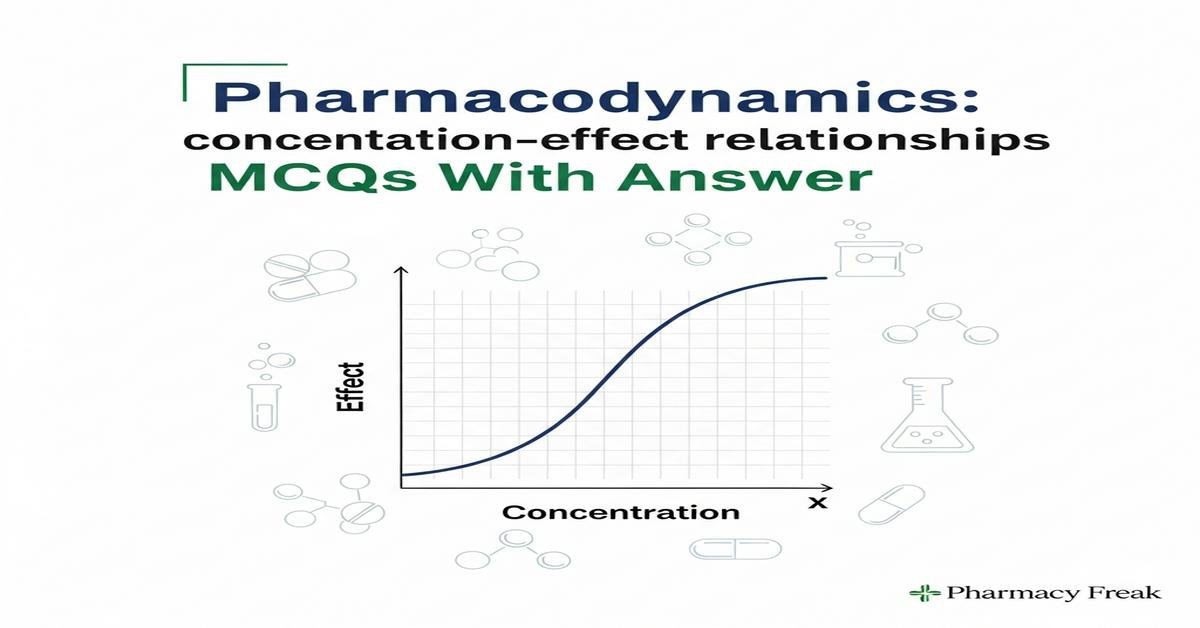
Pharmacodynamics: concentration–effect relationships MCQs With Answer is a focused revision resource designed for M.Pharm students preparing for advanced pharmacology exams. This collection emphasizes quantitative and conceptual aspects of how drug concentration relates to biological effect — including EC50, Emax, potency versus efficacy, receptor occupancy, spare receptors, Hill slope, and types of antagonism. Each question challenges application-level understanding and interpretation of concentration–response curves, operational models, and experimental analysis techniques such as Schild plots and pA2. Answers are provided to aid self-assessment. Use these MCQs for rigorous practice, to identify weak areas, and to deepen your grasp of core pharmacodynamic principles relevant to both research and clinical contexts.
Q1. What does EC50 represent in concentration–effect relationships?
- The concentration that occupies 50% of receptors
- The concentration that produces 50% of the maximal effect
- The concentration at which 50% of subjects respond
- The equilibrium dissociation constant of the receptor
Correct Answer: The concentration that produces 50% of the maximal effect
Q2. Which statement best distinguishes potency from efficacy?
- Potency is the maximal response a drug can produce; efficacy is the concentration required to produce that response
- Potency refers to the dose or concentration required for a given effect; efficacy denotes the maximal effect achievable
- Potency and efficacy are interchangeable terms describing maximal response
- Potency depends only on receptor number while efficacy depends only on affinity
Correct Answer: Potency refers to the dose or concentration required for a given effect; efficacy denotes the maximal effect achievable
Q3. How does a reversible competitive antagonist affect a graded concentration–response curve?
- Reduces the maximal response (Emax) without changing EC50
- Shifts the curve to the right (increases EC50) without reducing Emax
- Shifts the curve to the left and increases Emax
- Produces a nonparallel downward shift that cannot be overcome by more agonist
Correct Answer: Shifts the curve to the right (increases EC50) without reducing Emax
Q4. What is the typical effect of an irreversible (non-surmountable) antagonist on Emax and potency?
- Increases potency and increases Emax
- No change in Emax, rightward shift in potency
- Reduces Emax and cannot be fully overcome by increasing agonist concentration
- Left shift of the curve and increased Emax
Correct Answer: Reduces Emax and cannot be fully overcome by increasing agonist concentration
Q5. What do spare receptors (receptor reserve) imply about EC50 and KD?
- EC50 equals KD because response is proportional to occupancy
- EC50 is greater than KD due to inefficient coupling
- EC50 is less than KD, so maximal response occurs with incomplete receptor occupancy
- KD decreases while EC50 remains unchanged
Correct Answer: EC50 is less than KD, so maximal response occurs with incomplete receptor occupancy
Q6. A Hill coefficient (nH) greater than 1 in a concentration–response curve most likely indicates:
- Negative cooperativity between binding sites
- No cooperativity; simple one-site binding
- Positive cooperativity or multiple interacting binding sites
- That the agonist is an inverse agonist
Correct Answer: Positive cooperativity or multiple interacting binding sites
Q7. Which description best fits a partial agonist?
- Produces the same maximal effect as a full agonist when given at high concentration
- Has higher intrinsic efficacy than full agonists
- Produces lower maximal effect than a full agonist and can antagonize full agonist responses
- Has no efficacy but binds receptors with high affinity
Correct Answer: Produces lower maximal effect than a full agonist and can antagonize full agonist responses
Q8. What is an inverse agonist?
- A ligand that produces the same effect as the endogenous agonist
- A ligand that increases receptor expression on the cell surface
- A ligand that reduces constitutive receptor activity below basal levels
- A ligand that competitively blocks agonist binding without affecting basal activity
Correct Answer: A ligand that reduces constitutive receptor activity below basal levels
Q9. How is pA2 defined in classical pharmacology?
- The negative logarithm of the agonist concentration that produces 50% effect
- The negative logarithm of an antagonist concentration that requires a two-fold increase in agonist concentration to restore the original response
- The ratio of antagonist KD to agonist KD
- The slope of the Schild plot
Correct Answer: The negative logarithm of an antagonist concentration that requires a two-fold increase in agonist concentration to restore the original response
Q10. A Schild plot with a slope of approximately 1 is most consistent with which mechanism?
- Noncompetitive irreversible antagonism
- Allosteric modulation with negative cooperativity
- Simple reversible competitive antagonism at a single receptor population
- Agonist desensitization over time
Correct Answer: Simple reversible competitive antagonism at a single receptor population
Q11. In quantal dose–response curves, ED50 refers to:
- The dose producing effect in 50% of subjects
- The dose producing 50% of the maximal response in an individual
- The dose that kills 50% of cells in vitro
- The concentration producing half-maximum receptor occupancy
Correct Answer: The dose producing effect in 50% of subjects
Q12. The therapeutic index is commonly defined as which ratio?
- ED50/LD50
- LD50/ED50
- TD50/ED99
- EC50/KD
Correct Answer: LD50/ED50
Q13. In the Black and Leff operational model of agonism, the parameter tau (τ) reflects:
- The drug’s equilibrium dissociation constant (affinity)
- The intrinsic efficacy or transduction efficacy of the agonist-receptor system
- The Hill coefficient for cooperativity
- The in vivo clearance of the drug
Correct Answer: The intrinsic efficacy or transduction efficacy of the agonist-receptor system
Q14. Under a simple receptor-occupancy model with no spare receptors, how do EC50 and KD relate?
- EC50 is much lower than KD
- EC50 is equal to KD
- EC50 is greater than KD
- EC50 is unrelated to KD
Correct Answer: EC50 is equal to KD
Q15. A positive allosteric modulator (PAM) of an agonist typically:
- Decreases agonist potency and reduces maximal response
- Enhances agonist potency (leftward shift) and may increase efficacy depending on mechanism
- Acts as a competitive antagonist at the orthosteric site
- Has identical effects to an inverse agonist
Correct Answer: Enhances agonist potency (leftward shift) and may increase efficacy depending on mechanism
Q16. A Schild regression slope significantly different from 1 suggests which of the following?
- Simple reversible competitive antagonism at a single receptor type
- Non-competitive antagonism, allosteric interactions, or multiple receptor populations
- An agonist with very high intrinsic efficacy
- An experimental error that always invalidates the dataset
Correct Answer: Non-competitive antagonism, allosteric interactions, or multiple receptor populations
Q17. Which feature distinguishes an irreversible (covalent) antagonist from a reversible competitive antagonist?
- Irreversible antagonist binding can be overcome by high concentrations of agonist
- Irreversible antagonist typically reduces Bmax and lowers Emax, and its effect is not reversed by excess agonist
- Irreversible antagonists increase the slope of the concentration–response curve without changing Emax
- Irreversible antagonists only affect quantal responses, not graded responses
Correct Answer: Irreversible antagonist typically reduces Bmax and lowers Emax, and its effect is not reversed by excess agonist
Q18. The margin of safety is most accurately defined as which ratio?
- LD50/ED50
- TD50/ED50
- LD1/ED99
- ED99/LD1
Correct Answer: LD1/ED99
Q19. How does a partial agonist behave when co-administered with a full agonist at the same receptor?
- It increases the maximal response beyond that of the full agonist
- It has no effect on the response to the full agonist
- It competes with the full agonist and can reduce the overall response, acting functionally as an antagonist
- It permanently inactivates the receptor making the full agonist ineffective
Correct Answer: It competes with the full agonist and can reduce the overall response, acting functionally as an antagonist
Q20. Which parameter is best described as intrinsic activity in pharmacodynamics?
- The concentration at which a drug binds 50% of receptors
- The ratio of therapeutic to toxic dose
- The maximal effect a drug can produce relative to a standard full agonist
- The rate of drug metabolism in the liver
Correct Answer: The maximal effect a drug can produce relative to a standard full agonist

