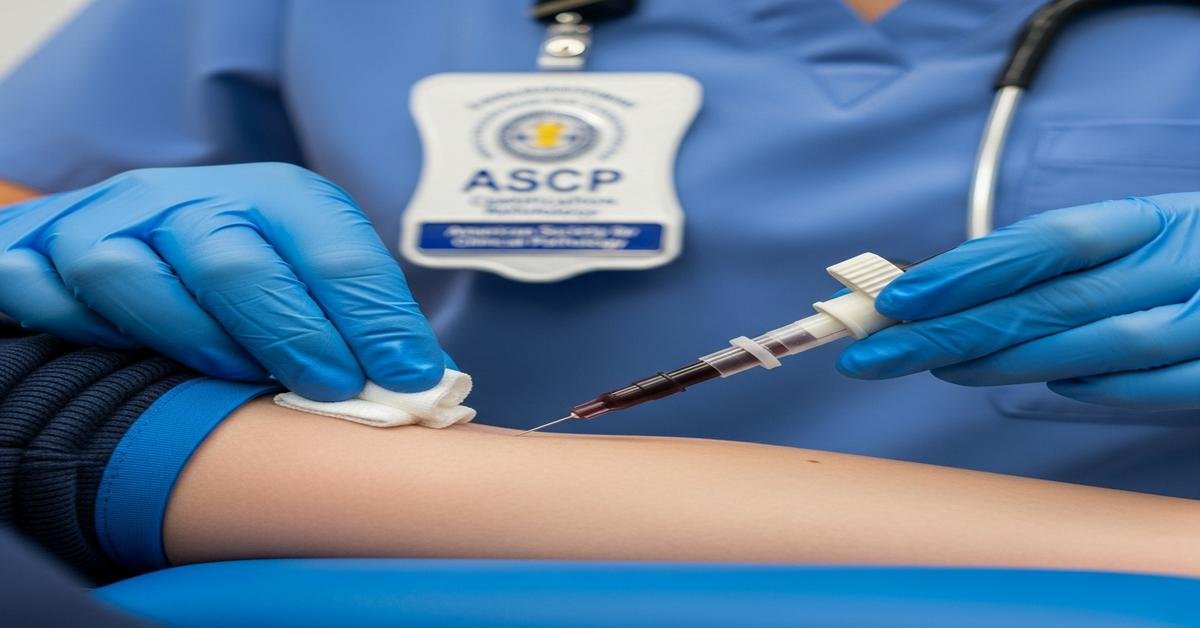
Phlebotomy is more than finding a vein. Done well, it protects patients, preserves specimen quality, and keeps the lab’s results trustworthy. The PBT (ASCP) credential—Phlebotomy Technician from the American Society for Clinical Pathology Board of Certification—is widely seen as the top certification for phlebotomists working in hospitals and clinical labs. This guide explains what PBT (ASCP) really is, why it matters, and exactly how to pass the exam on your first try.
What PBT (ASCP) Really Is — And What It Isn’t
PBT (ASCP) is a professional certification, not a state license. Certification proves you met national standards set by ASCP’s Board of Certification. Licensing is legal permission to practice from a state. A few states (for example, California and Washington) regulate phlebotomy separately. That is why you may need both: a certification to satisfy employers and, in some states, a license to meet the law. The distinction matters because employers often use ASCP certification as a hiring filter, while states enforce licensure.
People call PBT (ASCP) “elite” for a reason. Why? ASCP sets higher entry standards and aligns its content with hospital practice and quality systems. That makes the exam more rigorous and the credential more portable across states and large healthcare systems.
Why Employers Value PBT (ASCP)
- Quality and safety. The exam focuses on preanalytical error prevention. Fewer errors mean fewer redraws and better patient care.
- Standardization. ASCP’s content matches CAP/CLIA expectations. Labs trust it when auditing training files.
- Portability. Multi-state systems recognize ASCP. This helps you move or change employers without re-proving competence.
- Professional pathway. ASCP sits under the same BOC that certifies MLT/MLS. It signals you’re aligned with the lab’s culture of quality.
Eligibility Routes: Which One Fits You?
ASCP offers multiple ways to qualify. The goal is to confirm you have the skills to draw safely and process correctly.
- Route 1: NAACLS-accredited program completed in the past five years. This verifies vetted classroom and clinical training.
- Route 2: Formal phlebotomy program (not necessarily NAACLS) with classroom instruction, hands-on clinical time, and documented at least 100 successful unaided blood collections. ASCP asks for recent, verifiable training to ensure your skills are current.
- Route 3: Work experience—typically one year full-time as a phlebotomy tech in an acceptable clinical setting within the last five years, including 100 successful unaided collections. Experience shows you can perform under real-world constraints.
- Other allied health routes may apply (for example, certain nursing or lab assistant tracks with documented phlebotomy competency). These exist because many clinicians learn phlebotomy as part of broader training.
Tip: Keep clean documentation. Logs with dates, site types (venipuncture vs skin puncture), and signatures speed approval because they prove competence, not just time served.
Exam Format and Scoring
- Format: Computer-based, multiple-choice.
- Length: About 80 questions in roughly 2 hours. This length balances breadth of content with fatigue.
- Scoring: Scaled score with 400 as the passing standard. Scaling adjusts for question difficulty across test forms, so the standard is fair over time.
- Question style: Straight fact, best action/next step, safety-first scenarios, and quality control interpretation. These mirror real decisions at the bedside and bench.
What the Exam Covers (Blueprint You Can Study)
The blueprint emphasizes the preanalytical phase, because most lab errors start there. Focus your study where errors are preventable.
- Circulatory system and specimen collection (largest share).
- Anatomy of veins (median cubital vs cephalic vs basilic) and why site choice matters. Example: basilic sits near the brachial artery and median nerve—higher risk.
- Patient ID, consent, order verification, and special precautions (isolation, latex allergy).
- Venipuncture technique: angle, anchoring, bevel up, tourniquet time (< 1 minute), and two-attempt rule—because repeated attempts raise risk of hematoma and nerve injury.
- Capillary puncture: correct site, depth, and capillary order of draw (blood gases, EDTA, other additives, serum). EDTA first prevents clotting in small-volume samples.
- Specimen handling, transport, processing.
- Labeling at bedside. Mislabeling is a top cause of wrong-patient errors.
- Inversions by additive: sodium citrate (light blue) needs full draw for 9:1 ratio; EDTA mixes prevent clots; serum tubes must clot before spin. Ratios protect test accuracy.
- Temperature and light: bilirubin shields from light; ammonia on ice; cold agglutinins kept warm. These preserve analyte stability.
- Rejection criteria: hemolysis, wrong tube, underfilled light-blue, clotted EDTA. Rejections prevent invalid results reaching clinicians.
- Waived and point-of-care testing.
- Quality control (QC) frequency, lot-to-lot checks, and troubleshooting out-of-range results. QC protects patient results from device drift.
- Documentation, operator competency, and proficiency testing. Paper trails prove reliability.
- Non-blood specimens.
- Urine types: random, first morning, clean-catch midstream, 24-hour. Proper timing reflects analyte variation.
- Stool for occult blood (diet and drug restrictions), sputum vs saliva, throat or wound swabs. Correct collection prevents false results.
- Chain-of-custody for drug screens. Legal integrity depends on documented control.
- Laboratory operations and safety.
- Standard, contact, droplet, airborne precautions; PPE sequence; sharps disposal. Barriers prevent exposure.
- Exposure response (wash, report, evaluate). Fast action reduces transmission risk.
- HIPAA, documentation, professionalism, customer service with difficult draws. Trust and clarity reduce complaints and redraws.
How to Build a 6-Week Study Plan
This plan fits most candidates with recent training. Adjust pace if you need more review.
- Week 1: Blueprint overview; circulatory anatomy; patient ID; consent; safety. Make flashcards for veins, nerves, and contraindicated sites.
- Week 2: Venipuncture technique; additives; order of draw; tube inversions; special collections (blood cultures). Drill why the order of draw prevents additive carryover.
- Week 3: Capillary puncture; pediatric and geriatric nuances; bleeding disorders; two-attempt rule; difficult veins. Practice scenario questions.
- Week 4: Specimen handling and processing: clotting/centrifugation times, temperature/light, rejection criteria. Build a “stability chart” from your notes.
- Week 5: Non-blood specimens; POC testing; QC; documentation. Practice reading QC logs and deciding next actions.
- Week 6: Mixed practice exams; error logs; targeted review. Simulate timing: 80 questions in 100 minutes. Refine test-taking strategy.
Daily habits: 30–45 minutes of focused review, 15 minutes of flashcards, 10–15 practice questions. Short, consistent sessions beat weekend cramming because spaced repetition cements recall.
High-Yield Topics You Must Master
- Order of draw (venipuncture): Blood cultures → light blue (sodium citrate) → serum (red/gold) → heparin (green) → EDTA (lavender/pink) → glycolytic inhibitor (gray). This order minimizes additive cross-contamination.
- Light-blue tubes must be full. Coag tests require a 9:1 blood-to-citrate ratio. Underfilling dilutes plasma and prolongs clot times falsely.
- Capillary order of draw: Blood gases → EDTA → other additives → serum. Small volumes clot quickly; EDTA first secures hematology counts.
- Site selection and contraindications: Avoid the side of a mastectomy, sites with edema, hematoma, dialysis fistulas, and above an active IV. These sites distort results or risk harm.
- Tourniquet time ≤ 1 minute. Longer stasis concentrates analytes (hemoconcentration) and skews results.
- Specimen integrity: Protect bilirubin from light; put ammonia and lactic acid on ice; keep cold agglutinins warm. Stability safeguards accuracy.
- IDs and labeling: Two identifiers at bedside and label immediately. This is the strongest defense against wrong-patient events.
- Safety first questions: Needle-stick? Wash, report, evaluate promptly. The correct answer prioritizes exposure protocol before anything else.
Test-Taking Tactics That Work on PBT
- Read the verb. “First action,” “best next step,” and “most important” can point to different choices. Safety tends to come first.
- Use elimination. Cross off answers that violate policy (e.g., relabeling in the hallway) or physiology (e.g., squeezing the heel deep midline).
- Match the tube to the test. Coags → light blue; CBC → EDTA; glucose tolerance → gray. Wrong tube is almost always wrong answer.
- Time management. Aim for ~75 seconds per item on your first pass. Mark tough ones. Return with fresh eyes.
- Think preanalytical. If a result seems odd, look for collection/handling errors in the scenario. The exam rewards root-cause thinking.
Application, Fees, Scheduling, and Retakes
- Apply online. You’ll submit transcripts, training verification, and experience logs. ASCP checks recency and authenticity because competence decays without practice.
- Fees. Expect around approximately $135 in the U.S. Fees change, so verify current rates when you apply.
- Scheduling. After approval, you’ll receive an authorization to test and select a test center and date. Choose a morning slot if you focus best early.
- What to bring. Two IDs with signature, confirmation email. Lockers are provided; no notes or electronics inside the room.
- Retakes. If you do not pass, there is typically a 45-day wait before you can retest. Each attempt requires a new application and fee. The wait encourages additional study so you learn from the first attempt.
After You Pass: Verification, Badges, and Keeping It Current
- Verification. Employers can confirm your credential through ASCP’s online registry. This protects against resume fraud and speeds onboarding.
- Credential maintenance (CMP). ASCP requires ongoing continuing education to keep skills current. For PBT, plan on earning CE points over a 3-year cycle (for example, 9 CMP points with specific content like at least 1 in patient safety). CE keeps practice aligned with changing technology and guidelines.
- How to earn CE easily:
- Short online modules on patient ID, safety, or specimen handling.
- In-service trainings and competency fairs at your hospital.
- Workshops on POC testing, quality systems, or customer service.
- State licensure. If your state requires it, submit your ASCP proof as part of the process. Certification often satisfies the competency piece of licensure.
PBT (ASCP) vs Other Phlebotomy Certifications
There are several reputable credentials—NHA’s CPT, NCCT’s NCPT, AMT’s RPT, and others. Here is how PBT (ASCP) differs and when each may fit:
- Rigor and recognition. ASCP is widely recognized by hospital labs and systems because its body of knowledge aligns with lab accreditation standards. Outpatient clinics and physician offices often accept multiple certifications; large hospitals more often prefer ASCP.
- Prerequisites. ASCP typically expects formal training or substantial experience with documented unaided collections. Some other boards allow earlier testing during training. ASCP’s bar is higher to ensure readiness.
- Career mobility. If you may advance into MLT/MLS or move across states, ASCP offers a clear pathway under one board, which reduces friction.
Bottom line: If your target is a hospital or large system, choose PBT (ASCP). If you are entering a small clinic quickly, other certifications can get you started, and you can upgrade to ASCP later.
Real-World Scenarios You Should Be Ready For
- Underfilled light-blue tube. The lab calls: “Specimen rejected for citrate underfill.” Why? The 9:1 ratio is off, falsely elevating clot times. Best next step: redraw and ensure a full tube after discarding a waste tube if drawn from a line.
- Drawing above an IV. Physician orders a potassium. The only accessible arm has a running IV. Best action: draw from the other arm. If unavoidable, stop the IV for a few minutes, apply a tourniquet below the IV, discard an appropriate volume, then collect—because IV fluid dilutes analytes.
- Neonate heel stick. Where to puncture and how deep? Lateral or medial plantar surface, depth ≤ 2.0 mm. Midline risks hitting bone and nerves; deeper sticks increase osteomyelitis risk.
- Patient refuses. You have a stat order, but the patient refuses. Best action: stop, educate briefly, respect the refusal, and notify the nurse/ordering provider. Consent governs all procedures.
Final Prep Checklist
- Know cold: Order of draw (venous and capillary), tube additives, inversion counts, tourniquet time, light/temperature requirements.
- Can explain: Two identifiers, bedside labeling, two-attempt rule, site contraindications, hemolysis causes, rejection criteria.
- Can do: Choose correct tube for each test, troubleshoot POC QC failures, select correct urine collection type, document chain-of-custody.
- Policy mindset: When in doubt, choose safety, identity verification, and documentation. Those principles rarely steer you wrong.
- Day-of plan: Sleep, light meal, arrive 30 minutes early, manage time, mark and return to hard questions.
If you treat phlebotomy as a craft—where each step protects the patient and the result—the PBT (ASCP) exam becomes predictable. It rewards clean technique, smart handling, and good judgment under policy. Prepare with intention, practice to reduce errors, and sit for the test knowing you can deliver hospital-grade quality from tourniquet to transport.

I am a Registered Pharmacist under the Pharmacy Act, 1948, and the founder of PharmacyFreak.com. I hold a Bachelor of Pharmacy degree from Rungta College of Pharmaceutical Science and Research. With a strong academic foundation and practical knowledge, I am committed to providing accurate, easy-to-understand content to support pharmacy students and professionals. My aim is to make complex pharmaceutical concepts accessible and useful for real-world application.
Mail- Sachin@pharmacyfreak.com