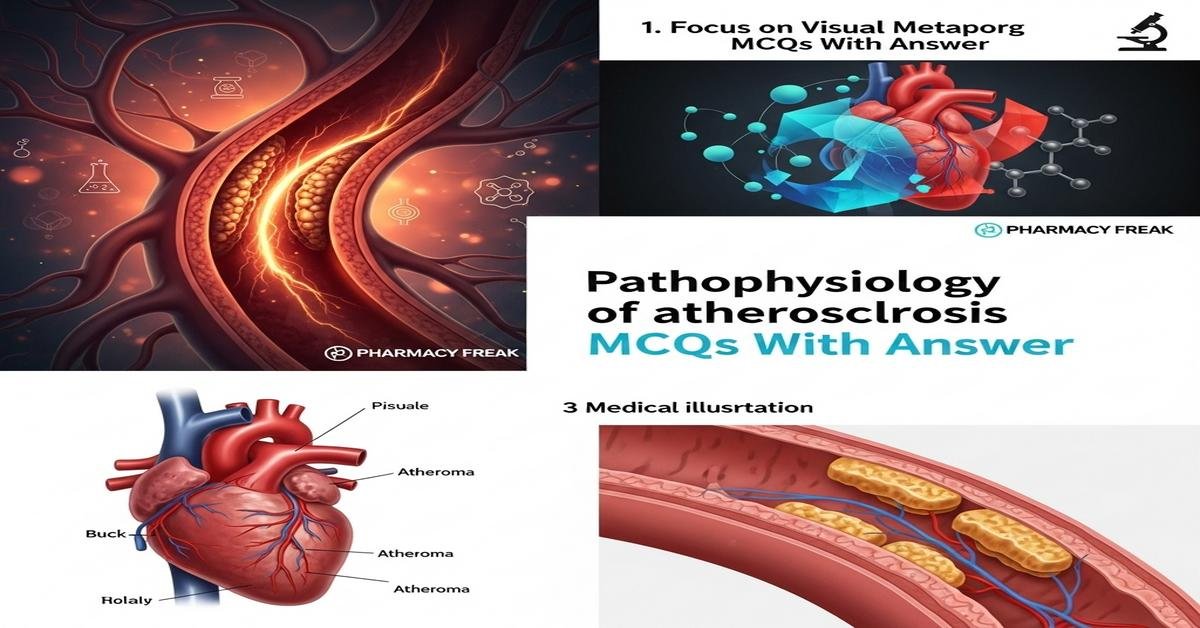
The pathophysiology of atherosclerosis is central to understanding cardiovascular disease for B. Pharm students. This concise overview links endothelial dysfunction, lipid oxidation, foam cell formation, chronic inflammation, smooth muscle migration, and plaque destabilization to clinical outcomes. Key concepts include low-density lipoprotein (LDL) retention and oxidation, macrophage scavenger receptors, cytokine-driven matrix degradation, and the role of high-density lipoprotein (HDL) in reverse cholesterol transport. Grasping molecular mediators like VCAM-1, MMPs, and NLRP3 inflammasome enhances therapeutic reasoning for statins, PCSK9 inhibitors, and anti-inflammatory strategies. Now let’s test your knowledge with 50 MCQs on this topic.
Q1. Which early event is most critical in the initiation of atherosclerotic plaque formation?
- Vascular smooth muscle cell calcification
- Endothelial dysfunction
- Thrombus organization
- Fibrous cap rupture
Correct Answer: Endothelial dysfunction
Q2. Oxidized LDL (oxLDL) contributes to atherogenesis primarily by:
- Enhancing HDL-mediated cholesterol efflux
- Stimulating foam cell formation via scavenger receptors
- Inhibiting endothelial adhesion molecule expression
- Decreasing inflammatory cytokine release
Correct Answer: Stimulating foam cell formation via scavenger receptors
Q3. Which macrophage receptor is most associated with uptake of modified LDL leading to foam cell formation?
- LDL receptor (LDLR)
- Scavenger receptor class A (SR-A)
- Insulin receptor
- Transferrin receptor
Correct Answer: Scavenger receptor class A (SR-A)
Q4. The fatty streak in early atherosclerosis is primarily composed of:
- Lymphocytes and calcified matrix
- Smooth muscle cells and collagen
- Foam cells and lipid-laden macrophages
- Platelet-rich thrombus
Correct Answer: Foam cells and lipid-laden macrophages
Q5. Which adhesion molecule is upregulated on activated endothelium and promotes monocyte recruitment?
- Albumin
- VCAM-1
- Hemoglobin
- Fibrillin
Correct Answer: VCAM-1
Q6. Matrix metalloproteinases (MMPs) promote plaque vulnerability by:
- Enhancing collagen synthesis in fibrous cap
- Degrading extracellular matrix proteins in the fibrous cap
- Preventing smooth muscle cell migration
- Increasing HDL production
Correct Answer: Degrading extracellular matrix proteins in the fibrous cap
Q7. Which cytokine is a key pro-inflammatory mediator in atherosclerotic plaques?
- Interleukin-10 (IL-10)
- Tumor necrosis factor-alpha (TNF-α)
- Transforming growth factor-beta (TGF-β)
- Interferon-beta (IFN-β)
Correct Answer: Tumor necrosis factor-alpha (TNF-α)
Q8. High-density lipoprotein (HDL) is protective because it:
- Enhances LDL oxidation
- Promotes reverse cholesterol transport from macrophages
- Stimulates foam cell formation
- Increases endothelial adhesion molecule expression
Correct Answer: Promotes reverse cholesterol transport from macrophages
Q9. Which enzyme is rate-limiting for cholesterol synthesis and target of statin therapy?
- HMG-CoA reductase
- Acetyl-CoA carboxylase
- Lipoprotein lipase
- Cholesterol ester transfer protein (CETP)
Correct Answer: HMG-CoA reductase
Q10. Which lipoprotein is most atherogenic due to its propensity to infiltrate the arterial intima?
- High-density lipoprotein (HDL)
- Very-low-density lipoprotein (VLDL)
- Low-density lipoprotein (LDL)
- Chylomicrons
Correct Answer: Low-density lipoprotein (LDL)
Q11. Endothelial nitric oxide (NO) protects against atherosclerosis by:
- Promoting platelet aggregation
- Causing vasoconstriction
- Inhibiting leukocyte adhesion and smooth muscle proliferation
- Increasing LDL oxidation
Correct Answer: Inhibiting leukocyte adhesion and smooth muscle proliferation
Q12. Which cell type synthesizes extracellular matrix components and contributes to fibrous cap formation?
- Neutrophils
- Vascular smooth muscle cells (VSMCs)
- Red blood cells
- Endothelial progenitor cells
Correct Answer: Vascular smooth muscle cells (VSMCs)
Q13. Plaque rupture commonly leads to which immediate pathological event?
- Resolution of inflammation
- Thrombus formation and acute vessel occlusion
- Increased HDL levels
- Enhanced collagen deposition
Correct Answer: Thrombus formation and acute vessel occlusion
Q14. Which laboratory marker is most commonly used as a systemic marker of vascular inflammation associated with atherosclerosis?
- Creatine kinase-MB
- C-reactive protein (CRP)
- Albumin
- Hemoglobin A1c
Correct Answer: C-reactive protein (CRP)
Q15. Foam cell apoptosis and defective efferocytosis contribute to:
- Fibrous cap thickening
- Necrotic core formation
- Increased HDL-mediated cholesterol efflux
- Decreased plaque lipid content
Correct Answer: Necrotic core formation
Q16. Which of the following best describes the role of reactive oxygen species (ROS) in atherosclerosis?
- ROS reduce LDL oxidation and are anti-atherogenic
- ROS mediate LDL oxidation and endothelial dysfunction
- ROS synthesize nitric oxide in endothelial cells
- ROS exclusively originate from dietary sources
Correct Answer: ROS mediate LDL oxidation and endothelial dysfunction
Q17. The NLRP3 inflammasome in macrophages promotes atherogenesis by activating which cytokine?
- Interleukin-1β (IL-1β)
- Interleukin-4 (IL-4)
- Interleukin-2 (IL-2)
- Interleukin-10 (IL-10)
Correct Answer: Interleukin-1β (IL-1β)
Q18. Which genetic animal model is widely used to study atherosclerosis due to hypercholesterolemia?
- Nude mice
- ApoE knockout mice
- SCID mice
- Transgenic pigs overexpressing HDL
Correct Answer: ApoE knockout mice
Q19. Which process explains smooth muscle cell migration into the intima during plaque development?
- Transdifferentiation from endothelial cells via endothelial-to-mesenchymal transition (EndMT)
- Chemokine- and growth factor-driven migration from media to intima
- Direct differentiation from circulating platelets
- Apoptosis of adventitial fibroblasts
Correct Answer: Chemokine- and growth factor-driven migration from media to intima
Q20. Lipoprotein(a) contributes to atherosclerosis risk primarily because it:
- Enhances HDL function
- Competes with LDL for receptor-mediated uptake
- Contains apolipoprotein(a) that promotes thrombosis and inflammation
- Directly degrades collagen in the fibrous cap
Correct Answer: Contains apolipoprotein(a) that promotes thrombosis and inflammation
Q21. Which imaging modality is most useful for identifying calcified atherosclerotic plaques in coronary arteries?
- Electrocardiography (ECG)
- Coronary artery calcium scoring by CT
- Carotid Doppler ultrasound
- Plain chest X-ray
Correct Answer: Coronary artery calcium scoring by CT
Q22. Which therapeutic strategy directly reduces LDL particle number by targeting PCSK9?
- Statins
- PCSK9 monoclonal antibodies
- Fibrates
- Niacin
Correct Answer: PCSK9 monoclonal antibodies
Q23. Ezetimibe reduces atherosclerotic risk primarily by:
- Inhibiting intestinal cholesterol absorption
- Increasing HMG-CoA reductase activity
- Blocking HDL uptake in the liver
- Stimulating LDL receptor degradation
Correct Answer: Inhibiting intestinal cholesterol absorption
Q24. Intraplaque hemorrhage contributes to plaque progression by:
- Reducing lipid core size
- Introducing erythrocyte membranes and extra cholesterol into the plaque
- Stabilizing the fibrous cap
- Decreasing macrophage recruitment
Correct Answer: Introducing erythrocyte membranes and extra cholesterol into the plaque
Q25. Which histological stain is commonly used to identify lipids in frozen tissue sections of atherosclerotic lesions?
- Hematoxylin and eosin (H&E)
- Oil Red O
- Masson’s trichrome
- Silver stain
Correct Answer: Oil Red O
Q26. Chronic hyperglycemia in diabetes accelerates atherosclerosis mainly through:
- Enhanced HDL production
- Glycation of proteins, increased oxidative stress, and endothelial dysfunction
- Decreasing LDL oxidation
- Reducing inflammatory cytokines
Correct Answer: Glycation of proteins, increased oxidative stress, and endothelial dysfunction
Q27. Which cellular event is most responsible for forming the necrotic core of advanced plaques?
- Proliferation of endothelial cells
- Accumulation of apoptotic/necrotic foam cells and extracellular lipid
- Increased collagen deposition
- HDL-mediated cholesterol efflux
Correct Answer: Accumulation of apoptotic/necrotic foam cells and extracellular lipid
Q28. Shear stress patterns that predispose to atherosclerosis are typically:
- High laminar shear stress
- Low and oscillatory shear stress
- Uniform shear stress
- Absent shear stress only in veins
Correct Answer: Low and oscillatory shear stress
Q29. Which of the following best explains how statins exert anti-inflammatory effects beyond lipid lowering?
- By increasing LDL oxidation
- By inhibiting isoprenoid synthesis affecting immune cell signaling
- By directly binding to VCAM-1
- By blocking MMP gene transcription through direct DNA binding
Correct Answer: By inhibiting isoprenoid synthesis affecting immune cell signaling
Q30. Which component of the plaque is most directly associated with risk of acute thrombosis when disrupted?
- Calcified nodule
- Fibrous cap exposing thrombogenic necrotic core
- Intact endothelium
- Adventitial adipose tissue
Correct Answer: Fibrous cap exposing thrombogenic necrotic core
Q31. Which growth factor is important for VSMC proliferation and migration in plaques?
- Erythropoietin (EPO)
- Platelet-derived growth factor (PDGF)
- Insulin-like growth factor binding protein (IGFBP)
- Vascular endothelial growth inhibitor (VEGI)
Correct Answer: Platelet-derived growth factor (PDGF)
Q32. What is the primary role of cholesterol ester transfer protein (CETP) in lipoprotein metabolism relevant to atherosclerosis?
- Transferring cholesteryl esters from HDL to LDL/VLDL in exchange for triglycerides
- Hydrolyzing triglycerides in chylomicrons
- Synthesizing apolipoprotein A-I
- Transporting free fatty acids into mitochondria
Correct Answer: Transferring cholesteryl esters from HDL to LDL/VLDL in exchange for triglycerides
Q33. Which of the following is a common consequence of advanced atherosclerotic narrowing in coronary arteries?
- Pulmonary embolism
- Myocardial ischemia and infarction
- Nephrotic syndrome
- Portal hypertension
Correct Answer: Myocardial ischemia and infarction
Q34. Which cell type within a plaque releases tissue factor that promotes coagulation after plaque disruption?
- Endothelial cells exclusively
- Macrophages and smooth muscle cells
- Red blood cells
- Lymphocytes exclusively
Correct Answer: Macrophages and smooth muscle cells
Q35. Which pharmacologic class primarily lowers triglycerides and may influence atherosclerotic risk?
- Statins
- Fibrates
- Beta-blockers
- ACE inhibitors
Correct Answer: Fibrates
Q36. Which experimental finding supports the role of inflammation in atherosclerosis?
- Anti-inflammatory therapy with IL-1β inhibitors reduced cardiovascular events in trials
- Complete absence of macrophages in plaques
- Decreased cytokine levels in symptomatic patients
- Removal of HDL increases plaque stability
Correct Answer: Anti-inflammatory therapy with IL-1β inhibitors reduced cardiovascular events in trials
Q37. The process of calcification in atherosclerotic plaques is most similar to which biological process?
- Bone formation (ossification)
- Hematopoiesis
- Neurogenesis
- Apoptosis of erythrocytes
Correct Answer: Bone formation (ossification)
Q38. Which lipid parameter is most directly reduced by PCSK9 inhibitors?
- HDL cholesterol
- Triglycerides
- LDL cholesterol
- Lipoprotein(a)
Correct Answer: LDL cholesterol
Q39. Which process describes reverse cholesterol transport?
- Transfer of cholesterol from HDL to peripheral tissues
- Removal of cholesterol from peripheral macrophages to the liver via HDL
- Synthesis of cholesterol in the liver for VLDL secretion
- Hepatic uptake of triglyceride-rich lipoproteins
Correct Answer: Removal of cholesterol from peripheral macrophages to the liver via HDL
Q40. Which platelet-derived factor contributes to vascular smooth muscle migration and proliferation?
- Interleukin-1 receptor antagonist (IL-1Ra)
- Platelet-derived growth factor (PDGF)
- Adiponectin
- Fibrinogen degradation product D
Correct Answer: Platelet-derived growth factor (PDGF)
Q41. Which of the following best describes vulnerable plaque characteristics?
- Thick fibrous cap, small lipid core, few macrophages
- Thin fibrous cap, large lipid-rich necrotic core, abundant inflammatory cells
- Absent necrotic core and heavy calcification only
- Predominantly collagen-rich, non-inflammatory tissue
Correct Answer: Thin fibrous cap, large lipid-rich necrotic core, abundant inflammatory cells
Q42. What is the role of smooth muscle cell-derived collagen in plaque stability?
- Collagen weakens the fibrous cap and promotes rupture
- Collagen strengthens the fibrous cap and enhances stability
- Collagen stimulates LDL oxidation
- Collagen promotes intraplaque hemorrhage
Correct Answer: Collagen strengthens the fibrous cap and enhances stability
Q43. Which intracellular lipid transporter in macrophages facilitates cholesterol efflux to apoA-I/HDL?
- ABCA1 (ATP-binding cassette transporter A1)
- SR-A
- CD36
- NPC1L1
Correct Answer: ABCA1 (ATP-binding cassette transporter A1)
Q44. In patients with atherosclerosis, plaque neovascularization typically originates from:
- Vasa vasorum sprouting into the intima
- Direct transformation of smooth muscle cells into endothelial cells
- Migration of red blood cells into the lumen
- Bone marrow-derived osteoblasts
Correct Answer: Vasa vasorum sprouting into the intima
Q45. Which lifestyle factor most strongly accelerates endothelial dysfunction and atherosclerosis?
- Regular physical activity
- Cigarette smoking
- Moderate alcohol consumption
- High dietary fiber intake
Correct Answer: Cigarette smoking
Q46. The clinical benefit of lowering LDL cholesterol is primarily due to:
- Reduction in triglyceride synthesis
- Less LDL infiltration and reduced plaque lipid accumulation
- Increase in plaque neovascularization
- Promotion of smooth muscle cell apoptosis
Correct Answer: Less LDL infiltration and reduced plaque lipid accumulation
Q47. Which experimental biomarker is directly linked to plaque macrophage activation and may predict events?
- Myoglobin
- Soluble CD163 or imaging of macrophage activity with PET tracers
- Serum albumin levels
- Urinary sodium
Correct Answer: Soluble CD163 or imaging of macrophage activity with PET tracers
Q48. Which molecular change is most associated with increased endothelial permeability to lipoproteins?
- Upregulation of tight junction proteins like claudin-5
- Disruption of endothelial junctions and increased transcytosis
- Increased endothelial glycocalyx thickness
- Downregulation of caveolae-mediated transport
Correct Answer: Disruption of endothelial junctions and increased transcytosis
Q49. Which therapeutic approach targets inflammation directly in atherosclerosis management?
- PCSK9 inhibitors
- IL-1β neutralizing antibodies (e.g., canakinumab)
- HMG-CoA reductase activators
- Niacin supplements only
Correct Answer: IL-1β neutralizing antibodies (e.g., canakinumab)
Q50. Which statement best summarizes the multifactorial pathophysiology of atherosclerosis?
- Atherosclerosis is solely a lipid storage disease without inflammation
- Atherosclerosis is a dynamic interplay of lipids, endothelial dysfunction, inflammation, immune cells, and vascular remodeling
- Atherosclerosis results only from genetic factors and cannot be modified
- Atherosclerosis is entirely reversible without pharmacologic intervention
Correct Answer: Atherosclerosis is a dynamic interplay of lipids, endothelial dysfunction, inflammation, immune cells, and vascular remodeling

