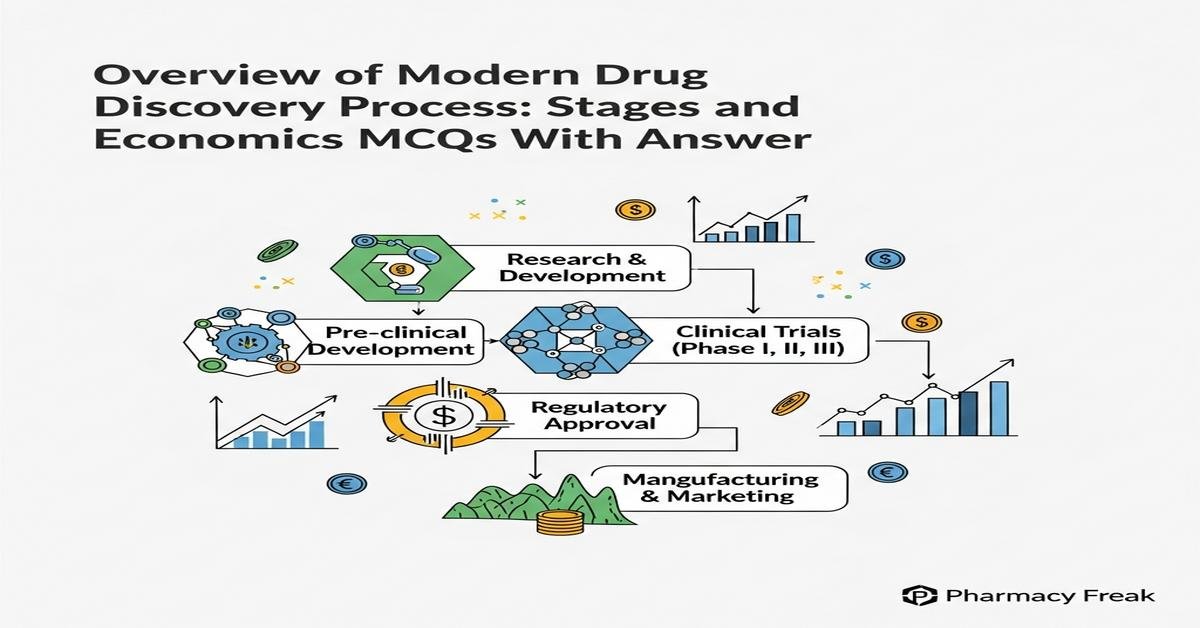
Overview of modern drug discovery process: stages and economics MCQs With Answer
Introduction: This quiz set reviews the contemporary drug discovery and development pathway, emphasizing key stages — from target identification and hit discovery through lead optimization, preclinical studies, clinical phases, regulatory review, and post-marketing activities. It also covers the economic drivers behind R&D decisions, including cost structure, attrition, timelines, and valuation methods such as risk-adjusted NPV. Designed for M.Pharm students, the questions probe mechanistic, practical and financial aspects to strengthen understanding of how scientific strategy and economic constraints shape decisions, risk mitigation approaches, and innovations that aim to improve success rates and reduce development costs.
Q1. Which of the following lists the main stages of the modern drug discovery and development process?
- Target identification and validation → Hit discovery → Lead optimization → Preclinical testing → Clinical trials → Regulatory submission → Post-marketing
- Clinical trials → Preclinical testing → Regulatory submission → Post-marketing → Discovery
- Marketing → Sales → Regulatory submission → Clinical trials
- Lead optimization → Post-marketing → Hit discovery → Target identification
Correct Answer: Target identification and validation → Hit discovery → Lead optimization → Preclinical testing → Clinical trials → Regulatory submission → Post-marketing
Q2. What is the primary purpose of target validation in drug discovery?
- To confirm that modulation of a biological target produces a meaningful therapeutic effect and an acceptable safety profile
- To identify commercial partners for manufacturing
- To optimize formulation and packaging for market launch
- To perform large-scale market surveys
Correct Answer: To confirm that modulation of a biological target produces a meaningful therapeutic effect and an acceptable safety profile
Q3. High-throughput screening (HTS) in early discovery is primarily used to:
- Rapidly test large compound libraries to identify initial active hits against a validated target
- Conduct large Phase III clinical trials
- Evaluate post-marketing safety signals
- Perform cost–benefit analysis of pricing strategies
Correct Answer: Rapidly test large compound libraries to identify initial active hits against a validated target
Q4. Lead optimization focuses mainly on improving which properties of a compound?
- Potency, selectivity, ADME properties and safety profile
- Packaging, color and brand name
- Distribution channels and pharmacy placement
- Patent filing timelines only
Correct Answer: Potency, selectivity, ADME properties and safety profile
Q5. What is an IND (Investigational New Drug) application?
- A regulatory submission requesting authorization to begin clinical trials in humans
- A marketing authorization application for product launch
- A contract with a contract research organization (CRO)
- An internal company report on lead optimization
Correct Answer: A regulatory submission requesting authorization to begin clinical trials in humans
Q6. The primary objective of a Phase I clinical trial is to:
- Assess safety, tolerability and pharmacokinetics in a small number of healthy volunteers or patients
- Demonstrate large-scale efficacy in thousands of patients
- Compare pricing strategies across markets
- Obtain marketing approval from regulators
Correct Answer: Assess safety, tolerability and pharmacokinetics in a small number of healthy volunteers or patients
Q7. Phase II clinical trials are primarily designed to:
- Provide proof-of-concept, explore dose–response and evaluate preliminary efficacy and short-term safety
- Monitor post-marketing adverse events
- Scale up commercial manufacturing
- Obtain orphan drug designation
Correct Answer: Provide proof-of-concept, explore dose–response and evaluate preliminary efficacy and short-term safety
Q8. The main goal of Phase III clinical trials is to:
- Confirm efficacy and safety in large, diverse patient populations to support regulatory approval
- Identify initial hits in compound libraries
- Perform in vitro ADME screening only
- Negotiate pricing with insurers
Correct Answer: Confirm efficacy and safety in large, diverse patient populations to support regulatory approval
Q9. What does an NDA (New Drug Application) or BLA (Biologics License Application) represent?
- A comprehensive submission to regulatory authorities requesting marketing approval based on preclinical and clinical data
- A research grant application to fund discovery studies
- A manufacturing batch record
- A clinical trial informed consent form
Correct Answer: A comprehensive submission to regulatory authorities requesting marketing approval based on preclinical and clinical data
Q10. Which factors are major drivers of the high cost of drug development?
- High attrition rates, lengthy timelines, expensive clinical trials and regulatory complexity
- Low cost of synthesis and minimal regulatory oversight
- Exclusive reliance on academic researchers without industry involvement
- Instant market adoption without clinical testing
Correct Answer: High attrition rates, lengthy timelines, expensive clinical trials and regulatory complexity
Q11. Approximately how long does it typically take from discovery to regulatory approval for a new drug?
- 10–15 years on average
- 1–2 years
- 3–4 months
- 25–30 years
Correct Answer: 10–15 years on average
Q12. What is the typical overall probability of a drug progressing from Phase I into approval?
- Approximately 10–15%
- Greater than 90%
- About 50–60%
- 0.1–0.5%
Correct Answer: Approximately 10–15%
Q13. Industry-quoted total R&D cost per approved drug (including capitalized costs and failures) is generally estimated at:
- Approximately US$1–2 billion
- US$50,000–100,000
- US$10–20 million
- US$100 billion
Correct Answer: Approximately US$1–2 billion
Q14. How do biomarkers most effectively reduce development risk?
- By enabling patient selection, demonstrating target engagement and providing early readouts of pharmacodynamic effect
- By replacing the need for all preclinical studies
- By guaranteeing regulatory approval without trials
- By lowering manufacturing costs substantially
Correct Answer: By enabling patient selection, demonstrating target engagement and providing early readouts of pharmacodynamic effect
Q15. Structure-based drug design relies primarily on:
- High-resolution 3D structural information of the target (e.g., X-ray crystallography, cryo-EM) to guide ligand optimization
- Large-scale phase IV observational studies
- Marketing surveys about patient preferences
- Empirical color-changing assays only
Correct Answer: High-resolution 3D structural information of the target (e.g., X-ray crystallography, cryo-EM) to guide ligand optimization
Q16. ADME/Tox studies in preclinical development are performed to:
- Characterize absorption, distribution, metabolism, excretion and toxicology to predict human safety and guide dosing
- Design the commercial logo and branding
- Replace clinical pharmacology studies in humans entirely
- Estimate the cost of marketing campaigns
Correct Answer: Characterize absorption, distribution, metabolism, excretion and toxicology to predict human safety and guide dosing
Q17. Orphan drug designation often provides which regulatory and economic incentives?
- Market exclusivity, fee waivers, tax credits and regulatory support for rare-disease therapies
- Guaranteed global pricing without negotiation
- Unlimited manufacturing subsidies
- Removal of all clinical trial requirements
Correct Answer: Market exclusivity, fee waivers, tax credits and regulatory support for rare-disease therapies
Q18. Risk-adjusted net present value (rNPV) in drug development is used to:
- Value a project by discounting expected future cash flows and adjusting for probabilities of technical and regulatory success
- Estimate the color and taste of the final medicine
- Compute employee bonuses unrelated to project outcomes
- Set manufacturing batch sizes
Correct Answer: Value a project by discounting expected future cash flows and adjusting for probabilities of technical and regulatory success
Q19. What is the primary role of contract research organizations (CROs) in modern drug development?
- To provide outsourced specialized services such as preclinical studies, clinical trial management and regulatory support
- To act as primary regulators approving drugs
- To manufacture finished drug products for global distribution exclusively
- To invest equity capital in biotech firms as venture capitalists
Correct Answer: To provide outsourced specialized services such as preclinical studies, clinical trial management and regulatory support
Q20. Which strategic approach most directly reduces late-stage clinical attrition?
- Improved target and lead validation using translational biomarkers and human-relevant models prior to large trials
- Cutting Phase III patient numbers in half to save costs
- Delaying regulatory submissions indefinitely
- Relying solely on animal efficacy data without human translational studies
Correct Answer: Improved target and lead validation using translational biomarkers and human-relevant models prior to large trials


I am a Registered Pharmacist under the Pharmacy Act, 1948, and the founder of PharmacyFreak.com. I hold a Bachelor of Pharmacy degree from Rungta College of Pharmaceutical Science and Research. With a strong academic foundation and practical knowledge, I am committed to providing accurate, easy-to-understand content to support pharmacy students and professionals. My aim is to make complex pharmaceutical concepts accessible and useful for real-world application.
Mail- Sachin@pharmacyfreak.com