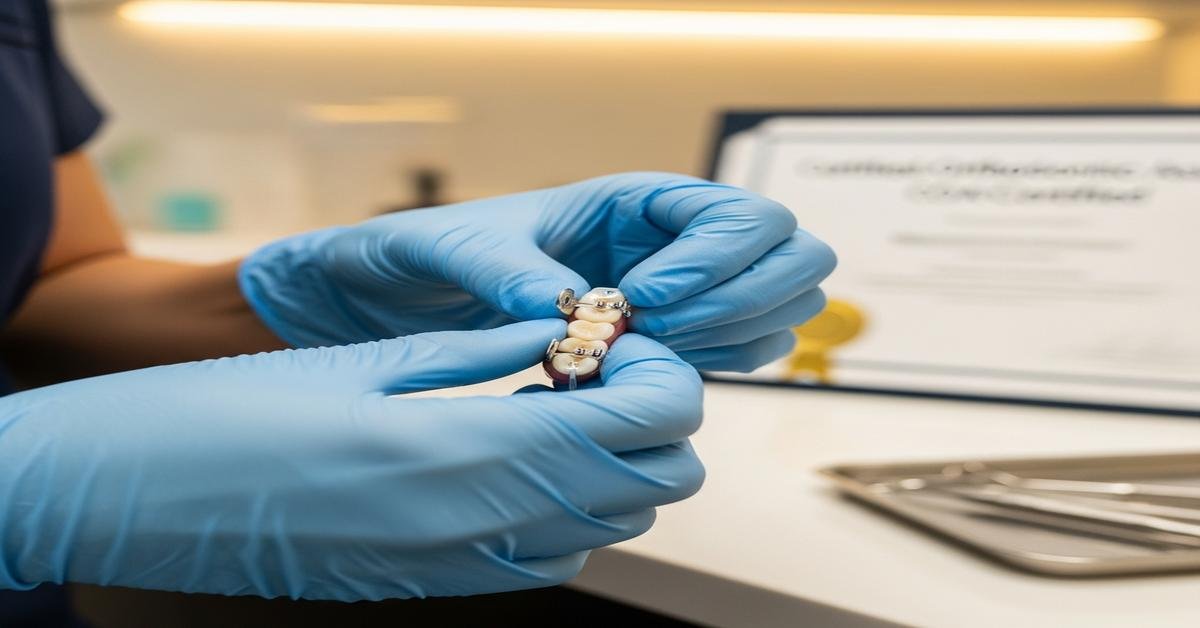
Orthodontic assistants keep specialty clinics moving. You manage records, set up and break down, change wires, scan, and reassure anxious teens. Pay is improving, but it varies widely. One lever you control is earning the Certified Orthodontic Assistant (COA) credential. This article explains how COA certification can change your salary in specialty clinics, why employers pay more for it, and how to use it to negotiate higher compensation without burning bridges.
What Orthodontic Assistants Earn Today
Pay for orthodontic assistants depends on location, experience, and how productive the clinic is. As of recent national data and employer surveys:
- Hourly pay: Commonly $18–$30 per hour. Many metro clinics land around $22–$28. Rural or low-cost areas may be closer to $18–$22.
- Annualized: At 38–40 hours per week, that’s roughly $36,000–$58,000 before overtime or bonuses.
- Bonuses: Specialty clinics often add production or case-start bonuses ($100–$600 per month is typical when targets are met). Why? Orthodontics runs on predictable starts and wire-change throughput. If assistants help hit schedule and conversion goals, owners share the upside.
These ranges are broad because orthodontic production per chair varies a lot. A quiet 2-chair start-up cannot pay what a 10-chair, two-doctor practice can. Your pay tracks the clinic’s revenue per clinical hour. That is the “why” behind most differences you see on job boards.
How COA Certification Changes Your Pay
Typical pay premium: COA-certified assistants often see $1.50–$4.00 more per hour than non-certified peers in the same market. In busy clinics, the premium can be higher because credentialed assistants carry more of the schedule and lower risk for the doctor.
Why employers pay more for COA:
- Verified competence. COA validates infection control, chairside orthodontic procedures, and records. Less training time and fewer errors save the practice money immediately.
- Throughput. Certified assistants usually run more chairs without bottlenecks. If one assistant helps the doctor complete two extra adjustments per hour, that added production justifies a higher wage.
- Compliance and liability. COA includes infection control knowledge. Fewer OSHA or sterilization lapses protect the clinic from fines and downtime.
- Training leverage. COAs can train newer assistants, raising the floor for the entire team. That reduces turnover costs.
In short, clinics pay for lower risk and higher output. COA is a credible signal of both.
Why Specialty Clinics Pay More
Specialty clinics—especially orthodontic practices—build schedules around exact intervals and standardized procedures. Small efficiency gains have big financial impact. Here’s the math many owners use:
- Revenue per chair-hour: If a chair generates $275 per hour and a skilled assistant helps the doctor add one more 15-minute adjustment, that’s roughly $69 more revenue in that hour. Over a full day, that can be hundreds of dollars.
- Error cost: A failed bond or missed elastic instruction can trigger an extra 20-minute visit, disrupting the day and lowering production. COA-level skills reduce remakes and callbacks.
- Start rate: Assistants who nail impressions/scans, photos, and patient education shorten new-patient visits and lift case acceptance. Higher starts mean healthier bonus pools.
This is why specialty clinics budget higher pay for assistants who reliably keep the schedule tight and the quality high. COA tells them you can do exactly that.
Skills the COA Signals to Employers
While state laws set the limits on what assistants can do, the COA typically signals mastery in areas practices value:
- Infection control and sterilization. Instrument flow, biologic monitoring, and OSHA/CDC standards. Why it matters: downtime from breaches is expensive.
- Orthodontic chairside procedures. Separators, ligatures, archwire changes, bracket debond assistance, and step-by-step flow for common adjustments. Why it matters: smoother appointments and fewer do-overs.
- Records and diagnostics. Intraoral/extraoral photos, impressions or digital scans, panoramic/ceph X-rays (with proper state permits). Why it matters: fast, accurate records shorten consults and speed starts.
- Patient communication. Oral hygiene coaching, elastic wear instructions, aligner compliance tips. Why it matters: fewer emergencies and longer wire intervals.
- Ortho-specific materials and instruments. Adhesives, wires, auxiliaries, and inventory control. Why it matters: reduced waste and no mid-appointment stockouts.
Adding modern tools—like iTero scanning, CBCT positioning (with training/permits), 3D printing of models or aligner auxiliaries—further increases your value because it expands what you can complete without the doctor’s direct time.
Real-World Pay Scenarios
Scenario 1: Suburban 3-chair orthodontic start-up
- Before COA: $21/hr, no bonus. Slower days, heavy doctor involvement.
- After COA: $24/hr + modest quarterly bonus ($150–$250/month when targets hit).
- Why the bump: Less chairside supervision needed, smoother records visits, and fewer redo impressions.
- Annual effect: ~$6,000–$7,000 increase.
Scenario 2: High-volume, multi-location practice
- Before COA: $25/hr + small production bonus (~$150/month).
- After COA + digital scanning proficiency: $28–$30/hr + larger bonus ($300–$500/month).
- Why the bump: Ability to run an extra chair during peak hours, cross-cover at another location, and train two junior assistants.
- Annual effect: $8,000–$12,000 increase.
Scenario 3: Rural clinic with limited applicant pool
- Before COA: $19/hr, no bonus.
- After COA + radiography permit: $22/hr + retention bonus ($1,000 annually).
- Why the bump: Hard-to-recruit market values credentialed, reliable staff who reduce doctor travel days.
- Annual effect: ~$4,000–$5,000 increase.
These examples show how the same credential plays out differently based on clinic volume and location. The common thread: COA lets you produce more value with less oversight.
ROI: Is COA Worth It?
The COA credential requires passing exams and maintaining continuing education. Typical out-of-pocket costs (exam fees, prep materials, CE) often total $500–$900 in the first year, depending on your path and state requirements.
Payback math:
- If your raise is $2.50/hr and you work 38 hours per week, that’s ~$95/week, or about $4,900/year before taxes.
- Your initial costs are typically recouped within 6–10 weeks.
That’s a strong ROI. The bigger variable isn’t the exam fee; it’s whether you use the credential to change your role—more chairs, teaching new hires, managing inventory, or leading digital workflows.
Factors That Move Your Salary Up or Down
- Region and cost of living. West Coast and Northeast metros generally pay more; rural Midwest and South often pay less. Why: patient fees and overhead differ by region.
- Experience with specific systems. Self-ligating brackets, aligner protocols, temporary anchorage devices, or software (Dolphin, Ortho2, Cloud 9). Why: less training time and fewer mistakes.
- State permits. Radiography, coronal polishing, sealants (where allowed), expanded functions. Why: legal ability to do more without the doctor increases throughput.
- Digital workflow skills. iTero/3Shape scanning, photography, 3D printing, model trimming. Why: faster consults and better case acceptance.
- Bilingual ability. Improves communication and conversion, especially in diverse markets.
- Schedule flexibility. Willingness to cover evenings or travel between offices often adds $1–$3/hr or stipends.
- Reliability and cross-coverage. Being the person who can float between records, sterilization, and chairside is worth more because it protects the schedule.
- Benefits and bonus structure. Health insurance, 401(k) match, CE reimbursement, scrubs, and ortho treatment discounts add thousands to total comp.
How to Use COA to Negotiate a Raise
Walk in with evidence, not just a certificate. Employers pay for results. Here’s a practical approach:
- Track metrics for 6–8 weeks before and after COA prep. Examples: average adjustment time, remakes/rebonds per week, on-time starts, emergency visits prevented, scans per day, sterilization pass rates.
- Quantify your impact. “My average scan time dropped from 15 to 9 minutes; that freed one extra adjustment block most days.”
- Bring documentation. COA card, state permits, CE log, and a short list of procedures you can handle independently (as allowed by your state).
- Tie it to revenue or risk. “By running a third chair on Wednesdays, we can add four 15-minute adjustments. That’s roughly $250–$300 in extra production each week.”
- Propose a structured raise. Example: “I’m requesting an immediate $2.50/hr increase, with a 90-day review for another $1/hr if we hit these throughput and quality goals.”
- Offer to train others. “I’ll standardize bracket removal steps and train two assistants so we cut 5 minutes off debond visits.”
Why this works: it shows you understand the business and you’re reducing the owner’s risk in giving you a raise.
Getting Into Higher-Paying Roles After COA
COA can be a stepping-stone. Clinics pay more for leadership and specialized tracks because those roles protect production and quality when things get busy.
- Lead assistant. Oversees tray setups, instrument maintenance, and chair assignments. Expected premium: +$1–$3/hr plus occasional bonuses.
- Treatment coordinator (TC). Uses clinical knowledge to present plans and close cases. Base pay often rises, and bonuses on case acceptance add up.
- Lab/3D print lead. Manages model printing and simple in-house appliances or aligner auxiliaries. Cuts lab costs and turnaround time.
- Infection control/OSHA officer. Maintains logs, runs spore tests, and trains staff. Prevents costly compliance issues.
- Multi-site trainer. Standardizes procedures across locations. Travel stipends or higher hourly rates are common.
To move up, volunteer to solve one high-friction problem (e.g., long new patient records, tray errors, or sterilization backlog) and present a plan. Then measure the improvement.
Common Mistakes That Hold Pay Back
- Relying only on “years of experience.” Employers pay more for output, not just tenure. Show metrics.
- Letting permits or CE lapse. A lapsed radiography or infection control credential lowers your legal scope and your leverage.
- No documentation of impact. If you can’t quantify your efficiency or quality gains, owners assume there aren’t any.
- Not cross-training. Specializing is good, but refusing sterilization or records coverage makes the schedule fragile.
- Skipping digital skills. Clinics go where the tech goes. If you don’t scan, you’ll hit a ceiling fast.
Action Plan for the Next 90 Days
- Week 1–2: Baseline. Time three common visits (records, adjustment, debond). Track remakes, emergencies, and on-time starts.
- Week 3–6: COA prep and targeted skill practice. Focus on any weak spots (infection control workflows, scan speed, photo consistency). Ask your lead for one extra responsibility you can own (e.g., sterilization monitoring or inventory).
- Week 7–8: Post-prep measurement. Re-time the same visits. Document improvements with simple charts or a one-page summary.
- Week 9: Build your case. Gather your COA documentation, state permits, CE log, and before/after metrics. Draft a raise proposal with clear benefits to the practice.
- Week 10–12: Meeting and follow-through. Present your proposal. If the owner wants proof, offer a 60–90 day pilot with agreed targets and a pre-set raise when met.
What Employers Notice Beyond the COA
- Professionalism under pressure. Calm, predictable chairside manner keeps the schedule on time and patients happy.
- Proactive problem-solving. Identifying bottlenecks (e.g., debond cleanup times) and proposing fixes shows leadership.
- Ownership of outcomes. Following up on post-adjustment soreness calls or elastic compliance turns potential emergencies into quick check-ins.
- Team health. Willingness to help sterilization or cover no-shows protects production. Owners value that highly.
Bottom Line: How COA Boosts Your Earning Power
The COA gives employers evidence that you can handle complex orthodontic tasks safely and efficiently. In specialty clinics where every 15-minute block counts, that proof translates into higher pay. Expect a typical premium of $1.50–$4.00 per hour, often more with digital skills, state permits, and leadership responsibilities. The investment usually pays back within a couple of months, and it opens doors to roles—lead assistant, treatment coordinator, lab/3D printing lead—that push your total compensation even higher.
If you want a raise, pair your COA with measurable improvements in speed, accuracy, and patient flow. Speak the clinic’s language—production, starts, rework, and compliance—and you’ll have the leverage to earn what you’re worth.

