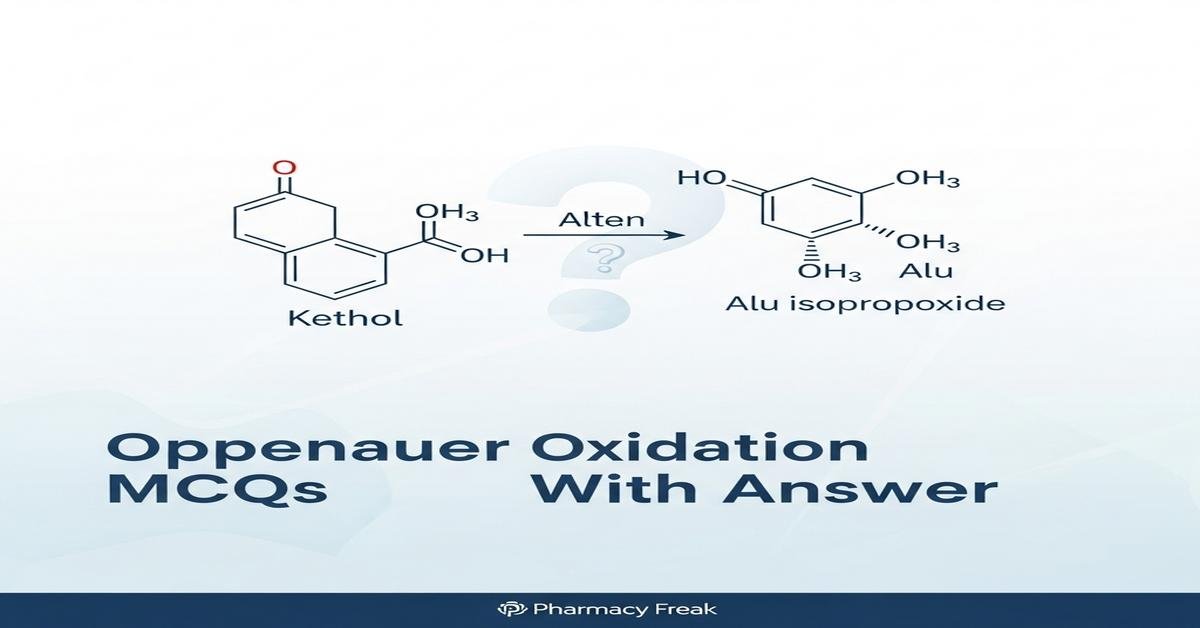
Oppenauer oxidation MCQs With Answer: This focused guide helps B. Pharm students master the Oppenauer oxidation, a reagent-controlled method for selective oxidation of secondary alcohols to ketones. The introduction summarizes mechanism, catalyst roles (aluminum isopropoxide), common hydrogen acceptors (acetone, benzophenone), reaction conditions (refluxing solvent), equilibrium control, stereochemical outcomes and practical synthetic applications in medicinal chemistry. Exam-style questions emphasize hydride transfer, six-membered transition states, choice of acceptor, solvent effects, competing side reactions and analytical monitoring by IR/NMR. Use this set to prepare for viva, exams, and practicals. Now let’s test your knowledge with 50 MCQs on this topic.
Q1. Which class of alcohols is the Oppenauer oxidation primarily used to oxidize?
- Primary alcohols to aldehydes
- Secondary alcohols to ketones
- Tertiary alcohols to carboxylic acids
- Allylic alcohols to acids
Correct Answer: Secondary alcohols to ketones
Q2. What is the common catalyst used in the classical Oppenauer oxidation?
- Palladium on carbon
- Aluminum isopropoxide
- Chromic acid
- Potassium permanganate
Correct Answer: Aluminum isopropoxide
Q3. Which reagent typically serves as the hydrogen acceptor in Oppenauer oxidation?
- Isopropanol
- Acetone
- Hydrogen gas
- Sodium borohydride
Correct Answer: Acetone
Q4. The Oppenauer oxidation mechanism involves which fundamental step?
- Single-electron transfer
- Radical chain propagation
- Hydride transfer through a cyclic transition state
- Direct proton abstraction by base
Correct Answer: Hydride transfer through a cyclic transition state
Q5. Which solvent is commonly used for Oppenauer oxidation to facilitate reflux and azeotropic removal?
- Water
- Tetrahydrofuran (THF)
- Toluene
- Methanol
Correct Answer: Toluene
Q6. How does Oppenauer oxidation relate to the Meerwein–Ponndorf–Verley (MPV) reduction?
- They are identical reactions with different names
- Oppenauer is the oxidative reverse of MPV reduction
- MPV uses radical chemistry while Oppenauer does not
- Oppenauer reduces ketones while MPV oxidizes alcohols
Correct Answer: Oppenauer is the oxidative reverse of MPV reduction
Q7. Why is benzophenone sometimes used instead of acetone as the acceptor?
- Benzophenone is a stronger hydride donor
- Benzophenone forms a more favorable equilibrium for oxidation
- Benzophenone is cheaper and more volatile
- Benzophenone prevents formation of ketones
Correct Answer: Benzophenone forms a more favorable equilibrium for oxidation
Q8. What type of transition state is proposed in the Oppenauer mechanism?
- Four-membered
- Five-membered
- Six-membered chair-like
- Open-chain acyclic
Correct Answer: Six-membered chair-like
Q9. Which substrate would be least reactive under standard Oppenauer conditions?
- Secondary benzylic alcohol
- Secondary aliphatic alcohol
- Tertiary alcohol
- Secondary allylic alcohol
Correct Answer: Tertiary alcohol
Q10. Which analytical change indicates successful oxidation of a secondary alcohol to a ketone in IR spectroscopy?
- Appearance of a strong OH stretch at 3300 cm−1
- Disappearance of C=O stretch at 1700 cm−1
- Appearance of a strong C=O stretch near 1700 cm−1
- Shift of C–H stretches to lower frequency
Correct Answer: Appearance of a strong C=O stretch near 1700 cm−1
Q11. Which factor shifts the Oppenauer oxidation equilibrium toward product formation?
- Using a catalytic amount of acceptor
- Using excess hydrogen acceptor and removing formed alcohol
- Lowering temperature significantly
- Using protic solvent like water
Correct Answer: Using excess hydrogen acceptor and removing formed alcohol
Q12. In the catalytic cycle, what species coordinates to aluminum to facilitate hydride transfer?
- Free alcohol molecule without deprotonation
- Alkoxide formed from the substrate alcohol
- Carbocation intermediate
- Peroxide radical
Correct Answer: Alkoxide formed from the substrate alcohol
Q13. What is a common temperature condition for Oppenauer oxidations using toluene?
- Room temperature (20–25 °C)
- Reflux of toluene (~110 °C)
- Cryogenic temperatures (-78 °C)
- 1000 °C under inert gas
Correct Answer: Reflux of toluene (~110 °C)
Q14. Which of the following functional groups is typically resistant under Oppenauer conditions?
- Secondary alcohol
- Aldehyde
- Tertiary alcohol
- Ketone acceptor
Correct Answer: Tertiary alcohol
Q15. What side reaction may occur if acetone is used and basic conditions prevail?
- Aldol condensation of acetone
- Hydrogenation of the substrate
- Formation of peroxides
- Cleavage of C–C bonds in substrate
Correct Answer: Aldol condensation of acetone
Q16. Which parameter is most critical to avoid over-oxidation or unwanted reactions?
- Choice of lamp for photochemistry
- Careful control of temperature and acceptor amount
- Using excess peroxide oxidant
- High-pressure hydrogen atmosphere
Correct Answer: Careful control of temperature and acceptor amount
Q17. How is stereochemistry affected when oxidizing a chiral secondary alcohol by Oppenauer oxidation?
- It leads to racemization in all cases
- It typically retains configuration at the carbon center
- Configuration is lost because a planar carbocation is formed
- Configuration may be retained since oxidation goes via hydride removal without C–C bond cleavage
Correct Answer: Configuration may be retained since oxidation goes via hydride removal without C–C bond cleavage
Q18. Which modification can increase reaction rate and minimize side reactions?
- Using stoichiometric aluminum metal
- Employing molecular sieves to remove water
- Adding strong mineral acids
- Running reaction in neat water
Correct Answer: Employing molecular sieves to remove water
Q19. Which substrate example is ideal for Oppenauer oxidation in drug synthesis?
- Primary alcohol in a sensitive molecule with aldehyde present
- Secondary benzylic alcohol to form a ketone intermediate
- Tertiary alcohol adjacent to aromatic ring
- Protected amide with no alcohol
Correct Answer: Secondary benzylic alcohol to form a ketone intermediate
Q20. What is a safer, greener advantage of Oppenauer oxidation compared to chromium(VI) oxidants?
- Generates toxic Cr byproducts
- Uses milder, catalytic aluminum and avoids heavy metals
- Requires stoichiometric heavy metal salts
- Always produces large amounts of hazardous waste
Correct Answer: Uses milder, catalytic aluminum and avoids heavy metals
Q21. Which analytical technique best monitors disappearance of an alcohol during Oppenauer reaction?
- Thin-layer chromatography (TLC) and IR
- Flame test
- Colorimetric pH paper
- Melting point determination
Correct Answer: Thin-layer chromatography (TLC) and IR
Q22. What happens if insufficient acceptor ketone is used?
- Reaction equilibrium may favor starting alcohol and give low conversion
- Oxidation proceeds to completion regardless
- Substrate undergoes polymerization instead
- Reaction converts ketone to alcohol exclusively
Correct Answer: Reaction equilibrium may favor starting alcohol and give low conversion
Q23. Which of the following is a typical byproduct formed from acetone acceptor?
- Isopropanol from reduction of acetone
- Acetic acid from oxidation of acetone
- Benzene from condensation
- Propane from hydrogenolysis
Correct Answer: Isopropanol from reduction of acetone
Q24. For selective oxidation of a secondary alcohol in presence of a primary alcohol, what is commonly observed?
- Primary alcohol is oxidized preferentially
- Secondary alcohol is generally oxidized preferentially under classical Oppenauer conditions
- Both alcohols are inert
- Tertiary alcohol is formed
Correct Answer: Secondary alcohol is generally oxidized preferentially under classical Oppenauer conditions
Q25. Which metal alkoxide would most closely mimic aluminum isopropoxide activity in Oppenauer-like reactions?
- Sodium ethoxide
- Zinc alkoxide under analogous conditions
- Ferrous chloride
- Silver nitrate
Correct Answer: Zinc alkoxide under analogous conditions
Q26. Why is a nonpolar, high-boiling solvent preferred?
- To dissolve inorganic salts only
- To allow heating to reflux without solvent decomposition and help remove small alcohols
- Because polar solvents promote faster oxidation
- To ensure photochemical initiation
Correct Answer: To allow heating to reflux without solvent decomposition and help remove small alcohols
Q27. Which structural feature on a secondary alcohol increases Oppenauer reactivity?
- Strong electron-withdrawing group on adjacent carbon reducing hydride lability
- Benzylic position stabilizing transition state
- Tertiary carbon substituents causing steric hindrance
- Absence of α-hydrogen
Correct Answer: Benzylic position stabilizing transition state
Q28. What is the role of aluminum isopropoxide besides being a Lewis acid?
- Acts as a hydrogen acceptor
- Forms alkoxide complex that enables hydride transfer
- Produces free radicals
- Generates ozone in situ
Correct Answer: Forms alkoxide complex that enables hydride transfer
Q29. Which condition would most likely decrease the selectivity of Oppenauer oxidation?
- Careful exclusion of moisture
- Operating at controlled reflux with optimized acceptor
- Presence of strong acids or bases causing side reactions
- Using fresh, dry catalyst
Correct Answer: Presence of strong acids or bases causing side reactions
Q30. What change in 1H NMR would indicate oxidation of a secondary alcohol to a ketone?
- Disappearance of OH singlet and shift/loss of the α-CH proton signal
- Appearance of a broad OH peak
- Formation of multiple new triplets between 0.5–1 ppm
- Increase in integration of aromatic signals
Correct Answer: Disappearance of OH singlet and shift/loss of the α-CH proton signal
Q31. Which technique can be used to remove produced isopropanol to drive equilibrium toward product?
- Distillation during reaction
- Add water to quench reaction
- Add excess acid to protonate isopropanol
- Store reaction cold
Correct Answer: Distillation during reaction
Q32. For substrates sensitive to basic conditions, what precaution is advisable?
- Use excess base
- Run the reaction under strongly alkaline aqueous conditions
- Use milder modified Oppenauer conditions or alternative oxidants
- Expose substrate to air oxidation at high temperature
Correct Answer: Use milder modified Oppenauer conditions or alternative oxidants
Q33. Which statement about primary alcohol oxidation in Oppenauer conditions is true?
- Primary alcohols are rapidly oxidized to carboxylic acids
- Primary alcohols are typically less reactive and often remain unoxidized under classical Oppenauer conditions
- Primary alcohols preferentially form esters under Oppenauer conditions
- Primary alcohols give immediate polymerization
Correct Answer: Primary alcohols are typically less reactive and often remain unoxidized under classical Oppenauer conditions
Q34. Which modification is known as a “modified Oppenauer” approach?
- Using chromium reagents with aluminum
- Using alternative Lewis acid catalysts or different ketone acceptors to improve selectivity
- Applying photoredox catalysts exclusively
- Replacing solvent with concentrated HCl
Correct Answer: Using alternative Lewis acid catalysts or different ketone acceptors to improve selectivity
Q35. In teaching labs, what hazard precaution is most relevant for Oppenauer reactions?
- Handle aluminum isopropoxide as non-hazardous dust
- Avoid open flames due to flammable solvents like toluene and acetone
- No need for ventilation because vapors are inert
- Reactions must be done under high pressure
Correct Answer: Avoid open flames due to flammable solvents like toluene and acetone
Q36. Which molecule could act as a poor acceptor and give low conversion?
- Benzophenone
- Acetone
- A ketone with very low ability to accept hydride (sterically hindered, less electrophilic)
- Cyclohexanone
Correct Answer: A ketone with very low ability to accept hydride (sterically hindered, less electrophilic)
Q37. What experimental observation suggests formation of alkoxide complexes during the reaction?
- Immediate gas evolution
- Change in solution color and increased solubility of catalyst with substrate
- Precipitation of metallic aluminum
- Formation of crystalline salts
Correct Answer: Change in solution color and increased solubility of catalyst with substrate
Q38. When scaling up Oppenauer oxidations in industry, which factor requires careful control?
- Ambient light levels
- Heat removal and control of reflux to avoid runaway aldol or condensation reactions
- Use of inert glassware only
- Changing catalyst to a noble metal
Correct Answer: Heat removal and control of reflux to avoid runaway aldol or condensation reactions
Q39. Which statement about the thermodynamics of Oppenauer oxidation is correct?
- The reaction is always irreversible and highly exothermic
- The reaction is equilibrium-controlled and can be driven by manipulating acceptor concentrations
- The reaction does not depend on acceptor structure
- The reaction proceeds by radical thermodynamics only
Correct Answer: The reaction is equilibrium-controlled and can be driven by manipulating acceptor concentrations
Q40. Which functional group on the substrate might interfere with Oppenauer oxidation?
- Protected ether remote from the alcohol
- Free aldehyde that can be further oxidized or react with acceptor
- Nonpolar alkyl chain with no functional groups
- Saturated hydrocarbon ring
Correct Answer: Free aldehyde that can be further oxidized or react with acceptor
Q41. What is the typical stoichiometric relationship between substrate and acceptor for efficient oxidation?
- Equimolar amounts always
- Excess acceptor is often used to push equilibrium toward product
- Large excess of substrate and minimal acceptor
- No acceptor required
Correct Answer: Excess acceptor is often used to push equilibrium toward product
Q42. How can one isolate the desired ketone after completion?
- Quench with strong oxidant
- Standard aqueous workup, removal of solvent and purification by column chromatography
- Direct crystallization from reaction mixture without workup
- Neutralize with cyanide to precipitate product
Correct Answer: Standard aqueous workup, removal of solvent and purification by column chromatography
Q43. Which property of aluminum isopropoxide makes it suited for catalysis in Oppenauer oxidation?
- Strong oxidizing power as a metal oxide
- Ability to form Lewis acidic centers and alkoxide ligands that mediate hydride transfer
- It is a radical initiator
- It decomposes to aluminum metal under conditions
Correct Answer: Ability to form Lewis acidic centers and alkoxide ligands that mediate hydride transfer
Q44. Which substrate type may give competing dehydration instead of oxidation?
- Simple secondary alcohols with no β-hydrogens
- Alcohols adjacent to strong acid-sensitive substituents under acidic conditions
- Primary alcohols in inert solvent
- Alcohols protected as silyl ethers
Correct Answer: Alcohols adjacent to strong acid-sensitive substituents under acidic conditions
Q45. If benzophenone is used as acceptor, what reduction product is formed?
- Benzhydrol (diphenylcarbinol)
- Benzene
- Benzoic acid
- Biphenyl
Correct Answer: Benzhydrol (diphenylcarbinol)
Q46. Which experimental change would slow down the Oppenauer oxidation?
- Increasing catalyst concentration
- Lowering reaction temperature far below solvent reflux
- Using a more electrophilic ketone acceptor
- Using dry solvent and inert atmosphere
Correct Answer: Lowering reaction temperature far below solvent reflux
Q47. What advantage does Oppenauer oxidation provide in multi-step synthesis of drug molecules?
- Harsh oxidative conditions that degrade sensitive groups
- Mild, selective oxidation of secondary alcohols compatible with many functional groups
- Nonselective oxidation that always needs protection strategies
- Requirement for stoichiometric heavy metals that contaminate APIs
Correct Answer: Mild, selective oxidation of secondary alcohols compatible with many functional groups
Q48. Which monitoring sign during reaction indicates potential aldol side-reaction of acetone?
- Formation of high-boiling, colored viscous residue
- Complete transparency and colorless solution
- Increase in gas pressure only
- Immediate crystallization of the product
Correct Answer: Formation of high-boiling, colored viscous residue
Q49. When designing an MCQ lab question for B.Pharm, which learning outcome is best targeted by Oppenauer experiments?
- Understanding radical polymerization kinetics
- Mastery of selective oxidation mechanisms and practical workup techniques
- Learning to synthesize inorganic salts exclusively
- Performing protein purification
Correct Answer: Mastery of selective oxidation mechanisms and practical workup techniques
Q50. Which precaution improves reproducibility of Oppenauer oxidation in student labs?
- Ignoring catalyst purity
- Standardizing catalyst, solvent drying, acceptor stoichiometry and reaction temperature
- Using random amounts of acceptor each time
- Skipping TLC monitoring
Correct Answer: Standardizing catalyst, solvent drying, acceptor stoichiometry and reaction temperature

