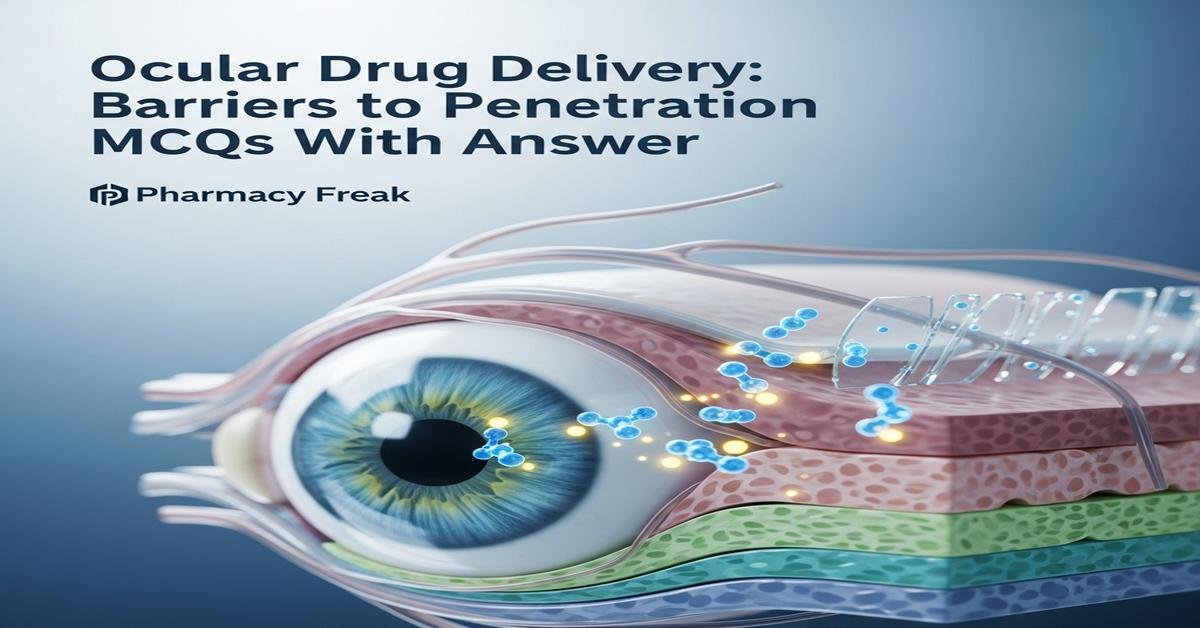
Ocular drug delivery: barriers to penetration MCQs With Answer is designed to help M. Pharm students master the anatomical, physiological and biochemical hurdles that limit drug access to anterior and posterior eye segments. This quiz focuses on static barriers (corneal epithelium, stroma, BAB, BRB), dynamic barriers (tear turnover, blinking, nasolacrimal drainage), and metabolic/transport barriers (enzymes, efflux pumps), alongside formulation strategies to overcome them. You will test your understanding of tear film dynamics, permeability determinants (size, charge, lipophilicity, ionization), transporter involvement, conjunctival–scleral pathways, melanin binding, and intraocular clearance routes. Each MCQ emphasizes clinically relevant mechanisms and design implications for ophthalmic dosage forms, strengthening your conceptual clarity for Drug Delivery Systems (MPH 102T).
Q1. Which ocular structure is the principal barrier to paracellular diffusion of hydrophilic drugs after topical instillation?
- Corneal epithelium tight junctions
- Corneal stroma collagen matrix
- Tear film lipid layer
- Iris pigment epithelium
Correct Answer: Corneal epithelium tight junctions
Q2. Among precorneal factors, which most rapidly reduces the residence time of instilled eye drops?
- Rapid nasolacrimal drainage and tear turnover
- High tear protein binding
- Low corneal hydration
- Slow corneal desquamation
Correct Answer: Rapid nasolacrimal drainage and tear turnover
Q3. Which statement correctly explains why most of a 30–50 µL eye drop is lost from the ocular surface?
- The drop volume exceeds the cul-de-sac capacity (~7–10 µL), causing spillover and nasolacrimal drainage
- The corneal endothelium immediately pumps the drug into the aqueous humor
- The vitreous humor rapidly absorbs the excess drug
- The iris sphincter muscle absorbs most of the drop
Correct Answer: The drop volume exceeds the cul-de-sac capacity (~7–10 µL), causing spillover and nasolacrimal drainage
Q4. For small unionized drugs, which lipophilicity range most favors corneal epithelial partitioning while still allowing stromal diffusion?
- logP ≈ −1
- logP ≈ 0.5
- logP ≈ 2–3
- logP > 5
Correct Answer: logP ≈ 2–3
Q5. Which efflux transporter expressed in corneal and conjunctival epithelia can limit intracellular drug accumulation?
- P-glycoprotein (ABCB1)
- OATP1B1
- PEPT1
- GLUT4
Correct Answer: P-glycoprotein (ABCB1)
Q6. Which component contributes directly to the blood–aqueous barrier (BAB)?
- Tight junctions of the nonpigmented ciliary epithelium
- Fenestrations of Schlemm’s canal endothelium
- Fenestrated endothelium of the choriocapillaris
- Trabecular meshwork beams
Correct Answer: Tight junctions of the nonpigmented ciliary epithelium
Q7. Which barrier chiefly limits topically applied drugs from reaching the retina and choroid?
- Blood–retinal barrier
- Corneal endothelium
- Lens capsule
- Vitreous gel
Correct Answer: Blood–retinal barrier
Q8. Which enzyme class in the tear film and corneal epithelium can hydrolyze ester prodrugs into active drugs?
- Carboxylesterases
- CYP3A4
- Monoamine oxidase
- Tyrosinase
Correct Answer: Carboxylesterases
Q9. Compared with the cornea, which statement about the conjunctival–scleral route is accurate?
- The sclera is more permeable to hydrophilic and larger molecules, but conjunctival blood and lymphatic flow enhance clearance
- The conjunctiva lacks lymphatics, so macromolecules accumulate easily
- The cornea shows higher permeability to macromolecules than the sclera
- Scleral thickness prevents any transscleral diffusion
Correct Answer: The sclera is more permeable to hydrophilic and larger molecules, but conjunctival blood and lymphatic flow enhance clearance
Q10. What approximate upper molecular size limit applies to paracellular transport across the corneal epithelium?
- < 200 Da
- < 500 Da
- 1000–2000 Da
- > 5000 Da
Correct Answer: < 500 Da
Q11. How does melanin binding in the uveal tract affect ocular drug disposition?
- It can sequester cationic, lipophilic drugs, reducing free drug initially but providing a depot that prolongs exposure
- It increases corneal epithelial permeability to hydrophilic drugs
- It prevents systemic absorption via the nasal mucosa
- It inactivates peptide drugs by enzymatic degradation
Correct Answer: It can sequester cationic, lipophilic drugs, reducing free drug initially but providing a depot that prolongs exposure
Q12. For a weakly basic drug (pKa ≈ 8.5), which adjustment promotes greater corneal epithelial permeation from tears?
- Formulating at a slightly higher pH (e.g., 7.5–8.0) to increase the unionized fraction, within comfort limits
- Formulating at pH 5.0 to fully protonate the drug
- Adding strong acids to increase tear turnover
- Using hypertonic solutions to shrink the corneal stroma
Correct Answer: Formulating at a slightly higher pH (e.g., 7.5–8.0) to increase the unionized fraction, within comfort limits
Q13. Which process is an example of a dynamic barrier in ocular drug delivery?
- Blinking and tear turnover
- Corneal epithelial tight junctions
- Retinal pigment epithelium tight junctions
- Esterase-mediated metabolism
Correct Answer: Blinking and tear turnover
Q14. Which formulation strategy primarily addresses precorneal clearance rather than trans-tissue permeability?
- Increasing viscosity or using mucoadhesive polymers (e.g., carbomers, HPMC)
- Designing highly lipophilic prodrugs
- Efflux pump inhibition
- Nanocrystal surface charge modulation
Correct Answer: Increasing viscosity or using mucoadhesive polymers (e.g., carbomers, HPMC)
Q15. Which corneal layer is rate-limiting for highly lipophilic drugs due to its hydrophilic composition?
- Corneal stroma (hydrated collagen and GAGs)
- Corneal epithelium
- Tear film lipid layer
- Descemet’s membrane
Correct Answer: Corneal stroma (hydrated collagen and GAGs)
Q16. Which pair constitutes the two anatomical components of the blood–retinal barrier (BRB)?
- Retinal pigment epithelium tight junctions and retinal capillary endothelial tight junctions
- Choriocapillaris fenestrations and trabecular meshwork
- Lens epithelium and corneal endothelium
- Iris stroma and sclera
Correct Answer: Retinal pigment epithelium tight junctions and retinal capillary endothelial tight junctions
Q17. Why can topical ophthalmic drugs cause systemic adverse effects?
- Drainage into the nasolacrimal duct with absorption across the nasal mucosa bypasses first-pass metabolism
- They are neutralized by tear proteins before absorption
- They are confined to the aqueous humor with no systemic access
- They are degraded exclusively by conjunctival enzymes
Correct Answer: Drainage into the nasolacrimal duct with absorption across the nasal mucosa bypasses first-pass metabolism
Q18. Which route best circumvents both corneal epithelial and conjunctival barriers to deliver drugs to the posterior segment?
- Intravitreal injection
- Topical eye drops
- Periocular ointment
- Oral administration
Correct Answer: Intravitreal injection
Q19. How do cyclodextrins help overcome solubility-related barriers in ocular delivery?
- They form inclusion complexes that increase apparent solubility and release free drug at the epithelial surface while minimizing surfactant-related irritation
- They chelate calcium to open tight junctions permanently
- They inhibit P-glycoprotein at the corneal epithelium
- They increase tear turnover to speed drug distribution
Correct Answer: They form inclusion complexes that increase apparent solubility and release free drug at the epithelial surface while minimizing surfactant-related irritation
Q20. Which pathway is responsible for elimination of drug from the anterior chamber, limiting exposure after it reaches aqueous humor?
- Conventional outflow via trabecular meshwork and Schlemm’s canal
- Photoreceptor transduction
- Axonal transport along the optic nerve
- Evaporation through the tear film
Correct Answer: Conventional outflow via trabecular meshwork and Schlemm’s canal


I am a Registered Pharmacist under the Pharmacy Act, 1948, and the founder of PharmacyFreak.com. I hold a Bachelor of Pharmacy degree from Rungta College of Pharmaceutical Science and Research. With a strong academic foundation and practical knowledge, I am committed to providing accurate, easy-to-understand content to support pharmacy students and professionals. My aim is to make complex pharmaceutical concepts accessible and useful for real-world application.
Mail- Sachin@pharmacyfreak.com