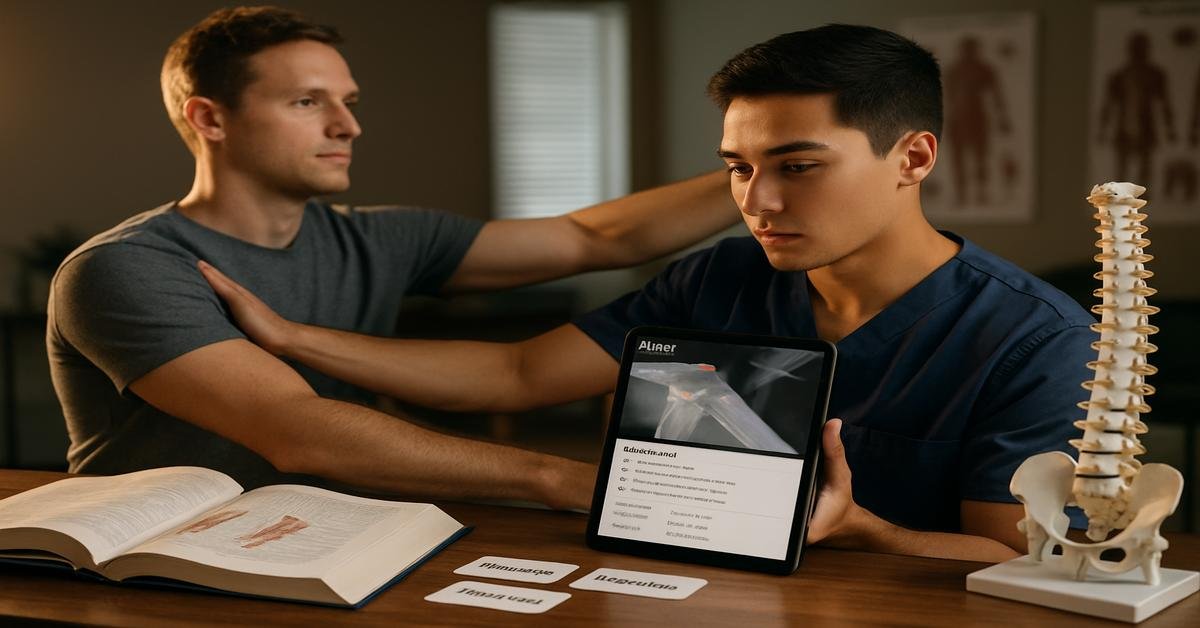
The NPTE-PT is not just a memory test. It checks whether you can think like a safe, entry-level physical therapist under pressure. That is why many students feel fine reviewing facts, then struggle when a musculoskeletal case asks them to connect anatomy, symptom behavior, red flags, exam findings, and treatment choices in one step. The good news is that passing the final board exam is usually less about studying more and more about studying in the right way. If you understand how the exam thinks, and if you train yourself to work through orthopedic cases in a clear clinical pattern, your score can rise fast.
Understand what the NPTE-PT is really testing
The exam rewards clinical judgment. You do need foundational knowledge, but facts alone are not enough. A question about shoulder pain may look like an anatomy item, but the real task may be to identify the most likely tissue involved, rule out cervical referral, choose the best special test, and know which finding changes the plan of care.
That matters because many candidates study in isolated buckets:
Muscle actions
Special tests
Protocols
Modalities
That approach helps recall, but not application. On exam day, the NPTE blends these pieces together. So your preparation should do the same.
Think of each musculoskeletal question as a short clinical encounter. Ask:
What is the most likely diagnosis or impairment pattern?
What is unsafe to miss?
What objective finding best supports the answer?
What treatment choice fits the stage and irritability of the condition?
What answer is correct right now, not eventually?
That last point is important. The exam often tests sequence. A treatment may be useful later, but the best first step might be referral, imaging awareness, protection, or a simpler exam procedure.
Build a study plan that matches the exam
A good study plan should reduce randomness. Many students waste time because they mix weak and strong topics without a system. A better plan has three parts: content review, case-based practice, and error analysis.
1. Content review
Use this phase to sharpen core knowledge. In musculoskeletal physical therapy, that means:
Joint arthrokinematics and osteokinematics
Contractile vs non-contractile tissue patterns
Healing timelines
Pain behavior and irritability
Common orthopedic diagnoses by region
Red flags and referral signs
Exercise progression and dosage basics
2. Case-based practice
This is where scores improve. Do mixed questions, not just topic-specific drills. Real testing conditions require you to switch from lumbar stenosis to ACL rehab to inflammatory arthritis without warning. That mental shifting is a skill.
3. Error analysis
This is the step many people skip. After each practice set, do not just count how many you got wrong. Find out why you missed them. Most mistakes fall into a few categories:
You did not know the content
You knew it but misread the stem
You missed a red flag
You chose a technically true answer that was not the best answer
You forgot to consider stage, severity, or irritability
If you label your mistakes this way, patterns appear. Then your study becomes targeted instead of emotional.
Master musculoskeletal cases by using a repeatable clinical framework
When a case question appears, use the same thought process every time. This lowers panic and improves accuracy.
Step 1: Identify the body region and dominant problem
Is this shoulder instability, rotator cuff pathology, cervical radiculopathy, hip OA, lumbar disc involvement, meniscal injury, or something systemic pretending to be orthopedic? Name the likely category first. That narrows the answer choices.
Step 2: Decide whether it is mechanical, inflammatory, neurological, vascular, or non-musculoskeletal
This matters because treatment logic changes completely. Mechanical pain usually changes with movement or position. Inflammatory pain often has morning stiffness, swelling, warmth, and pain at rest. Neurological symptoms may include dermatomal numbness, myotomal weakness, or reflex changes. Vascular and systemic signs demand caution.
Step 3: Check for red flags before planning treatment
The NPTE cares about safety. If a patient has unexplained weight loss, night pain not changed by position, saddle anesthesia, bowel or bladder changes, fever, recent trauma with osteoporosis risk, or signs of DVT, your first thought should not be exercise selection.
Step 4: Match symptoms to tissue behavior
This is one of the strongest musculoskeletal skills you can build. Ask what the tissue is doing.
Contractile tissue: pain with active motion, pain with resisted testing, pain with stretch
Inert or non-contractile tissue: pain with passive motion, stress to ligament or capsule, joint compression, traction, or end-range loading
For example, if a patient has lateral elbow pain with gripping, pain with resisted wrist extension, and tenderness at the common extensor tendon, that points toward a contractile problem. If another patient has shoulder pain with capsular restriction and limited passive external rotation more than abduction more than internal rotation, you should think adhesive capsulitis pattern.
Step 5: Consider irritability and stage
A highly irritable acute condition needs a different plan than a low-irritability chronic one. This is where many treatment questions are won or lost.
For example:
An acutely inflamed shoulder after injury may need protection, pain-limited ROM, and gentle isometrics.
A chronic tendinopathy often responds better to progressive loading than to rest.
A post-op knee in the early phase may need swelling control and extension restoration before advanced strengthening.
Same body part. Different stage. Different best answer.
Know the high-yield musculoskeletal patterns that show up often
You do not need to memorize endless lists. You do need to recognize common patterns quickly.
Shoulder
Rotator cuff involvement: painful arc, weakness, pain with resisted movements, possible night pain
Adhesive capsulitis: progressive stiffness, especially passive external rotation loss, often painful early and stiff later
Instability: apprehension with vulnerable positions, younger patients or trauma history
Cervical referral: shoulder symptoms with neck movement influence, neurological signs, or non-mechanical shoulder exam
Lumbar spine
Disc involvement: possible directional preference, radicular signs, worse with flexion or sitting in some cases
Stenosis: older adult, worse with extension and walking, better with flexion or sitting
Spondylolisthesis or instability: extension sensitivity, possible step-off, activity-related pain
Cauda equina: bowel or bladder dysfunction, saddle anesthesia, major neurological concern
Knee
ACL injury: non-contact twisting, pop, rapid swelling, instability
Meniscal pathology: locking, catching, joint line pain, twisting aggravation
OA: age-related stiffness, crepitus, pain with weight bearing, functional decline
Patellofemoral pain: pain with stairs, squatting, prolonged sitting, load tolerance issue
Hip
OA: groin pain, reduced internal rotation, stiffness with gait changes
Greater trochanteric pain syndrome: lateral hip pain, side-lying pain, tenderness, load sensitivity
Femoral neck fracture or stress injury concern: severe weight-bearing pain, trauma or bone health risk, urgent referral pattern
Learning these patterns helps because many exam questions are not obscure. They are common conditions presented with one or two distractors designed to test your judgment.
Use special tests the way the exam expects you to use them
Many students overvalue special tests. The NPTE usually treats them as part of a cluster, not magic proof. A positive test can support your hypothesis, but history and basic exam findings often matter more.
For example, one positive shoulder impingement test does not automatically mean the answer is subacromial pain syndrome. You still need to consider age, mechanism, weakness, ROM, cervical involvement, and irritability.
A practical rule is this: use special tests to refine, not replace, your clinical reasoning.
Also remember that the best next test is often the safest and simplest one. If a patient has acute severe pain after trauma, forcing aggressive end-range movement may not be appropriate. If neuro signs are present, a screening exam may matter more than another orthopedic test.
Answer treatment questions by thinking in phases
Treatment questions in musculoskeletal cases often become easy when you organize them by phase.
Acute phase
Protect healing tissue
Reduce pain and swelling
Maintain safe mobility
Avoid overloading irritable tissue
Subacute phase
Restore ROM
Begin progressive strengthening
Improve movement quality
Address contributing impairments
Chronic or return-to-function phase
Increase load tolerance
Build endurance and power when needed
Use task-specific progression
Prepare for work, sport, or daily demands
Example: if a patient is two days after an ankle sprain with marked swelling and antalgic gait, the best answer is unlikely to be advanced balance challenge or plyometric training. But if the patient is six weeks out with minimal pain and persistent instability, those higher-level interventions may be exactly right.
Improve test-taking without turning into a “test trick” student
You should not rely on tricks, but you should use smart exam habits.
Read the last line first. This tells you whether the question asks for diagnosis, best test, first intervention, contraindication, or prognosis.
Notice timing words. Terms like initial, most appropriate, best next step, and first matter.
Remove unsafe choices first. Safety is a strong filter on NPTE items.
Do not add facts. Answer from the case you were given, not the one you imagined.
Be careful with absolute language. Choices with always or never are often too broad in clinical care.
One more key habit: when torn between two answers, ask which one is more supported by the stem. Not which one sounds familiar. Not which one you studied yesterday. Which one the actual case supports.
Use practice exams to train stamina and judgment
Content knowledge can drop when fatigue rises. Full-length practice exams help you build pacing, attention, and emotional control.
After each exam, review more than the wrong answers. Review the correct answers you guessed on. A guessed correct answer is still a weak area.
Track the following:
Score by system
Score by question type
Errors from rushing
Errors from overthinking
Topics that keep repeating
If musculoskeletal cases are your weak area, do not only reread notes. Rework cases out loud. Explain why the symptoms fit one diagnosis more than another. Explain why one treatment is right for that phase. If you cannot explain it simply, you do not own it yet.
What to do in the final weeks before the exam
The last stretch should focus on sharpening, not cramming.
Review high-yield conditions and red flags daily
Do mixed practice questions under timed conditions
Keep a short error notebook with patterns, not giant notes
Practice clinical frameworks for ortho cases until they feel automatic
Protect sleep and routine because fatigue hurts reasoning
A useful final-week exercise is to take one condition and compare it with two look-alikes. For example:
Rotator cuff tear vs adhesive capsulitis vs cervical radiculopathy
Lumbar stenosis vs disc herniation vs hip OA referral
Meniscal injury vs patellofemoral pain vs knee OA
This works because the exam often tests discrimination, not simple recall.
The mindset that helps most on exam day
Try to think like a careful new clinician, not a desperate test taker. Your job is to identify the main problem, protect the patient, and choose the best next action from the information given. That mindset fits the exam well.
If you get stuck on a musculoskeletal case, return to basics:
What tissue or structure is most likely involved?
Is there anything dangerous here?
What finding best confirms the pattern?
What intervention fits this stage and irritability level?
Passing the NPTE-PT is not about being perfect. It is about being consistently safe, logical, and clinically grounded. If you train your study around real case reasoning, especially in musculoskeletal practice, the exam becomes much more manageable. And that is exactly the kind of thinking you will need when the questions are no longer on a screen, but standing in front of you in the clinic.

