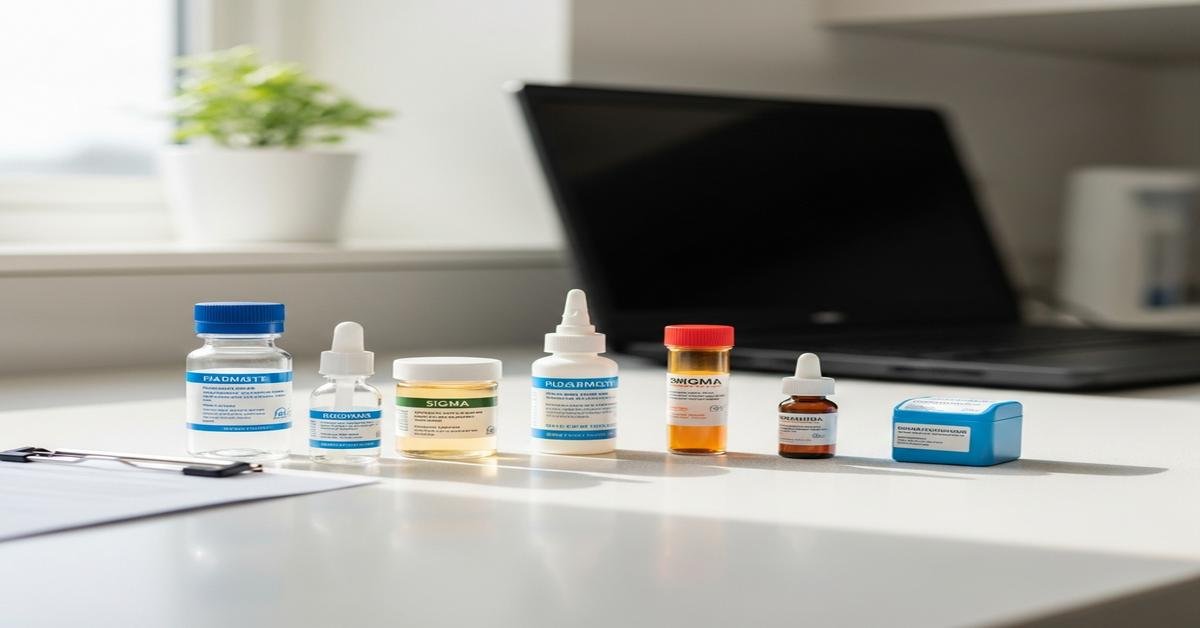
The ExCPT is a working exam. It tests what you actually do as a pharmacy technician: process prescriptions, keep patients safe, follow the law, and do math without errors. If you focus on the core skills below, you’ll be ready for most questions you see on test day—and the tasks you’ll do at the pharmacy counter.
The 5 competencies ExCPT leans on
Most ExCPT items are practical, scenario-based questions with a few straight recall and math problems mixed in. They mirror the flow of a real shift: take in the order, enter it correctly, catch problems, fill and label accurately, and follow legal and safety rules. Here are the five areas that show up again and again—and how to study them.
1) Medication Order Entry and Fill Process
What you need to know
- Reading prescriptions accurately: Patient ID, prescriber info and DEA (if controlled), date, drug, strength, dose form, quantity, directions (SIG), refills, substitutions.
- Interpreting SIGs: tid, q6h, prn, hs, ac/pc, gtts, tsp/tbsp. Also know unsafe abbreviations to avoid (e.g., “U,” “QD,” “QOD”).
- DAW codes: 0 (no product selection indicated), 1 (brand medically necessary), 2 (patient requests brand).
- Profile checks: Allergies, duplicate therapy, interactions, appropriate dose/age.
- Labeling essentials: Patient name, drug name/strength, directions, quantity, prescriber, fill date, Rx number, pharmacy info, auxiliary labels, beyond-use date (if compounded).
- Workflow controls: NDC match, lot/expiration tracking, barcode scan, pharmacist final check, proper storage and handoff.
- Third-party basics: BIN/PCN/group, common rejections (refill too soon, prior auth required, invalid DOB, non-matched NDC), coordination of benefits.
Why this matters: Most errors start at entry. The exam wants to see that you can interpret, enter, and pass along a clean, accurate order.
Typical question styles
- A prescription says “Amoxicillin 400 mg/5 mL, 1 tsp bid x 10 days.” Which quantity is correct? (Answer requires converting tsp to mL, then total mL.)
- The prescriber writes for brand medically necessary. Which DAW code applies?
- Insurance rejects a claim as “refill too soon.” What should you check first?
How to study
- Practice translating SIGs into plain language and days’ supply.
- Memorize top DAW codes and common rejection reasons with your next steps.
- Drill the label contents and what must be on a controlled-substance label in your state.
2) Medication Safety and Quality Assurance
What you need to know
- Error prevention: The “five rights,” Tall Man lettering, separating look-alike/sound-alike (LASA) drugs, using barcodes, reading back verbal orders.
- High-alert meds: Insulins, anticoagulants (warfarin), opioids, concentrated electrolytes (KCl), chemo and hazardous drugs.
- Do-not-use abbreviations: U, IU, QD, trailing zeros, naked decimal points.
- Quality checks: NDC 3-segment match (labeler-product-package), lot/expiration, reconciliation, fridge/freezer storage ranges, look for tampering.
- Reporting: Distinguish adverse drug events from dispensing errors. Know internal incident reporting and when to escalate to the pharmacist. Be familiar with MedWatch (product safety/adverse events) and vaccine adverse event reporting.
- Recalls: Class I (serious harm/death), Class II (temporary/reversible), Class III (unlikely harm). What to do when a recall hits your inventory.
Why this matters: The safest pharmacies are systematic. The exam checks that you recognize risk and follow safe processes every time.
Typical question styles
- Which practice reduces LASA mix-ups? (Examples: Tall Man labels, separation, indication on label.)
- What is the correct action if you discover a patient received the wrong strength yesterday? (Notify pharmacist immediately; start incident process and patient outreach.)
- Classify a recall and identify the correct pharmacy response.
How to study
- Memorize do-not-use abbreviations and when to use leading/trailing zeros.
- Make a short list of high-alert and hazardous meds you see often.
- Practice “spot the error” drills with look-alike labels and NDC mismatches.
3) Pharmacy Law and Regulations
What you need to know
- Controlled substances:
- Schedules II–V basics and examples you see often.
- Prescription requirements for controlled drugs (DEA number, dates, refills rules).
- Schedule II: No refills. Partial-fills allowed under specific conditions; know this differs by setting and state—federal rules set a baseline.
- Schedule III–V: Up to 5 refills within 6 months from the date written. One-time transfer between pharmacies unless a shared, real-time database allows more (follow state law).
- DEA forms: 222 (order C-II), 106 (theft/loss), 41 (destruction).
- Key federal laws:
- HIPAA privacy basics (minimum necessary, disclose only to those involved in care/payment/operations).
- OBRA ’90 counseling mandate by pharmacists; techs support and document offers to counsel.
- Poison Prevention Packaging Act: child-resistant caps, common exceptions (e.g., nitroglycerin SL).
- Combat Methamphetamine Epidemic Act: pseudoephedrine limits—3.6 g/day, 9 g/30 days retail (7.5 g mail-order); ID and logbook requirements.
- Safety programs: REMS examples (isotretinoin iPLEDGE, clozapine monitoring). Tech role is verification and documentation.
- Recalls and returns: Handling procedures and documentation.
- Recordkeeping: Maintain controlled substance records and invoices; know that federal rules set minimums and states can be stricter.
Why this matters: Law questions make sure you protect patients and the pharmacy license. When in doubt, the stricter rule (often state) applies in practice, but ExCPT expects federal baselines.
Typical question styles
- How many refills are allowed for a Schedule IV prescription? (Up to 5 in 6 months.)
- Which DEA form documents significant theft of controlled substances? (Form 106.)
- What is the daily retail sales limit for pseudoephedrine? (3.6 grams.)
How to study
- Create a one-page summary: schedules, refills, transfers, DEA forms, pseudoephedrine limits, recall classes.
- Drill brand/generic examples of commonly scheduled meds (e.g., oxycodone C-II, alprazolam C-IV).
- Do quick flashcards on HIPAA do’s/don’ts and OBRA ’90 counseling basics.
4) Pharmacology and Top Medications
What you need to know
- Top classes and examples:
- Hypertension: ACE inhibitors (lisinopril), ARBs (losartan), beta-blockers (metoprolol), CCBs (amlodipine), diuretics (HCTZ).
- Lipids: Statins (atorvastatin, simvastatin). Key caution: myopathy signs go to pharmacist.
- Diabetes: Metformin, sulfonylureas (glipizide), GLP-1s (semaglutide), insulins (glargine, lispro). Hypoglycemia risk differs by agent.
- GI: PPIs (omeprazole), H2 blockers (famotidine), antiemetics (ondansetron).
- Infectious disease: Penicillins (amoxicillin), macrolides (azithromycin), fluoroquinolones (levofloxacin). Watch allergies and interactions (e.g., QT risk).
- Psych: SSRIs (sertraline), SNRIs (venlafaxine), benzodiazepines (lorazepam C-IV).
- Pain: NSAIDs (ibuprofen), opioids (oxycodone C-II), acetaminophen limits (max daily dosing).
- Respiratory: SABA (albuterol), inhaled corticosteroids (fluticasone), combo inhalers.
- Brand/generic pairs: Expect many of the top 200.
- Common side effects and cautions: ACE cough, statin muscle pain, metformin GI upset/lactic acidosis risk, opioids constipation, warfarin bleeding signs.
- Interactions to flag: Warfarin with many drugs, CYP interactions, MAOIs with tyramine, QT prolongers together.
- Storage and handling: Refrigerated items (certain insulins, vaccines), light/moisture protection.
Why this matters: You’re the first safety net. Recognizing a red flag lets you pull in the pharmacist before a problem reaches the patient.
Typical question styles
- Match a drug to its class or indication. Example: Losartan is an ARB used for hypertension.
- Identify a counseling flag to escalate. Example: New statin + severe muscle pain.
- Storage question. Example: Which product must be refrigerated before dispensing?
How to study
- Build class-based flashcards: class → mechanism (one line) → key drug → side effect to flag.
- Group brand/generics by look-alike endings (e.g., “-pril” ACEs, “-sartan” ARBs, “-olol” beta-blockers, “-prazole” PPIs).
- Make a short list of interactions and “always tell the pharmacist” symptoms.
5) Pharmacy Math and Compounding (Sterile and Nonsterile)
What you need to know
- Core math:
- Ratios, proportions, dimensional analysis.
- Metric/household conversions: mg↔g, mL↔L, tsp (5 mL), tbsp (15 mL), oz (30 mL), lb↔kg (2.2 lb = 1 kg).
- Percent strength and concentration: w/v, w/w, v/v.
- Alligation for mixing strengths. Dilution formula: C1V1 = C2V2.
- Dosing: mg/kg/day, divided doses; days’ supply; IV rates (mL/hr, gtt/min with drop factor).
- Nonsterile compounding:
- Techniques: trituration, levigation, spatulation, geometric dilution, pulverization by intervention.
- Equipment: glass vs. wedgewood vs. porcelain mortars; ointment slabs; syringes for viscous liquids.
- Beyond-use dating basics for nonsterile preparations (follow USP guidance and pharmacy policy). Understand difference between expiration date (manufacturer) and BUD (compounded product stability).
- Labeling: ingredients, concentrations, BUD, storage, auxiliary labels.
- Sterile compounding and aseptic technique:
- Hand hygiene and garbing order: shoe covers, head/facial hair cover, mask, wash hands/forearms, gown, sterile gloves; sanitize gloves with 70% IPA.
- Hood practices: work at least 6 inches inside; don’t block airflow; clean from cleanest to dirtiest (back to front/top to bottom as applicable) with approved disinfectants.
- Critical sites: needle, syringe tip, vial stopper. Never touch; keep in first air.
- Hazardous drugs basics: use appropriate engineering controls and PPE; recognize USP <800> principles at a high level.
Why this matters: One math slip can cause harm. The exam checks that you can set up clean equations and follow safe technique every time you compound.
Typical question styles
- Days’ supply: 1 inhaler has 200 puffs; SIG 2 puffs bid. How many days? (50 days.)
- Dose calculation: 7.5 mg/kg/day for a 20-kg child divided q12h. What is each dose? (Total 150 mg/day → 75 mg per dose.)
- Alligation: Mix 10% and 1% to make 100 g of 5%. How many grams of each?
- Aseptic technique: Which step is inappropriate in the laminar airflow workbench? (E.g., working near the edge, blocking first air.)
How to study
- Write units on every number. Cancel units as you go. If units don’t cancel, your setup is wrong.
- Memorize a small conversion set (tsp, tbsp, oz, lb↔kg) and percent strength relationships.
- Practice 10–15 math problems daily: dosing, days’ supply, compounding, and IV rates.
- Rehearse garbing and hood steps out loud. Muscle memory helps under pressure.
Mini problem set with solutions
- 1) Days’ supply. Metformin 500 mg, take 1 tab po bid. Dispense 60. Days’ supply?
Solution: 2 tabs/day. 60/2 = 30 days. - 2) Liquid volume. Amoxicillin 400 mg/5 mL. SIG: 5 mL bid x 10 days. What total volume?
Solution: 10 mL/day × 10 days = 100 mL. Dispense next available size that covers 100 mL (often 100 mL or 150 mL per stock). - 3) Weight-based dose. Order: 0.2 mg/kg. Patient: 165 lb. Available: 2 mg/mL. What volume?
Solution: 165 lb ÷ 2.2 = 75 kg. Dose = 0.2 × 75 = 15 mg. Volume = 15 mg ÷ 2 mg/mL = 7.5 mL. - 4) Alligation. Make 250 g of 2.5% from 1% and 5%.
Setup: Parts of 5% = 2.5 − 1 = 1.5; parts of 1% = 5 − 2.5 = 2.5.
Total parts = 1.5 + 2.5 = 4.
Solution: 5% amount = (1.5/4) × 250 = 93.75 g; 1% amount = (2.5/4) × 250 = 156.25 g. - 5) IV rate. Infuse 1,000 mL NS over 8 hours. mL/hr?
Solution: 1000 ÷ 8 = 125 mL/hr.
High-yield facts to memorize fast
- DAW codes: 0 = no product selection; 1 = brand medically necessary; 2 = patient wants brand.
- Controlled basics: C-II: no refills. C-III–V: up to 5 refills in 6 months; one-time transfer (unless shared database allows more; follow state law).
- DEA forms: 222 order C-II; 106 theft/loss; 41 destruction.
- PSE limits: 3.6 g/day; 9 g/30 days retail; ID + logbook.
- Recall classes: I serious, II reversible/temporary, III unlikely harm.
- Do-not-use: U, IU, QD/QOD, trailing zeros, no naked decimals.
- Conversions: 1 tsp = 5 mL; 1 tbsp = 15 mL; 1 oz = 30 mL; 2.2 lb = 1 kg.
- Storage: Most insulins/vaccines need refrigeration; avoid freezing; check product specifics.
How the exam tests these skills
Expect short patient cases instead of trivia. You’ll use the order entry workflow to decide the next best step, check for safety, apply law limits, and run a quick calculation. Questions often hide one key detail—a patient’s age, a prior allergy, or a SIG that doesn’t match the quantity. Read the stem twice and look for mismatches before you calculate.
Study plan for the last two weeks
- Days 14–10: Build your law one-pager and a top-200 drug list by class. Do 20 mixed questions daily.
- Days 9–6: Heavy math practice (30 problems/day). Add compounding technique drills and aseptic steps.
- Days 5–3: Full-length practice sets (60–80 questions). Review every miss and write the “fix” in your notebook.
- Day 2: Re-memorize high-yield lists: DEA forms, PSE limits, DAW codes, do-not-use abbreviations, conversions.
- Day 1: Light review and rest. Pack ID, watch, nonprogrammable calculator if allowed. Sleep.
Test-day tactics
- Do math last in each block. Grab quick wins first. Mark longer calculations and return with a clear head.
- Units first. Write the units you need. Set up the equation so units cancel cleanly.
- Watch the SIG vs. quantity. If days’ supply doesn’t match a typical plan (like 30), recheck.
- When in legal doubt, choose the stricter safeguard. No refills on C-IIs; verify ID for PSE; document.
- Always escalate safety concerns to the pharmacist. That is the expected action when harm is possible.
Common pitfalls to avoid
- Trailing zeros and naked decimals. 1.0 mg can be read as 10 mg; .5 mg can be missed. Use 1 mg and 0.5 mg.
- Look-alike NDCs. Match all three segments before you scan and fill.
- Miscalculating by not converting units. Pounds to kilograms is a frequent trap.
- Forgetting auxiliary labels. Shake well for suspensions; finish all antibiotics; may cause drowsiness; keep refrigerated where applicable.
- Mixing brand-generic with different strengths. Verify exact strength, not just the name.
Final check: your readiness list
- I can read any SIG and write plain-language directions back.
- I know C-II vs. C-III–V refill/transfer rules and which DEA form does what.
- I can do days’ supply, mg/kg dosing, IV rates, percent strength, and alligation without a calculator crutch.
- I can list 10 high-alert meds and 10 LASA pairs I’ll separate in the workflow.
- I can explain pseudoephedrine limits, recall classes, and how to document an error.
- I know the garbing order and how to keep critical sites in first air.
Master these five competencies, and you’ll cover the heart of the ExCPT. More important, you’ll build habits that keep patients safe and your pharmacy running smoothly. Focus on clean entry, strong safety checks, solid law, reliable math, and calm compounding technique. That combination is what the exam—and the job—rewards.

