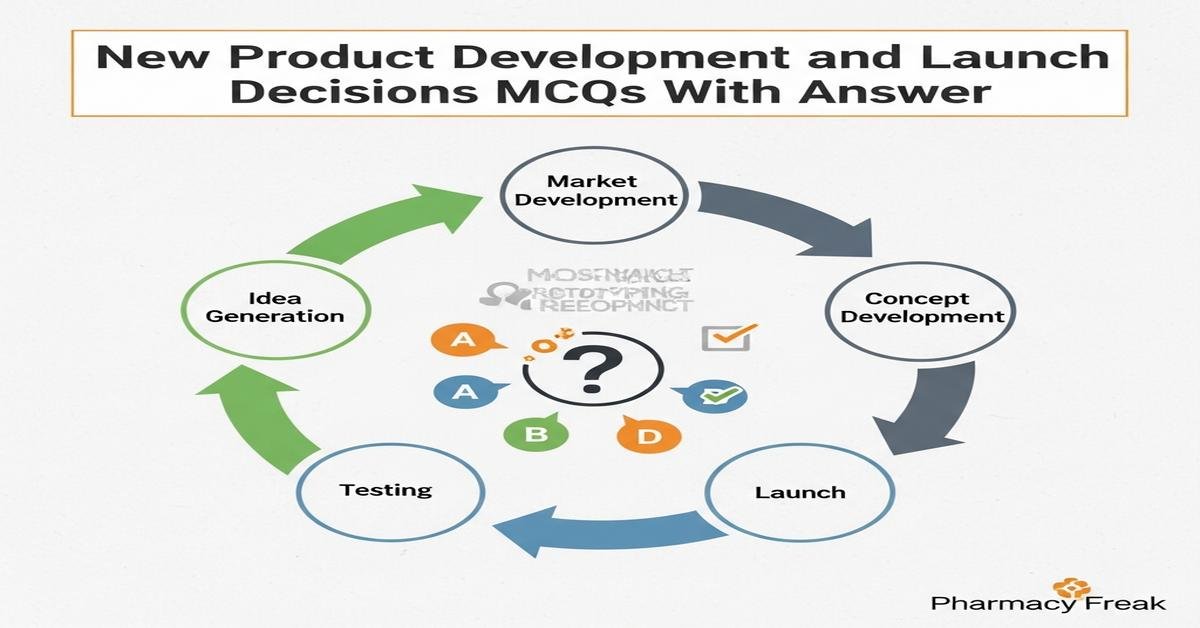
New product development and launch decisions are critical topics for B.Pharm students preparing to enter the pharmaceutical industry. This introduction covers practical aspects of pharmaceutical formulation, scale-up, clinical trials, regulatory approvals (IND, NDA/MAA, ANDA), GMP, stability studies, intellectual property, and market access. Understanding idea screening, prototype development, pilot batches, technology transfer, and post-marketing surveillance helps you evaluate risks and make evidence-based launch decisions. Emphasis on Quality by Design, pharmacovigilance, and commercial considerations prepares you for real-world product lifecycle management and ethical obligations. Now let’s test your knowledge with 30 MCQs on this topic.
Q1. What is the first formal stage in pharmaceutical new product development?
- Concept testing with patients
- Idea generation and screening
- Regulatory submission
- Full-scale commercial production
Correct Answer: Idea generation and screening
Q2. Which stage primarily focuses on optimizing the drug formulation and excipient selection?
- Market segmentation
- Formulation development
- Post-marketing surveillance
- Reimbursement negotiation
Correct Answer: Formulation development
Q3. The main purpose of idea screening in NPD is to:
- Design packaging artwork
- Reduce technical, regulatory, and commercial risk
- Create final marketing materials
- Initiate pharmacovigilance
Correct Answer: Reduce technical, regulatory, and commercial risk
Q4. Which regulatory submission is required to begin human clinical trials in many regions?
- New Drug Application (NDA)
- Abbreviated New Drug Application (ANDA)
- Investigational New Drug (IND) application
- Marketing Authorization Application (MAA)
Correct Answer: Investigational New Drug (IND) application
Q5. Which type of study evaluates a drug product’s stability under accelerated conditions?
- Bioequivalence study
- Accelerated stability study
- Phase I clinical trial
- Post-approval commitments study
Correct Answer: Accelerated stability study
Q6. Good Manufacturing Practice (GMP) primarily ensures:
- Faster regulatory approvals
- Product quality, safety, and consistency
- Higher marketing budgets
- Patent protection
Correct Answer: Product quality, safety, and consistency
Q7. For obtaining marketing authorization of a novel drug, the typical submission is:
- IND
- NDA / MAA
- Pre-IND briefing only
- Phase IV report
Correct Answer: NDA / MAA
Q8. Bioequivalence studies are required to demonstrate that a generic product:
- Has superior efficacy to the reference
- Is chemically identical in all excipients
- Has similar bioavailability to the reference product
- Requires new clinical trials
Correct Answer: Has similar bioavailability to the reference product
Q9. Phase II clinical trials are primarily designed to assess:
- Long-term post-marketing safety
- Drug manufacturing reproducibility
- Efficacy and dose-ranging in patients
- Bioequivalence versus generics
Correct Answer: Efficacy and dose-ranging in patients
Q10. Technology transfer in pharmaceutical development refers to:
- Transferring regulatory ownership to another company
- Moving a process from development to commercial manufacturing
- Licensing a patent to a competitor
- Marketing the product in a new country
Correct Answer: Moving a process from development to commercial manufacturing
Q11. A pilot batch is produced to:
- Test market acceptance in pharmacies
- Verify manufacturing process, scale-up, and validation
- Replace the stability program
- Serve as the final commercial batch
Correct Answer: Verify manufacturing process, scale-up, and validation
Q12. Quality by Design (QbD) in pharmaceuticals emphasizes:
- Reducing clinical trial phases
- Designing quality into the product through risk-based understanding
- Outsourcing all analytical testing
- Focusing only on end-product testing
Correct Answer: Designing quality into the product through risk-based understanding
Q13. Which form of intellectual property protects a novel chemical entity?
- Trademark
- Trade secret
- Patent
- Copyright
Correct Answer: Patent
Q14. A critical commercial consideration when deciding to launch a drug is:
- Color of the pill
- Market access and reimbursement strategy
- Number of clinical sites used in Phase I
- Type of glass used in analytical vials
Correct Answer: Market access and reimbursement strategy
Q15. Pharmacovigilance is best described as:
- Measuring drug potency in vitro
- Monitoring and evaluating adverse events post-marketing
- Determining the synthetic route for APIs
- Market research for physician preferences
Correct Answer: Monitoring and evaluating adverse events post-marketing
Q16. An ANDA is submitted for:
- A novel chemical entity
- A biologic license application
- A generic drug approval without clinical efficacy studies
- A pediatric exclusivity request
Correct Answer: A generic drug approval without clinical efficacy studies
Q17. Business analysis during NPD typically estimates:
- Stability chamber temperature profiles
- Costs, projected revenues, break-even and ROI
- Chromatographic method development
- Number of excipients allowable
Correct Answer: Costs, projected revenues, break-even and ROI
Q18. A key challenge during formulation scale-up is:
- Designing promotional campaigns
- Maintaining critical process parameters and reproducibility
- Selecting the brand name
- Preparing the patient information leaflet
Correct Answer: Maintaining critical process parameters and reproducibility
Q19. Which ICH guideline covers stability testing of new drug substances and products?
- ICH Q3A
- ICH Q1A
- ICH Q8
- ICH M4
Correct Answer: ICH Q1A
Q20. For sterile injectable products, the most important packaging attribute is:
- Color of the label
- Container-closure integrity
- Pill scoring
- Marketing claim wording
Correct Answer: Container-closure integrity
Q21. Effective market segmentation for a pharmaceutical product is commonly based on:
- Packaging material density
- Therapeutic area and prescriber specialty
- Manufacturing site location
- Expiry date conventions
Correct Answer: Therapeutic area and prescriber specialty
Q22. Which form of IP specifically protects a drug’s brand name?
- Patent
- Trademark
- Trade secret
- Design patent
Correct Answer: Trademark
Q23. Phase III clinical trials are primarily intended to:
- Assess pharmacokinetics in animals
- Confirm efficacy and monitor adverse events in large patient populations
- Replace the need for stability studies
- Test production-line automation
Correct Answer: Confirm efficacy and monitor adverse events in large patient populations
Q24. An orphan drug designation is granted for therapies targeting:
- Common colds
- Rare diseases with small patient populations
- Over-the-counter supplements
- Improved packaging designs
Correct Answer: Rare diseases with small patient populations
Q25. A cost-plus pricing strategy determines price by:
- Benchmarking competitor efficacy
- Adding a fixed margin to unit production cost
- Setting price equal to regulatory fees
- Using only perceived value to patients
Correct Answer: Adding a fixed margin to unit production cost
Q26. A “first-in-class” drug is characterized by:
- Being the cheapest option
- A novel mechanism of action not previously approved
- Having identical bioequivalence to a reference
- Being only over-the-counter
Correct Answer: A novel mechanism of action not previously approved
Q27. Minimum Inhibitory Concentration (MIC) is used to:
- Measure tablet hardness
- Determine the lowest antibiotic concentration that inhibits visible bacterial growth
- Assess dissolution of sustained-release tablets
- Evaluate container closure integrity
Correct Answer: Determine the lowest antibiotic concentration that inhibits visible bacterial growth
Q28. A commonly used metric to evaluate market performance after launch is:
- Time in stability chamber
- Market share (%)
- Number of analytical methods developed
- Number of pilot batches produced
Correct Answer: Market share (%)
Q29. The purpose of a pilot plant in pharmaceutical development is to:
- Conduct Phase IV epidemiology studies
- Scale up the process and produce validation batches under controlled conditions
- Create the final patient leaflet
- Serve as a commercial distribution center
Correct Answer: Scale up the process and produce validation batches under controlled conditions
Q30. The primary ethical requirement before enrolling a human volunteer in a clinical trial is:
- A signed material transfer agreement
- Informed consent from the participant
- Completed market analysis
- Proof of patent filing
Correct Answer: Informed consent from the participant

