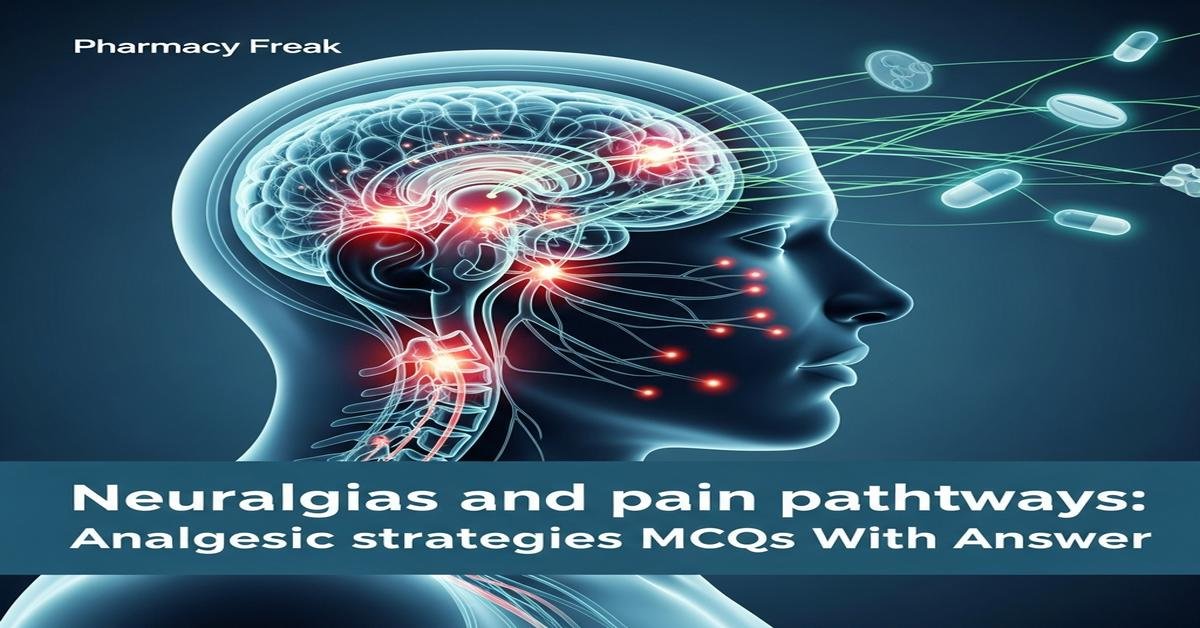
Neuralgias and pain pathways: analgesic strategies MCQs With Answer is a focused quiz resource tailored for M.Pharm students covering pathophysiology and pharmacotherapy of neuralgias and neuropathic pain. This set emphasizes mechanistic understanding of peripheral and central pain pathways, key molecular targets (e.g., voltage-gated sodium and calcium channels, NMDA, TRPV1), and therapeutic strategies including anticonvulsants, antidepressants, topical agents, NMDA antagonists and interventional options. Questions probe drug mechanisms, clinical choices for trigeminal and postherpetic neuralgia, adverse effects, pharmacokinetic interactions and novel targets like Nav1.7. Designed to deepen applied knowledge for examinations and clinical decision-making, each MCQ includes a clear correct answer to aid rapid revision and self-assessment.
Q1. Which is the primary pharmacological mechanism by which carbamazepine relieves symptoms in trigeminal neuralgia?
- Potent NMDA receptor antagonism reducing central sensitization
- Inhibition of voltage-gated sodium channels, stabilizing the inactivated state
- Enhancement of GABAergic transmission in the trigeminal nucleus
- Cyclooxygenase inhibition reducing local inflammation
Correct Answer: Inhibition of voltage-gated sodium channels, stabilizing the inactivated state
Q2. Gabapentin and pregabalin exert analgesic effects in neuropathic pain primarily by which mechanism?
- Agonism at mu-opioid receptors in the dorsal horn
- Binding the alpha2-delta subunit of voltage-gated calcium channels to reduce excitatory neurotransmitter release
- Direct blockade of NMDA receptors to prevent central sensitization
- Inhibition of monoamine reuptake to enhance descending inhibition
Correct Answer: Binding the alpha2-delta subunit of voltage-gated calcium channels to reduce excitatory neurotransmitter release
Q3. Which topical therapy is commonly recommended as first-line for localized postherpetic neuralgia?
- Lidocaine 5% patch applied to painful area
- High-dose topical diclofenac gel
- Oral amitriptyline applied topically
- Topical capsaicin is ineffective and not recommended
Correct Answer: Lidocaine 5% patch applied to painful area
Q4. Central sensitization in chronic neuropathic pain is best characterized by which process?
- Reduced excitability of dorsal horn neurons leading to analgesia
- NMDA receptor-mediated synaptic plasticity increasing dorsal horn excitability causing allodynia and hyperalgesia
- Primary demyelination of peripheral sensory axons without spinal changes
- Upregulation of peripheral prostaglandin synthesis as the main driver
Correct Answer: NMDA receptor-mediated synaptic plasticity increasing dorsal horn excitability causing allodynia and hyperalgesia
Q5. Opioid-induced hyperalgesia is largely attributed to which mechanism?
- Downregulation of opioid receptors only, without other central changes
- Activation of NMDA receptors and pronociceptive central sensitization
- Increased peripheral prostaglandin synthesis counteracting opioids
- Blockade of descending inhibitory monoaminergic pathways exclusively
Correct Answer: Activation of NMDA receptors and pronociceptive central sensitization
Q6. The drug of choice for classic trigeminal neuralgia in initial therapy is:
- Carbamazepine
- Paregabalin
- Morphine sulfate
- Duloxetine
Correct Answer: Carbamazepine
Q7. Mutations in which voltage-gated sodium channel subtype (gene SCN9A) are strongly associated with inherited painful neuropathies and are a target for new analgesics?
- Nav1.7
- Nav1.8
- Nav1.3
- Nav1.4
Correct Answer: Nav1.7
Q8. For chronic neuropathic pain, which overall pharmacologic strategy is considered most appropriate?
- Use of anticonvulsants (e.g., gabapentinoids) and antidepressants (TCAs/SNRIs) targeting neuronal hyperexcitability and descending inhibition
- Routine use of oral NSAIDs as monotherapy
- High-dose systemic corticosteroids as first-line chronic therapy
- Long-term opioid monotherapy without adjuvants
Correct Answer: Use of anticonvulsants (e.g., gabapentinoids) and antidepressants (TCAs/SNRIs) targeting neuronal hyperexcitability and descending inhibition
Q9. Tricyclic antidepressants relieve neuropathic pain primarily via which pharmacodynamic action?
- Strong agonism at mu-opioid receptors
- Inhibition of serotonin and norepinephrine reuptake enhancing descending inhibitory pathways
- Direct blockade of peripheral sodium channels only
- Selective COX-2 inhibition reducing prostaglandins
Correct Answer: Inhibition of serotonin and norepinephrine reuptake enhancing descending inhibitory pathways
Q10. Low-dose ketamine can be useful in refractory neuropathic pain because it:
- Is a potent GABA-A receptor agonist that sedates patients
- Antagonizes NMDA receptors, reducing central sensitization
- Is a selective serotonin reuptake inhibitor improving mood
- Inhibits peripheral prostaglandin synthesis
Correct Answer: Antagonizes NMDA receptors, reducing central sensitization
Q11. The analgesic effect of topical capsaicin in neuropathic pain results from which mechanism?
- Antagonism of voltage-gated sodium channels on peripheral nerves
- Activation then desensitization of TRPV1 channels leading to depletion of substance P
- Direct inhibition of spinal NMDA receptors
- Peripheral cyclooxygenase inhibition reducing inflammation
Correct Answer: Activation then desensitization of TRPV1 channels leading to depletion of substance P
Q12. Which of the following drugs is classified as an alpha2-delta ligand used for neuropathic pain?
- Pregabalin
- Carbamazepine
- Duloxetine
- Lidocaine
Correct Answer: Pregabalin
Q13. For diabetic peripheral neuropathy, which oral agent is commonly recommended as a first-line pharmacotherapy with proven efficacy?
- Duloxetine
- Ibuprofen
- Topical diclofenac
Correct Answer: Duloxetine
Q14. The analgesic action of botulinum toxin in focal neuropathic pain is associated with which mechanism?
- Cleavage of SNAP-25 protein preventing release of neurotransmitters and neuropeptides
- Nonselective sodium channel blockade at the nerve membrane
- Systemic immunosuppression reducing inflammation
- Inhibition of prostaglandin synthesis in peripheral tissues
Correct Answer: Cleavage of SNAP-25 protein preventing release of neurotransmitters and neuropeptides
Q15. Which adverse effect of tricyclic antidepressants is particularly problematic in elderly patients with neuropathic pain?
- Pronounced anticholinergic effects and orthostatic hypotension with cardiac conduction prolongation
- Severe hepatotoxicity in most elderly patients
- Marked renal accumulation causing nephrotoxicity
- Primary respiratory depression at therapeutic doses
Correct Answer: Pronounced anticholinergic effects and orthostatic hypotension with cardiac conduction prolongation
Q16. Why are traditional NSAIDs generally less effective for neuropathic pain compared with nociceptive pain?
- Neuropathic pain is primarily driven by neuronal hyperexcitability and central mechanisms rather than prostaglandin-mediated inflammation
- NSAIDs cannot penetrate peripheral nerve sheaths at any therapeutic dose
- NSAIDs are rapidly metabolized in neuropathic patients making them ineffective
- Neuropathic pain is exclusively psychological and not responsive to anti-inflammatories
Correct Answer: Neuropathic pain is primarily driven by neuronal hyperexcitability and central mechanisms rather than prostaglandin-mediated inflammation
Q17. How does a lidocaine 5% patch provide analgesia in localized neuropathic pain?
- Topical inhibition of prostaglandin synthesis in the skin
- Local blockade of voltage-gated sodium channels in peripheral nociceptors reducing ectopic discharges
- Activation of peripheral serotonin receptors to produce analgesia
- Serving primarily as a placebo with no proven local effect
Correct Answer: Local blockade of voltage-gated sodium channels in peripheral nociceptors reducing ectopic discharges
Q18. Which adjuvant drug class is commonly used to achieve an opioid-sparing effect in neuropathic pain management?
- Gabapentinoids (e.g., pregabalin, gabapentin)
- Topical NSAIDs
- Systemic corticosteroids as long-term therapy
- High-dose acetaminophen alone
Correct Answer: Gabapentinoids (e.g., pregabalin, gabapentin)
Q19. Carbamazepine has important pharmacokinetic interactions because it:
- Is a potent inducer of hepatic CYP3A4 enzymes, reducing plasma concentrations of many co-administered drugs
- Strongly inhibits renal tubular secretion of most analgesics
- Blocks intestinal absorption of lipophilic drugs non-specifically
- Is eliminated unchanged in urine so drug interactions are negligible
Correct Answer: Is a potent inducer of hepatic CYP3A4 enzymes, reducing plasma concentrations of many co-administered drugs
Q20. A promising novel analgesic target for inherited and acquired neuropathic pain is selective blockade of which channel subtype?
- Nav1.7 selective sodium channel blockers
- Muscarinic M2 receptor antagonists
- COX-1 selective inhibitors
- Voltage-gated potassium channel Kv1.1 activators exclusively
Correct Answer: Nav1.7 selective sodium channel blockers

