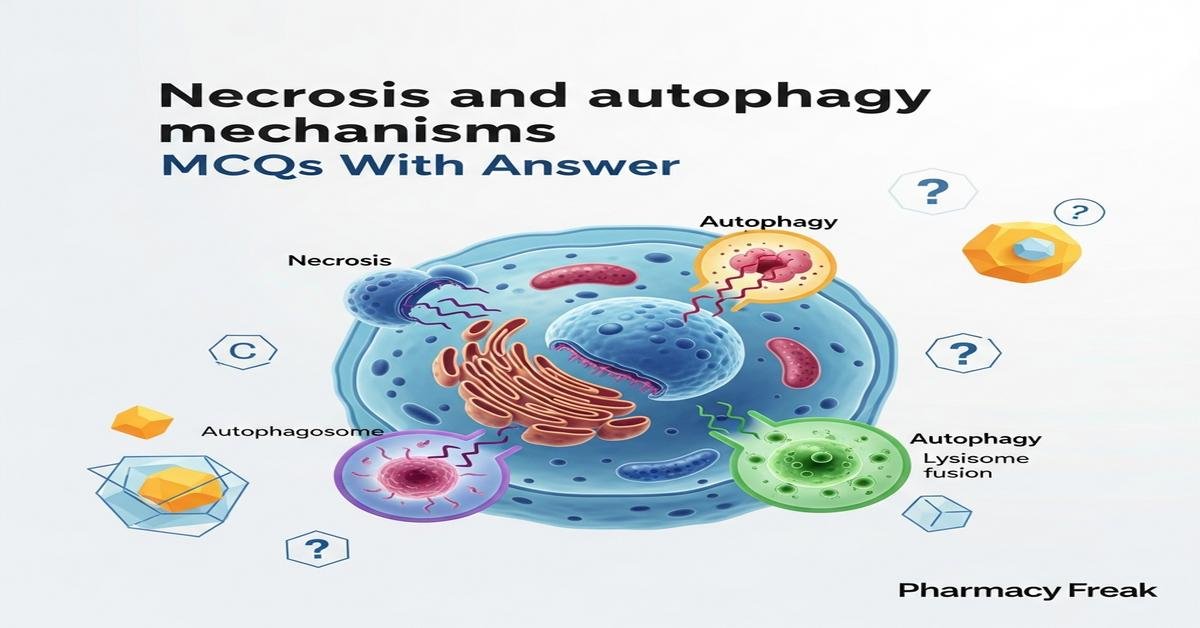
Necrosis and autophagy mechanisms MCQs With Answer
This question set is designed for M.Pharm students to strengthen understanding of necrosis and autophagy at molecular and pharmacological levels. The questions cover canonical and regulated forms of necrosis (necroptosis, pyroptosis, ferroptosis), key damage-associated molecular patterns, and detailed autophagy machinery including initiation complexes, Atg conjugation systems, selective autophagy (mitophagy), regulators (mTOR, AMPK, ULK1, Beclin-1), and common experimental tools and drugs. Each MCQ emphasizes mechanistic detail and therapeutic relevance to help bridge basic cell biology with drug-targeting strategies and experimental interpretation in advanced pharmacology studies.
Q1. Which of the following best describes classical necrosis in pathological conditions?
- Organized nuclear fragmentation without inflammation
- Energy-dependent formation of apoptotic bodies
- Irreversible cell swelling, plasma membrane rupture and release of intracellular contents causing inflammation
- Autophagosome-mediated degradation of cytoplasmic components
Correct Answer: Irreversible cell swelling, plasma membrane rupture and release of intracellular contents causing inflammation
Q2. Necroptosis is executed through which molecular pathway?
- Cytochrome c release and caspase-9 activation
- RIPK1–RIPK3 complex formation leading to MLKL-mediated plasma membrane disruption
- GPX4 inhibition causing lipid peroxidation
- Caspase-1 cleavage of gasdermin D to form membrane pores
Correct Answer: RIPK1–RIPK3 complex formation leading to MLKL-mediated plasma membrane disruption
Q3. Which pharmacological inhibitor is most commonly used to block necroptosis by targeting RIPK1 kinase activity?
- Ferrostatin-1
- Necrostatin-1
- Bafilomycin A1
- Z-VAD-FMK
Correct Answer: Necrostatin-1
Q4. Pyroptosis is characterized by inflammatory cell death mediated by which effector protein that forms membrane pores after caspase cleavage?
- MLKL
- Gasdermin D
- Beclin-1
- LC3
Correct Answer: Gasdermin D
Q5. Ferroptosis is mechanistically defined by which of the following?
- Caspase-3 activation and DNA laddering
- Lysosomal rupture and cathepsin release
- Iron-dependent lipid peroxidation due to GPX4 inactivation
- Formation of autophagosomes via Atg12–Atg5 conjugation
Correct Answer: Iron-dependent lipid peroxidation due to GPX4 inactivation
Q6. Under nutrient-rich conditions which key complex inhibits autophagy initiation?
- ULK1 complex
- Beclin-1–VPS34 complex
- mTORC1
- Parkin–PINK1 complex
Correct Answer: mTORC1
Q7. The primary kinase complex that initiates canonical autophagy by phosphorylating downstream Atg proteins is:
- AMPK–LKB1 complex
- ULK1 (Atg1) complex
- PI3K class I complex
- RIPK1–RIPK3 complex
Correct Answer: ULK1 (Atg1) complex
Q8. Beclin-1 is an essential autophagy protein that forms a core complex with which lipid kinase to nucleate autophagosomal membranes?
- Class I PI3K
- VPS34 (class III PI3K)
- mTOR
- PKC
Correct Answer: VPS34 (class III PI3K)
Q9. Which protease cleaves pro-LC3 to generate LC3-I as the first step in LC3 processing?
- Caspase-8
- Cathepsin D
- ATG4
- Calpain
Correct Answer: ATG4
Q10. Conversion of LC3-I to LC3-II requires covalent lipidation with which lipid moiety?
- Phosphatidylserine (PS)
- Phosphatidylinositol (PI)
- Phosphatidylethanolamine (PE)
- Sphingomyelin
Correct Answer: Phosphatidylethanolamine (PE)
Q11. The Atg12 conjugation system forms a complex important for autophagosome formation; Atg12 is covalently linked to which protein?
- Atg16L1
- Atg5
- LC3
- Beclin-1
Correct Answer: Atg5
Q12. p62/SQSTM1 serves which primary role in selective autophagy?
- Acts as a lysosomal proton pump
- Functions as an E3 ubiquitin ligase for mitophagy
- Serves as an adaptor linking ubiquitinated cargo to LC3 for autophagic degradation
- Cleaves LC3 to LC3-I
Correct Answer: Serves as an adaptor linking ubiquitinated cargo to LC3 for autophagic degradation
Q13. Bafilomycin A1 inhibits autophagic flux by which mechanism?
- Inhibiting class III PI3K (VPS34)
- Blocking ULK1 kinase activity
- Inhibiting vacuolar H+-ATPase to prevent lysosomal acidification
- Activating mTORC1 to suppress autophagy initiation
Correct Answer: Inhibiting vacuolar H+-ATPase to prevent lysosomal acidification
Q14. 3-Methyladenine (3-MA) is used experimentally to block autophagy by inhibiting which enzyme activity?
- mTORC1
- Class III PI3K (VPS34)
- ATG4 protease
- V-ATPase
Correct Answer: Class III PI3K (VPS34)
Q15. Which experimental observation most reliably indicates an increase in autophagic flux (rather than mere blockade of degradation)?
- Decrease in LC3-II levels after bafilomycin treatment
- No change in LC3-II with addition of lysosomal inhibitor
- Accumulation of LC3-II after bafilomycin treatment compared to untreated cells
- Reduced p62 levels only in the presence of lysosomal inhibitors
Correct Answer: Accumulation of LC3-II after bafilomycin treatment compared to untreated cells
Q16. Mitophagy frequently utilizes which pathway involving stabilization of PINK1 on damaged mitochondria and recruitment of Parkin?
- mTOR–ULK1 pathway
- PINK1–Parkin ubiquitin-dependent mitophagy pathway
- Beclin-1–VPS34 independent autophagy
- Gasdermin-mediated mitochondrial clearance
Correct Answer: PINK1–Parkin ubiquitin-dependent mitophagy pathway
Q17. Autophagy reduces activation of the NLRP3 inflammasome primarily by which mechanism?
- Direct inhibition of caspase-1 enzymatic activity
- Degradation of damaged mitochondria and mitochondrial ROS that activate NLRP3
- Sequestration of gasdermin D in autophagosomes
- Phosphorylation of NLRP3 by ULK1
Correct Answer: Degradation of damaged mitochondria and mitochondrial ROS that activate NLRP3
Q18. Autophagic cell death (type II programmed cell death) is typically characterized as which of the following?
- Caspase-dependent DNA fragmentation identical to apoptosis
- Cell death with prominent autophagic vacuolization and often caspase-independent mechanisms
- Rapid plasma membrane rupture with uncontrolled inflammation
- Exclusive activation of necroptosis signaling
Correct Answer: Cell death with prominent autophagic vacuolization and often caspase-independent mechanisms
Q19. Which damage-associated molecular pattern (DAMP) is commonly released during necrotic cell death and can activate innate immunity via TLR4?
- LC3-II
- HMGB1 (High-mobility group box 1)
- PINK1
- Beclin-1
Correct Answer: HMGB1 (High-mobility group box 1)
Q20. Which compound is a small-molecule inhibitor commonly used experimentally to block ferroptosis by acting as a radical-trapping antioxidant?
- Necrostatin-1
- Ferrostatin-1
- 3-Methyladenine
- Bafilomycin A1
Correct Answer: Ferrostatin-1

