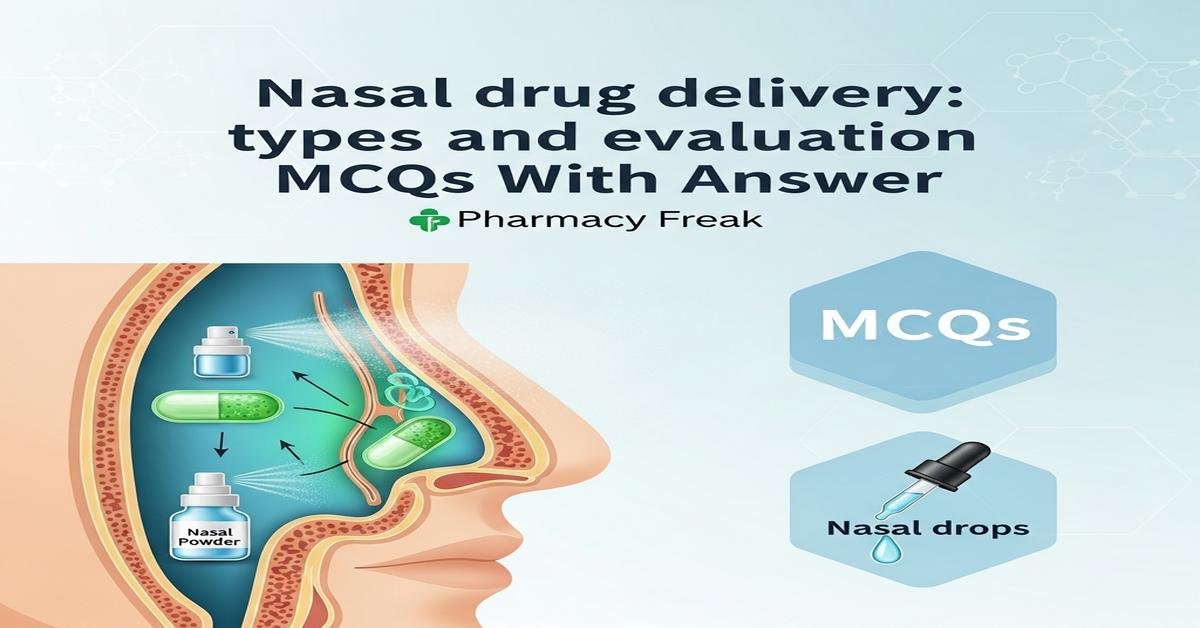
Nasal drug delivery offers a versatile route for both local and systemic therapy, and increasingly, for targeted nose-to-brain delivery. This blog presents an advanced set of multiple-choice questions designed for M.Pharm students studying Molecular Pharmaceutics (NTDS, MPH 201T). The quiz emphasizes nasal anatomy, transport pathways, formulation strategies (sprays, gels, powders, liposomes, microspheres), mucoadhesion, permeation enhancers, enzymatic barriers, dosing devices, and in vitro/ex vivo/in vivo evaluation techniques. Each question tests conceptual understanding and application to formulation development, evaluation, and clinical translation—helpful for exam preparation and practical formulation design decisions in nasal drug delivery research.
Q1. What are the primary classifications of nasal drug delivery based on therapeutic target?
- Local nasal, systemic, and direct nose-to-brain delivery
- Oral, parenteral, and topical delivery
- Pulmonary, ocular, and transdermal delivery
- Enteric, sustained-release, and immediate-release delivery
Correct Answer: Local nasal, systemic, and direct nose-to-brain delivery
Q2. Which nasal epithelial region is principally responsible for olfactory (direct nose-to-brain) drug transport?
- Respiratory epithelium lining the inferior turbinate
- Olfactory epithelium in the superior nasal cavity
- Vestibular epithelium at the nostril entrance
- Anterior septal mucosa
Correct Answer: Olfactory epithelium in the superior nasal cavity
Q3. Which factor most strongly affects deposition of aerosolized nasal formulations within the nasal cavity?
- Particle size and spray plume geometry
- Formulation color and odor
- Drug molecular weight only
- Systemic blood flow rate
Correct Answer: Particle size and spray plume geometry
Q4. What is the typical particle size range for nasal powders intended to deposit in the anterior nasal cavity and avoid lung penetration?
- 0.1–1 µm
- 1–5 µm
- 10–100 µm
- 100–500 µm
Correct Answer: 10–100 µm
Q5. Which mechanism is a major barrier to prolonged nasal residence of formulations?
- Mucociliary clearance
- Hepatic first-pass metabolism
- Gastric emptying
- Renal excretion
Correct Answer: Mucociliary clearance
Q6. Which excipient class is most commonly used to increase nasal residence time via mucoadhesion?
- Low-viscosity surfactants
- Mucoadhesive polymers (e.g., chitosan, carbopol)
- Organic solvents (e.g., ethanol)
- Sugar alcohols (e.g., sorbitol)
Correct Answer: Mucoadhesive polymers (e.g., chitosan, carbopol)
Q7. Which evaluation method best simulates mucociliary clearance in vitro for nasal formulations?
- Diffusion cell across cellulose membrane
- Rheological measurement at 25°C
- Ex vivo nasal mucosa ciliary beat frequency assay or mucociliary transportability test
- Accelerated stability at 40°C
Correct Answer: Ex vivo nasal mucosa ciliary beat frequency assay or mucociliary transportability test
Q8. For peptides delivered intranasally, which strategy reduces metabolic degradation by nasal peptidases?
- Co-administration of protease inhibitors or use of enzyme-resistant analogs
- Increasing isotonicity with high salt
- Decreasing formulation pH to 1.5
- Using long-chain triglycerides as solvent
Correct Answer: Co-administration of protease inhibitors or use of enzyme-resistant analogs
Q9. Which nasal device is most appropriate to deliver a measured metered-dose liquid spray to reach deeper regions of the nasal cavity?
- Dropper bottle
- Metered-dose nasal spray pump with controlled plume
- Large-volume irrigation syringe
- Powder insufflator with large particle output
Correct Answer: Metered-dose nasal spray pump with controlled plume
Q10. What is a principal advantage of nasal delivery for systemic small molecules compared with oral administration?
- Complete avoidance of all enzymatic metabolism in the nose
- Rapid absorption with partial avoidance of hepatic first-pass metabolism
- Guaranteed 100% bioavailability
- Indefinite stability at room temperature
Correct Answer: Rapid absorption with partial avoidance of hepatic first-pass metabolism
Q11. Which physicochemical property most strongly favors passive transcellular absorption across nasal epithelium?
- High molecular weight and high polarity
- Low log P and extreme hydrophilicity
- Moderate lipophilicity and low molecular weight
- Large peptide sequence (>2000 Da)
Correct Answer: Moderate lipophilicity and low molecular weight
Q12. Which in vitro test is commonly used to evaluate nasal spray plume geometry and droplet size distribution?
- PAMPA assay
- Laser diffraction or cascade impaction analysis
- Osmolality determination
- Dialysis bag release test
Correct Answer: Laser diffraction or cascade impaction analysis
Q13. Which formulation approach is favored for direct nose-to-brain delivery of lipophilic CNS drugs?
- High-viscosity aqueous solution without absorption enhancers
- Liposomal or nanoparticle-based carriers designed to target olfactory region
- Large uncoated microparticles (>200 µm)
- Pure crystalline drug powder with no excipients
Correct Answer: Liposomal or nanoparticle-based carriers designed to target olfactory region
Q14. Which parameter must be optimized to minimize nasal irritation while maintaining drug solubility and stability?
- Formulation pH close to physiological nasal pH (≈5.5–6.5)
- Highly acidic pH <2
- pH >9 to enhance solubility
- Undetermined pH is acceptable
Correct Answer: Formulation pH close to physiological nasal pH (≈5.5–6.5)
Q15. When designing a nasal powder formulation, which property is most important to ensure flow and dose reproducibility?
- High hygroscopicity to absorb ambient moisture
- Controlled particle size distribution and low cohesion
- Extremely broad particle size distribution including >500 µm fractions
- High melting point excipients only
Correct Answer: Controlled particle size distribution and low cohesion
Q16. Which regulatory consideration is critical for nasal vaccines compared with injectable vaccines?
- No need for sterility testing
- Demonstration of mucosal immune response (e.g., IgA) and local tolerability
- Only systemic antibody testing is required
- Omit evaluation of local reactogenicity
Correct Answer: Demonstration of mucosal immune response (e.g., IgA) and local tolerability
Q17. Which analytical measure is commonly used to quantify in vitro drug release from nasal gels or mucoadhesive systems?
- Mass spectrometry of undissolved gel matrix
- Franz diffusion cell or modified diffusion apparatus across synthetic or excised mucosa
- Drop-counting visual assay
- pH measurement of gel only
Correct Answer: Franz diffusion cell or modified diffusion apparatus across synthetic or excised mucosa
Q18. Which permeation enhancer is frequently used for nasal delivery and also exhibits mucoadhesive and transient tight-junction opening properties?
- Sodium lauryl sulfate as a strong surfactant
- Chitosan and its derivatives
- High concentrations of ethanol (>50%)
- Hydrofluoric acid
Correct Answer: Chitosan and its derivatives
Q19. In ex vivo permeability studies using excised nasal mucosa, which outcome indicates that a formulation may have increased epithelial permeability via paracellular route?
- Decreased transepithelial electrical resistance (TEER) values
- Increased mucociliary beat frequency
- No change in mannitol flux
- Increased TEER values
Correct Answer: Decreased transepithelial electrical resistance (TEER) values
Q20. Which pharmacokinetic characteristic is most likely observed after successful intranasal administration of a small molecule with good nasal absorption?
- Extremely delayed Tmax (>24 hours)
- Rapid Tmax (typically minutes to an hour) and potentially lower first-pass metabolism
- Zero systemic exposure irrespective of dose
- Exclusive accumulation in the gastrointestinal tract
Correct Answer: Rapid Tmax (typically minutes to an hour) and potentially lower first-pass metabolism


I am a Registered Pharmacist under the Pharmacy Act, 1948, and the founder of PharmacyFreak.com. I hold a Bachelor of Pharmacy degree from Rungta College of Pharmaceutical Science and Research. With a strong academic foundation and practical knowledge, I am committed to providing accurate, easy-to-understand content to support pharmacy students and professionals. My aim is to make complex pharmaceutical concepts accessible and useful for real-world application.
Mail- Sachin@pharmacyfreak.com