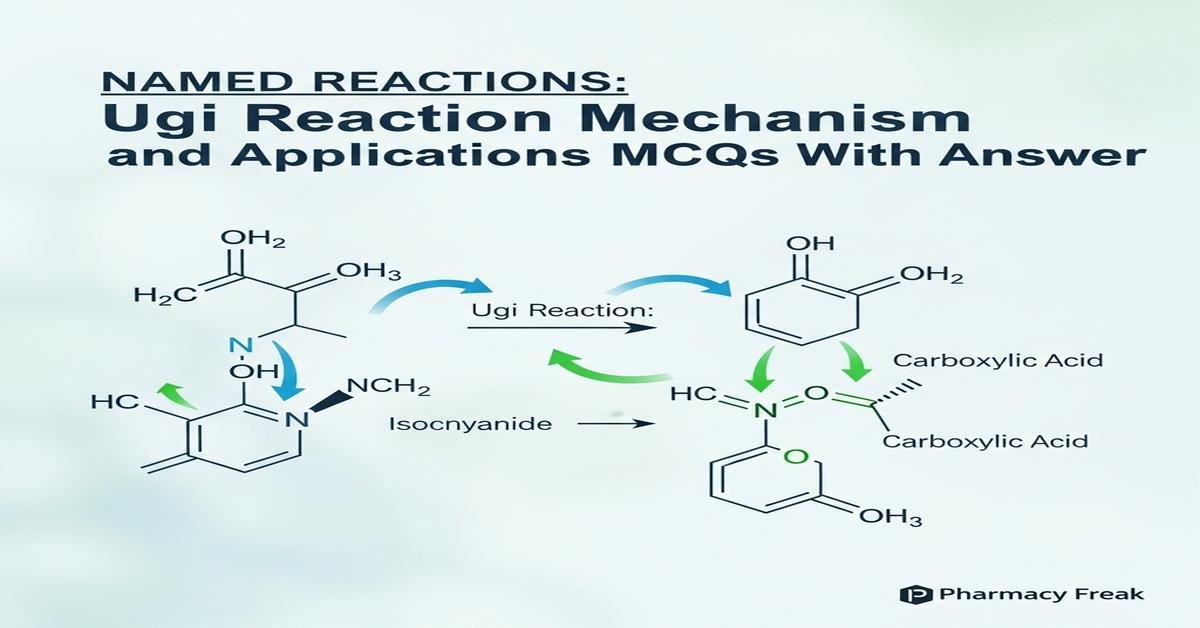
Introduction: The Ugi reaction, a cornerstone multicomponent coupling in modern organic synthesis, assembles an amine, a carbonyl compound, an isocyanide and a carboxylic acid into structurally diverse peptidomimetic scaffolds in a single step. For M.Pharm students, mastering its mechanism — imine/iminium formation, isocyanide addition to give a nitrilium intermediate, and the Mumm rearrangement yielding an α-acylamino amide — is essential for rational drug-design applications and combinatorial library generation. This blog presents 20 focused MCQs on the Ugi reaction mechanism, common variations, reaction parameters, stereochemical considerations and pharmaceutical applications to deepen conceptual understanding and exam readiness.
Q1. Which set of components is required for the classical Ugi four-component reaction?
- Amine, aldehyde or ketone, isocyanide, carboxylic acid
- Amine, alkyne, isocyanide, carboxylic acid
- Amine, aldehyde, nitrile, acid chloride
- Amine, epoxide, isocyanide, carboxylic acid
Correct Answer: Amine, aldehyde or ketone, isocyanide, carboxylic acid
Q2. What is the initial key step in the mechanism of the Ugi reaction?
- Formation of an imine or iminium ion from the amine and carbonyl compound
- Nucleophilic attack of the carboxylate on the isocyanide
- Direct acylation of the amine by the carboxylic acid
- Radical addition of isocyanide to the carbonyl
Correct Answer: Formation of an imine or iminium ion from the amine and carbonyl compound
Q3. After iminium formation, attack of which reagent on the iminium gives the nitrilium intermediate?
- Isocyanide
- Carboxylate anion
- Water
- Alcohol solvent
Correct Answer: Isocyanide
Q4. The Mumm rearrangement in the Ugi mechanism involves which transformation?
- Acyl transfer from oxygen to nitrogen to form the amide linkage (O→N acyl transfer)
- Intramolecular cyclization to give an oxazoline
- Radical fragmentation of the nitrilium ion
- Hydrolysis of the imine to regenerate starting carbonyl
Correct Answer: Acyl transfer from oxygen to nitrogen to form the amide linkage (O→N acyl transfer)
Q5. What is the typical core product class obtained directly from the classical Ugi 4-component reaction?
- α-Acylamino amide (peptidomimetic bis-amide)
- Tetrazole
- β-Lactam
- Nitroalkane
Correct Answer: α-Acylamino amide (peptidomimetic bis-amide)
Q6. Which Ugi modification is commonly used to synthesize tetrazoles, useful as carboxylic acid bioisosteres?
- Ugi-azide (using azidotrimethylsilane or sodium azide)
- Ugi-Smiles
- Passerini reaction
- Bischler-Möhlau modification
Correct Answer: Ugi-azide (using azidotrimethylsilane or sodium azide)
Q7. Which solvent is most frequently employed for standard Ugi reactions due to its solubility and protic nature?
- Methanol
- Hexane
- Water only
- Dimethyl sulfoxide (DMSO)
Correct Answer: Methanol
Q8. Mechanistically, what dual role does the carboxylic acid (or its carboxylate) play in the Ugi reaction?
- Acts as a nucleophile to trap the nitrilium intermediate and as the acyl donor in the Mumm rearrangement
- Serves only as a proton source to generate iminium ion
- Functions exclusively as a leaving group
- Is solely a solvent additive
Correct Answer: Acts as a nucleophile to trap the nitrilium intermediate and as the acyl donor in the Mumm rearrangement
Q9. Which strategy is commonly used to achieve intramolecular Ugi cyclizations for macrocycles or fused rings?
- Use a bifunctional substrate that contains both nucleophilic and electrophilic sites tethered to allow intramolecular trapping
- Perform the reaction at high dilution without tethered functionalities
- Replace isocyanide with a diazo compound
- Omit the carboxylic acid to promote cyclization
Correct Answer: Use a bifunctional substrate that contains both nucleophilic and electrophilic sites tethered to allow intramolecular trapping
Q10. A major limitation when using chiral substrates in the Ugi reaction is often:
- Racemization or erosion of stereochemical purity at stereocenters adjacent to the reacting centers
- Excessive enantioselectivity that is hard to control
- Inability to form any new stereocenters
- Complete intolerance of any functional groups
Correct Answer: Racemization or erosion of stereochemical purity at stereocenters adjacent to the reacting centers
Q11. The Ugi–Smiles variation replaces the carboxylic acid with which nucleophilic component to enable aromatic substitution pathways?
- Activated phenol or phenoxide (Smiles rearrangement partners)
- Primary alcohol
- Thiolate anion
- Amide
Correct Answer: Activated phenol or phenoxide (Smiles rearrangement partners)
Q12. To introduce stereocontrol in an Ugi reaction, a practical approach is to:
- Use chiral auxiliaries or chiral starting materials rather than rely solely on asymmetric catalysis
- Replace the isocyanide with an achiral nitrile
- Perform the reaction at extremely high temperatures
- Use strong oxidants to lock stereochemistry
Correct Answer: Use chiral auxiliaries or chiral starting materials rather than rely solely on asymmetric catalysis
Q13. Experimental trapping of which species provided strong mechanistic evidence for the proposed Ugi nitrilium intermediate?
- Nucleophilic trapping experiments that intercept the nitrilium with external nucleophiles (e.g., azide)
- Observation of free radicals by EPR
- Detection of carbocations by mass spectrometry only
- Isolation of free isocyanide dimers
Correct Answer: Nucleophilic trapping experiments that intercept the nitrilium with external nucleophiles (e.g., azide)
Q14. Under typical laboratory conditions, Ugi reactions are most often run at:
- Room temperature (ambient temperature)
- –78 °C
- Refluxing water only
- 200 °C
Correct Answer: Room temperature (ambient temperature)
Q15. Which description best matches the reactivity of an isocyanide in the Ugi mechanism?
- It behaves as a nucleophilic carbon species that attacks the iminium to form a nitrilium intermediate
- It only acts as a simple spectator solvent
- It serves exclusively as an oxidizing agent
- It functions as a stable leaving group
Correct Answer: It behaves as a nucleophilic carbon species that attacks the iminium to form a nitrilium intermediate
Q16. One principal application of the Ugi reaction in pharmaceutical research is:
- Rapid generation of diverse small-molecule libraries for hit discovery via combinatorial chemistry
- Large-scale hydrogenation of aromatic rings
- Selective oxidation of primary alcohols to aldehydes
- Polymer cross-linking in drug formulations
Correct Answer: Rapid generation of diverse small-molecule libraries for hit discovery via combinatorial chemistry
Q17. A common post-Ugi transformation used to access heterocycles from Ugi adducts is:
- Intramolecular cyclodehydration or cyclization to furnish lactams, oxazoles or other ring systems
- Direct ozonolysis to give diols
- Thermal cleavage to regenerate starting materials
- Photochemical isomerization to alkenes
Correct Answer: Intramolecular cyclodehydration or cyclization to furnish lactams, oxazoles or other ring systems
Q18. How do electron-withdrawing substituents on the aldehyde influence the rate of imine formation in the Ugi sequence?
- They accelerate imine formation by increasing carbonyl electrophilicity
- They prevent imine formation entirely
- They have no influence on imine formation rate
- They slow down imine formation by stabilizing the aldehyde
Correct Answer: They accelerate imine formation by increasing carbonyl electrophilicity
Q19. Which practical condition is recommended to minimize racemization when performing an Ugi reaction with a chiral acid or amine?
- Lowering the temperature and minimizing reaction time to reduce epimerization
- Using strong mineral acids at high temperature
- Prolonged heating in basic aqueous media
- Exposure to light for extended periods
Correct Answer: Lowering the temperature and minimizing reaction time to reduce epimerization
Q20. Which one of the following statements about the Ugi reaction is FALSE?
- It is a four-component condensation that directly delivers peptidomimetic bis-amides in a single step
- It tolerates a wide range of functional groups and is useful in diversity-oriented synthesis
- It always provides enantiomerically pure products without special measures
- Numerous variants (Ugi-azide, Ugi–Smiles) expand its structural scope
Correct Answer: It always provides enantiomerically pure products without special measures


I am a Registered Pharmacist under the Pharmacy Act, 1948, and the founder of PharmacyFreak.com. I hold a Bachelor of Pharmacy degree from Rungta College of Pharmaceutical Science and Research. With a strong academic foundation and practical knowledge, I am committed to providing accurate, easy-to-understand content to support pharmacy students and professionals. My aim is to make complex pharmaceutical concepts accessible and useful for real-world application.
Mail- Sachin@pharmacyfreak.com