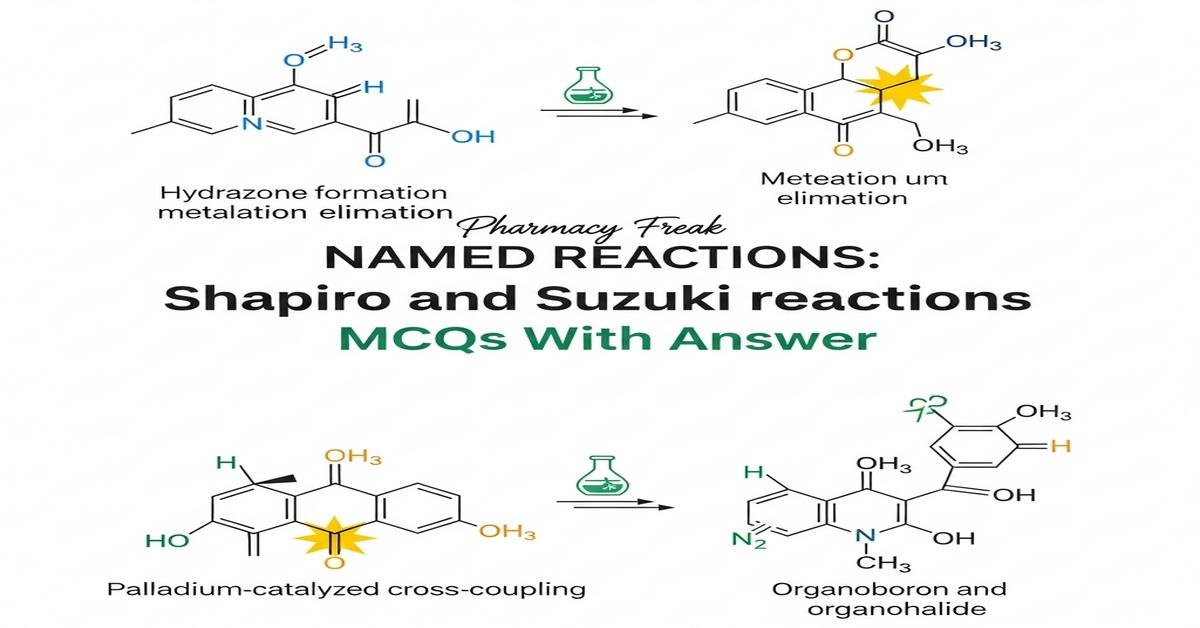
Named Reactions: Shapiro and Suzuki reactions MCQs With Answer is designed for M.Pharm students preparing for advanced organic chemistry examinations and competitive tests. This set focuses on mechanistic insight, scope, limitations, reagents, stereochemical outcomes, and practical applications of the Shapiro and Suzuki reactions—two powerful tools in modern organic synthesis. Questions emphasize reaction intermediates, catalytic cycles, reagent selection, and real-world uses in medicinal chemistry, ensuring conceptual depth and exam relevance. Each MCQ is crafted to test understanding beyond memorization, helping students link mechanistic steps to synthetic strategy and predict outcomes when designing or troubleshooting synthetic routes commonly encountered in drug discovery and development.
Q1. What is the main transformation achieved by the Shapiro reaction?
- Conversion of carbonyl compounds (hydrazones) to alkenes using a strong base
- Oxidation of alcohols to carbonyl compounds using hydrazine
- Formation of carbon–carbon bonds via palladium catalysis
- Reduction of nitro groups to amines under acidic conditions
Correct Answer: Conversion of carbonyl compounds (hydrazones) to alkenes using a strong base
Q2. Which reagent is classically used to deprotonate hydrazones and generate the vinyllithium intermediate in the Shapiro reaction?
- n-Butyllithium (n-BuLi)
- Pd(PPh3)4
- Boron trifluoride etherate (BF3·OEt2)
- Sodium borohydride (NaBH4)
Correct Answer: n-Butyllithium (n-BuLi)
Q3. Which species is expelled as a driving force during the key step of the Shapiro reaction mechanism?
- Dinitrogen (N2)
- Carbon monoxide (CO)
- Hydrogen gas (H2)
- Chlorine gas (Cl2)
Correct Answer: Dinitrogen (N2)
Q4. What is the immediate organometallic intermediate formed after nitrogen extrusion in the Shapiro reaction?
- Vinyllithium species
- Alkylborane intermediate
- Palladium(0) complex
- Carbocation stabilized by hydrazone
Correct Answer: Vinyllithium species
Q5. The Suzuki–Miyaura cross-coupling primarily forms which type of bond?
- Carbon–carbon (C(sp2)–C(sp2)) bond between an organoboron reagent and an aryl or vinyl halide
- Carbon–nitrogen (C–N) bond via amination of aryl halides
- Carbon–sulfur (C–S) bond using thiol coupling
- Carbon–oxygen (C–O) bond via etherification
Correct Answer: Carbon–carbon (C(sp2)–C(sp2)) bond between an organoboron reagent and an aryl or vinyl halide
Q6. In the Suzuki coupling mechanism, what is the principal role of the base?
- Activate the organoboron reagent (form boronate) and facilitate transmetalation
- Reduce Pd(II) to Pd(0)
- Oxidize the aryl halide to a radical cation
- Protonate the leaving group to speed up oxidative addition
Correct Answer: Activate the organoboron reagent (form boronate) and facilitate transmetalation
Q7. Which palladium catalyst is commonly employed for Suzuki reactions in academic and industrial syntheses?
- Pd(PPh3)4
- n-Butyllithium (n-BuLi)
- AlCl3 (Aluminum chloride)
- Grubbs catalyst (Ru-based)
Correct Answer: Pd(PPh3)4
Q8. A major synthetic advantage of the Suzuki reaction compared to many other cross-couplings is:
- High functional-group tolerance and mild aqueous/neutral conditions
- Generation of stoichiometric toxic tin waste
- Requirement for extremely dry and oxygen-free conditions only
- Exclusive applicability to sp3–sp3 couplings
Correct Answer: High functional-group tolerance and mild aqueous/neutral conditions
Q9. Which aryl halide typically undergoes the fastest oxidative addition to palladium in Suzuki couplings?
- Aryl iodides
- Aryl chlorides
- Aryl fluorides
- Aryl nitrates
Correct Answer: Aryl iodides
Q10. Which of the following best distinguishes the Wittig reaction from the Shapiro reaction when forming alkenes?
- The Wittig reaction uses a phosphonium ylide, while the Shapiro reaction uses hydrazone formation followed by strong base to generate vinyllithium
- The Wittig reaction extrudes N2 gas, and the Shapiro reaction forms an oxaphosphetane
- Both reactions require palladium catalysts for carbon–carbon bond formation
- Wittig reactions are carried out with n-BuLi to form vinyllithium directly
Correct Answer: The Wittig reaction uses a phosphonium ylide, while the Shapiro reaction uses hydrazone formation followed by strong base to generate vinyllithium
Q11. Which organoboron reagent is most commonly employed in Suzuki couplings for ease of handling and availability?
- Boronic acids (R–B(OH)2)
- Organostannanes (R–SnBu3)
- Organolithiums (R–Li)
- Diazonium salts (Ar–N2+)
Correct Answer: Boronic acids (R–B(OH)2)
Q12. A typical observable gaseous byproduct of a Shapiro reaction is:
- Nitrogen gas (N2)
- Oxygen gas (O2)
- Methane (CH4)
- Carbon dioxide (CO2)
Correct Answer: Nitrogen gas (N2)
Q13. Which step in the Suzuki catalytic cycle transfers the organic group from boron to palladium?
- Transmetalation
- Oxidative addition
- Reductive elimination
- Ligand exchange with solvent
Correct Answer: Transmetalation
Q14. For effective generation of the vinyllithium intermediate in the Shapiro reaction, typical conditions include:
- Treatment of the hydrazone with two equivalents of n-BuLi at low temperature
- Heating hydrazone with catalytic Pd(PPh3)4 in aqueous base
- Oxidation with m-CPBA to form an azine
- Photochemical irradiation in the presence of iodine
Correct Answer: Treatment of the hydrazone with two equivalents of n-BuLi at low temperature
Q15. Which statement best describes the typical scope of Suzuki coupling regarding hybridization of coupling partners?
- Best established for C(sp2)–C(sp2) couplings; C(sp2)–C(sp3) couplings are possible but more challenging
- Exclusively effective for C(sp3)–C(sp3) couplings
- Only works for heteroatom–carbon bond formation, not carbon–carbon bonds
- Operates only between two organometallic lithium reagents
Correct Answer: Best established for C(sp2)–C(sp2) couplings; C(sp2)–C(sp3) couplings are possible but more challenging
Q16. A major limitation of the classical Shapiro reaction in complex molecule synthesis is:
- Poor tolerance of strongly base-sensitive functional groups due to the requirement for strong organolithium bases
- Formation of stoichiometric tin waste that is toxic and difficult to remove
- Absolute requirement for palladium catalysts which are expensive
- Inability to form disubstituted alkenes
Correct Answer: Poor tolerance of strongly base-sensitive functional groups due to the requirement for strong organolithium bases
Q17. Which base is commonly used in Suzuki cross-coupling reactions in aqueous or biphasic media?
- Potassium carbonate (K2CO3)
- n-Butyllithium (n-BuLi)
- Aluminum trichloride (AlCl3)
- Trifluoroacetic acid (TFA)
Correct Answer: Potassium carbonate (K2CO3)
Q18. After oxidative addition of an aryl halide to Pd(0) in the Suzuki cycle, what is the correct description of the palladium species formed?
- Aryl–palladium(II) halide complex
- Palladium(IV) dihalide complex
- Pd(0)–boronate complex
- Free aryl radical and Pd(I) dimer
Correct Answer: Aryl–palladium(II) halide complex
Q19. Which of these is a typical downstream step after generating the vinyllithium in a Shapiro sequence if a nucleophile is intentionally trapped?
- Electrophilic trapping (e.g., protonation or carbonyl addition) to form substituted alkenes or allylic products
- Direct oxidation to a carboxylic acid under mild aqueous conditions
- Pd-catalyzed cross-coupling without workup
- Conversion to organoboron species via transmetallation with B2pin2 under ambient conditions
Correct Answer: Electrophilic trapping (e.g., protonation or carbonyl addition) to form substituted alkenes or allylic products
Q20. Which reaction is most frequently used in medicinal chemistry to construct biaryl motifs in lead optimization and library synthesis?
- Suzuki–Miyaura cross-coupling
- Shapiro olefination
- Kolbe electrolysis
- Beckmann rearrangement
Correct Answer: Suzuki–Miyaura cross-coupling


I am a Registered Pharmacist under the Pharmacy Act, 1948, and the founder of PharmacyFreak.com. I hold a Bachelor of Pharmacy degree from Rungta College of Pharmaceutical Science and Research. With a strong academic foundation and practical knowledge, I am committed to providing accurate, easy-to-understand content to support pharmacy students and professionals. My aim is to make complex pharmaceutical concepts accessible and useful for real-world application.
Mail- Sachin@pharmacyfreak.com