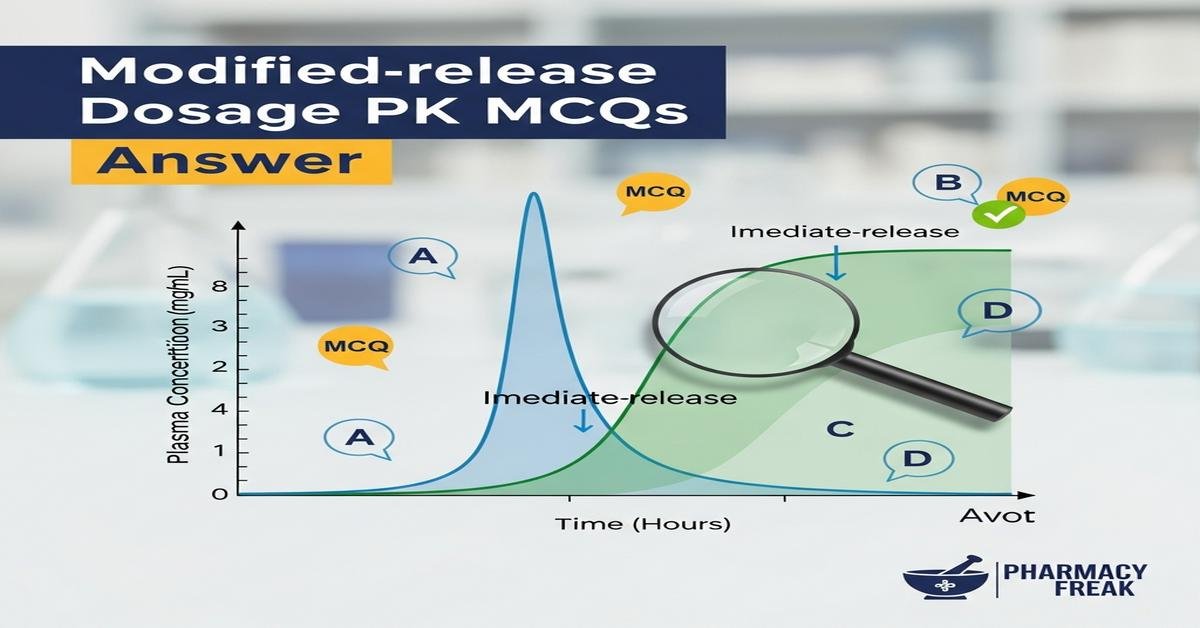
Introduction: This quiz collection on Modified-release dosage PK is designed for M.Pharm students studying Advanced Biopharmaceutics & Pharmacokinetics (MPH 202T). It focuses on pharmacokinetic principles and mathematical concepts critical to designing and evaluating sustained-, controlled- and pulsatile-release formulations. Questions cover release mechanisms, kinetics models (zero-order, first-order, Higuchi, Korsmeyer-Peppas), IVIVC levels, flip‑flop kinetics, dosing strategies, steady-state considerations, and formulation-related factors such as multi-unit vs single-unit systems and polymer behavior. Each MCQ aims to reinforce problem-solving and conceptual understanding required for formulation development, regulatory assessment, and clinical translation of modified-release products.
Q1. Which of the following best describes a zero-order drug release from a modified-release dosage form?
- Rate of drug release decreases exponentially with time
- Constant amount of drug is released per unit time
- Release rate is proportional to surface area and concentration gradient
- Drug release occurs only after a lag time and then all at once
Correct Answer: Constant amount of drug is released per unit time
Q2. In a matrix-type sustained release tablet governed by Higuchi kinetics, the cumulative amount of drug released (Q) is proportional to which mathematical function of time?
- Q ∝ t (linear)
- Q ∝ t^2 (quadratic)
- Q ∝ t^0.5 (square root of time)
- Q ∝ e^(-kt) (exponential decay)
Correct Answer: Q ∝ t^0.5 (square root of time)
Q3. Which release mechanism is MOST likely when drug release from a polymeric device shows a Korsmeyer-Peppas release exponent (n) of 0.6 for a cylindrical tablet?
- Pure Fickian diffusion
- Case II transport (relaxational/erosional)
- Anomalous (non-Fickian) transport—combination of diffusion and polymer relaxation
- Zero-order release
Correct Answer: Anomalous (non-Fickian) transport—combination of diffusion and polymer relaxation
Q4. For an oral controlled-release product designed to maintain Css at a target level, which of the following relations correctly gives the required constant input rate R0 (mass/time) under steady-state conditions?
- R0 = Vd × Css × kel
- R0 = Cl × Css
- R0 = (Dose × F) / τ
- R0 = kel / (Vd × Css)
Correct Answer: R0 = Cl × Css
Q5. Flip‑flop kinetics in modified-release formulations occurs when:
- Absorption is much faster than elimination, so elimination controls plasma profile
- Absorption is much slower than elimination, so absorption rate controls terminal slope
- The drug follows zero-order absorption and first-order elimination simultaneously
- There is no absorption phase and drug is directly administered into systemic circulation
Correct Answer: Absorption is much slower than elimination, so absorption rate controls terminal slope
Q6. Which parameter is most directly reduced by using a modified-release formulation compared to an immediate-release form, assuming same total daily dose and bioavailability?
- Area under the plasma concentration–time curve (AUC)
- Mean residence time (MRT)
- Peak-to-trough fluctuation in plasma concentration (peak-trough swing)
- Systemic clearance (Cl)
Correct Answer: Peak-to-trough fluctuation in plasma concentration (peak-trough swing)
Q7. For multiple dosing of an immediate-release drug with first-order elimination, the accumulation ratio R (Css peak over Css after first dose) is given by R = 1/(1 – e^-kelτ). How will increasing dosing interval τ affect R?
- R increases (greater accumulation)
- R decreases (less accumulation)
- R remains unchanged
- R becomes negative
Correct Answer: R decreases (less accumulation)
Q8. Which IVIVC level corresponds to a point-to-point correlation between in vitro dissolution and in vivo plasma concentration profile (i.e., predictive of the entire plasma curve)?
- Level A
- Level B
- Level C
- Level D
Correct Answer: Level A
Q9. A controlled-release tablet releases drug by erosion of the matrix. Which polymer characteristic MOST strongly influences the erosion-controlled release rate?
- Polymer glass transition temperature (Tg) only
- Polymer molecular weight and hydrophilicity
- Drug pKa only
- Tablet color and shape only
Correct Answer: Polymer molecular weight and hydrophilicity
Q10. When designing a once-daily modified-release product, which pharmacokinetic property of the drug favors success of a single-unit sustained-release tablet?
- Very short half-life (<1 hour) and high required daily dose
- Narrow therapeutic index with large interindividual variability
- Small dose, moderate half-life (6–12 h), and good oral bioavailability
- Extensive first-pass metabolism resulting in very low F
Correct Answer: Small dose, moderate half-life (6–12 h), and good oral bioavailability
Q11. For a once-daily modified-release product, to maintain average steady-state concentration (Css,avg) equal to desired target using total daily dose D and dosing interval τ = 24 h, which formula is correct when bioavailability F and clearance Cl are known?
- Css,avg = (F × D) / (Cl × τ)
- Css,avg = (Cl × τ) / (F × D)
- Css,avg = (F × Cl) / (D × τ)
- Css,avg = (D) / (F × Cl × τ)
Correct Answer: Css,avg = (F × D) / (Cl × τ)
Q12. Which statement about multi-unit (e.g., pellets) versus single-unit modified-release systems is TRUE?
- Single-unit systems always have less risk of dose dumping than multi-unit systems
- Multi-unit systems distribute more uniformly in the GI tract and reduce variability from food and GI motility
- Multi-unit systems cannot provide delayed or pulsatile release
- Single-unit systems are preferred when minimizing intersubject variability in gastric emptying is critical
Correct Answer: Multi-unit systems distribute more uniformly in the GI tract and reduce variability from food and GI motility
Q13. A drug with first-order elimination has kel = 0.1 h^-1. For a twice-daily controlled-release product (τ = 12 h), calculate the accumulation factor (Racc) for fluctuation using R = 1/(1 – e^-kelτ). Which is closest?
- R ≈ 1.1
- R ≈ 1.27
- R ≈ 2.5
- R ≈ 10
Correct Answer: R ≈ 1.27
Q14. Which in vivo condition is MOST likely to alter the release profile of an enteric-coated modified-release tablet?
- Rapid small intestinal transit with low gastric residence
- Normal fed-state gastric emptying with low pH meals
- Presence of bile salts in small intestine
- Altered gastric pH due to proton pump inhibitor therapy
Correct Answer: Altered gastric pH due to proton pump inhibitor therapy
Q15. For a reservoir-type controlled-release implant providing near zero-order release, which factor primarily determines the release rate?
- Surface area of the reservoir and permeability of the rate-controlling membrane
- Total drug load only, independent of membrane properties
- Systemic clearance of the drug
- Color and size of the implant
Correct Answer: Surface area of the reservoir and permeability of the rate-controlling membrane
Q16. Which mathematical model is most appropriate to describe dissolution from a planar polymeric film where diffusion through a swollen polymer controls release?
- Higuchi model (Q ∝ t^0.5)
- Michaelis-Menten kinetics
- Langmuir adsorption isotherm
- Zero-order kinetics only
Correct Answer: Higuchi model (Q ∝ t^0.5)
Q17. A modified-release formulation aims to reduce Cmax but maintain AUC equal to immediate release. Which of the following is a correct expectation?
- Cmax will be lower and Tmax will be delayed; AUC remains similar if F unchanged
- Cmax will be higher and AUC will decrease
- Tmax will be unchanged and AUC will increase
- Both Cmax and AUC will decrease due to slowing release
Correct Answer: Cmax will be lower and Tmax will be delayed; AUC remains similar if F unchanged
Q18. In establishing a Level A IVIVC, deconvolution of plasma data is often performed. What is deconvolution used for in this context?
- To convert in vitro dissolution to tablet hardness
- To estimate the in vivo input (absorption) rate from plasma concentration-time data
- To calculate the partition coefficient of the drug
- To determine the melting point of the polymer
Correct Answer: To estimate the in vivo input (absorption) rate from plasma concentration-time data
Q19. Which of the following situations would most likely require a loading dose when switching a patient to a modified-release product designed to release drug slowly over 24 hours?
- Drug has very long half-life and slow release would delay attainment of therapeutic level
- Drug has ultrashort half-life and immediate effect is not needed
- Drug exhibits linear pharmacokinetics with fast onset
- Drug is given topically and not systemically absorbed
Correct Answer: Drug has very long half-life and slow release would delay attainment of therapeutic level
Q20. Which analytical approach is most useful to determine whether a modified-release formulation shows true zero-order release versus apparent zero-order over a limited timeframe?
- Plot cumulative amount released versus square root of time only
- Apply model-fitting to multiple kinetics (zero-order, first-order, Higuchi, Korsmeyer-Peppas) and compare goodness-of-fit metrics
- Measure only dissolution at a single time point
- Assess only tablet hardness and friability
Correct Answer: Apply model-fitting to multiple kinetics (zero-order, first-order, Higuchi, Korsmeyer-Peppas) and compare goodness-of-fit metrics


I am a Registered Pharmacist under the Pharmacy Act, 1948, and the founder of PharmacyFreak.com. I hold a Bachelor of Pharmacy degree from Rungta College of Pharmaceutical Science and Research. With a strong academic foundation and practical knowledge, I am committed to providing accurate, easy-to-understand content to support pharmacy students and professionals. My aim is to make complex pharmaceutical concepts accessible and useful for real-world application.
Mail- Sachin@pharmacyfreak.com