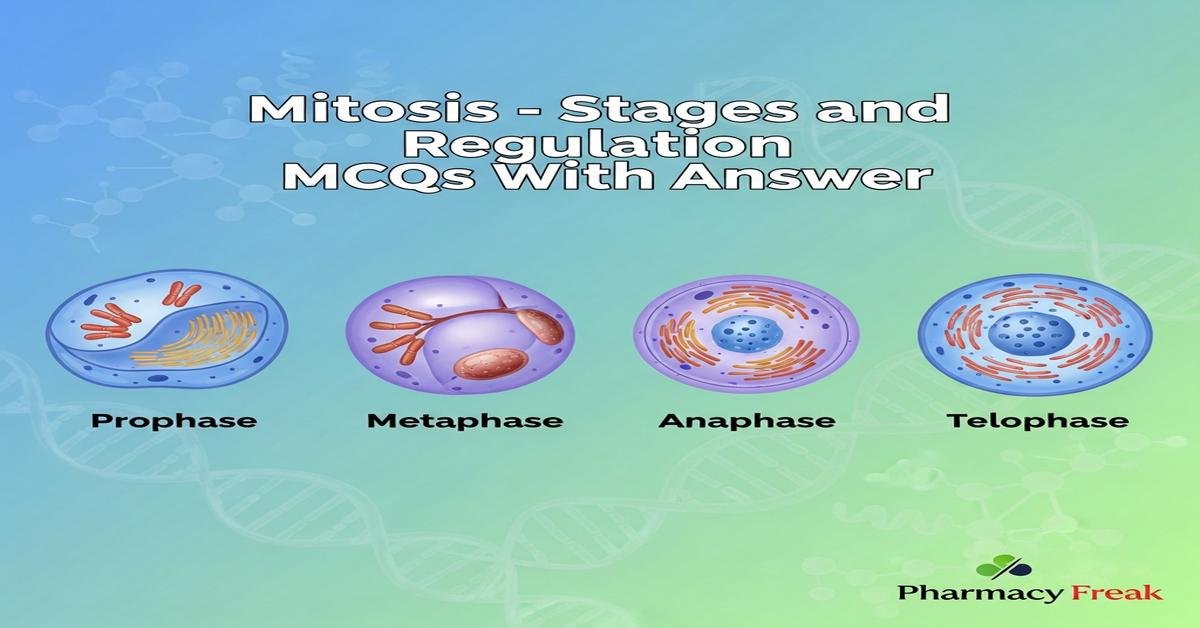
Mitosis is the precise process of nuclear division that allocates replicated chromosomes into two genetically identical daughter nuclei. For B. Pharm students, a clear grasp of the stages of mitosis—prophase, prometaphase, metaphase, anaphase and telophase—and regulation by cyclins, cyclin-dependent kinases (CDKs), checkpoints (p53, ATM/ATR), APC/C, separase and cohesin is essential. Understanding spindle dynamics, centrosome behavior and the spindle assembly checkpoint links directly to pharmacology and cancer biology. This knowledge underpins mechanisms of anti-mitotic drugs (taxanes, vinca alkaloids, colchicine), drug toxicity and targeted therapies, and is vital for rational drug design and therapeutics. Now let’s test your knowledge with 30 MCQs on this topic.
Q1. What is the primary purpose of mitosis in somatic cells?
- To produce haploid gametes for sexual reproduction
- To replicate DNA without cell division
- To segregate duplicated chromosomes into two genetically identical daughter nuclei
- To repair DNA double-strand breaks during G1
Correct Answer: To segregate duplicated chromosomes into two genetically identical daughter nuclei
Q2. Which is the correct sequential order of classical mitotic stages?
- Metaphase → Anaphase → Prophase → Telophase
- Prophase → Prometaphase → Metaphase → Anaphase → Telophase
- Anaphase → Telophase → Metaphase → Prophase
- G1 → S → G2 → M
Correct Answer: Prophase → Prometaphase → Metaphase → Anaphase → Telophase
Q3. Which protein complex is primarily responsible for compacting chromosomes during mitosis?
- Cohesin
- Condensin
- Histone deacetylase (HDAC)
- Kinesin-13
Correct Answer: Condensin
Q4. What molecular event directly allows sister chromatids to separate at anaphase onset?
- Phosphorylation of cohesin by Cdk2
- Ubiquitin-mediated degradation of securin by APC/C, activating separase
- Activation of kinesin motors by MAP kinase
- Release of condensin from chromatin
Correct Answer: Ubiquitin-mediated degradation of securin by APC/C, activating separase
Q5. The spindle assembly checkpoint (SAC) primarily monitors which feature to delay anaphase?
- DNA replication completion
- Correct kinetochore–microtubule attachments and tension across sister kinetochores
- Centrosome duplication fidelity
- Actomyosin ring formation
Correct Answer: Correct kinetochore–microtubule attachments and tension across sister kinetochores
Q6. Maturation-promoting factor (MPF) is a complex composed of which molecules?
- Cyclin D and Cdk4
- Cyclin B and Cdk1
- Cyclin E and Cdk2
- Cyclin A and Cdk6
Correct Answer: Cyclin B and Cdk1
Q7. Which kinase negatively regulates Cdk1 by inhibitory phosphorylation to prevent premature mitotic entry?
- Cdc25 phosphatase
- Wee1 kinase
- Polo-like kinase 1 (Plk1)
- Aurora B kinase
Correct Answer: Wee1 kinase
Q8. Which enzyme activates Cdk1 by removing inhibitory phosphates at the G2/M transition?
- Cdk-activating kinase (CAK)
- Cdc25 phosphatase
- Wee1 kinase
- Anaphase-promoting complex (APC/C)
Correct Answer: Cdc25 phosphatase
Q9. Degradation of which protein is directly responsible for cyclin B destruction and mitotic exit?
- Securin
- Cyclin A
- Cyclin B via APC/C-mediated ubiquitination
- Cdc25
Correct Answer: Cyclin B via APC/C-mediated ubiquitination
Q10. Aurora B kinase is primarily involved in which mitotic function?
- Microtubule polymerization at the centrosome
- Tension-sensing and correction of improper kinetochore–microtubule attachments
- Cleavage furrow constriction during cytokinesis
- DNA replication licensing
Correct Answer: Tension-sensing and correction of improper kinetochore–microtubule attachments
Q11. Which class of anti-mitotic drugs stabilizes microtubules and prevents their depolymerization?
- Vinca alkaloids
- Taxanes
- Topoisomerase inhibitors
- mTOR inhibitors
Correct Answer: Taxanes
Q12. Vinca alkaloids (e.g., vinblastine) primarily act by which mechanism?
- Stabilizing microtubules and preventing depolymerization
- Inhibiting tubulin polymerization and promoting microtubule depolymerization
- Inhibiting DNA gyrase
- Blocking actin polymerization
Correct Answer: Inhibiting tubulin polymerization and promoting microtubule depolymerization
Q13. Which centromeric histone variant is essential for kinetochore assembly?
- H3K9me3
- CENP-A
- H2AX
- HP1
Correct Answer: CENP-A
Q14. Cytokinesis in animal cells is driven primarily by which structure?
- Centriole duplication
- Actomyosin contractile ring
- Microtubule midbody elongation only
- Nuclear envelope reformation
Correct Answer: Actomyosin contractile ring
Q15. Which checkpoint prevents entry into S phase when DNA damage is detected during G1?
- Spindle assembly checkpoint (SAC)
- G1/S checkpoint mediated by p53 and p21
- G2/M checkpoint mediated by Cdc25
- M checkpoint mediated by separase
Correct Answer: G1/S checkpoint mediated by p53 and p21
Q16. The tumor suppressor p53 contributes to cell-cycle arrest mainly by inducing which CDK inhibitor?
- p16INK4a
- p21 (Cip1/Waf1)
- p27Kip1
- Rb protein
Correct Answer: p21 (Cip1/Waf1)
Q17. What is the role of securin in mitosis?
- Activates separase to cleave cohesin
- Inhibits separase until ubiquitinated and degraded by APC/C
- Phosphorylates cohesin to induce separation
- Forms the kinetochore inner plate
Correct Answer: Inhibits separase until ubiquitinated and degraded by APC/C
Q18. During which cell-cycle phase do centrosomes duplicate?
- G1 phase
- S phase
- M phase
- G0 phase
Correct Answer: S phase
Q19. Which motor protein family (e.g., Eg5) is responsible for pushing spindle poles apart during early mitosis?
- Dynein (minus-end directed motor)
- Kinesin-5 (plus-end directed tetrameric motors like Eg5)
- Myosin II
- Spindle assembly checkpoint complex (Mad2)
Correct Answer: Kinesin-5 (plus-end directed tetrameric motors like Eg5)
Q20. Chromosomal aneuploidy in tumors most often arises from failure of which process?
- DNA methylation
- Mitotic checkpoint function leading to chromosome missegregation
- Transcriptional silencing of oncogenes
- Excessive cytokinesis
Correct Answer: Mitotic checkpoint function leading to chromosome missegregation
Q21. Biorientation of sister chromatids at metaphase means:
- Both sister kinetochores attach to microtubules from the same spindle pole
- Each sister kinetochore attaches to microtubules from opposite spindle poles
- Chromatids have not yet condensed
- The nuclear envelope is intact
Correct Answer: Each sister kinetochore attaches to microtubules from opposite spindle poles
Q22. A defining feature of prometaphase is:
- Reformation of the nuclear envelope
- Condensation of chromatin into chromosomes
- Breakdown of the nuclear envelope and kinetochore–microtubule interactions
- Cytokinetic furrow ingression
Correct Answer: Breakdown of the nuclear envelope and kinetochore–microtubule interactions
Q23. The anaphase-promoting complex/cyclosome (APC/C) functions as:
- A phosphatase that activates Cdk1
- An E3 ubiquitin ligase targeting mitotic regulators for degradation
- A DNA repair nuclease
- A microtubule-severing enzyme
Correct Answer: An E3 ubiquitin ligase targeting mitotic regulators for degradation
Q24. Polo-like kinase 1 (Plk1) contributes to mitotic entry by:
- Inhibiting Cdc25 phosphatase
- Phosphorylating and activating Cdc25 and promoting centrosome maturation
- Stabilizing securin
- Degrading cyclin B directly
Correct Answer: Phosphorylating and activating Cdc25 and promoting centrosome maturation
Q25. Which statement best describes anaphase B?
- Chromosome arms condense while centrosomes disassemble
- Spindle poles move further apart, elongating the spindle
- Sister chromatids are cohesed together by cohesin
- Nuclear envelope re-forms around daughter nuclei
Correct Answer: Spindle poles move further apart, elongating the spindle
Q26. Which phosphatase family is important for mitotic exit in mammalian cells by reversing Cdk1 phosphorylation?
- Protein phosphatase 2A (PP2A) family
- PTEN phosphatases
- Tyrosine phosphatase SHP2 only
- Adenylyl cyclase
Correct Answer: Protein phosphatase 2A (PP2A) family
Q27. Colchicine impairs mitosis by which mechanism?
- Inhibiting topoisomerase II
- Binding tubulin and preventing microtubule polymerization
- Activating Cdc25 to trigger premature anaphase
- Blocking proteasome activity
Correct Answer: Binding tubulin and preventing microtubule polymerization
Q28. Which kinases are primary sensors of DNA damage that activate cell-cycle checkpoints relevant to mitotic regulation?
- MAPK and ERK
- ATM and ATR
- PIM kinases
- mTOR and PI3K
Correct Answer: ATM and ATR
Q29. Which complex holds sister chromatids together from S phase until anaphase?
- Condensin complex
- Cohesin complex
- APC/C complex
- Kinesin-13
Correct Answer: Cohesin complex
Q30. Which event directly triggers the metaphase-to-anaphase transition?
- Activation of cohesin to hold chromatids together
- APC/C-mediated ubiquitination and degradation of securin, allowing separase to cleave cohesin
- Dephosphorylation of histones by HDACs
- Nuclear envelope reassembly
Correct Answer: APC/C-mediated ubiquitination and degradation of securin, allowing separase to cleave cohesin

