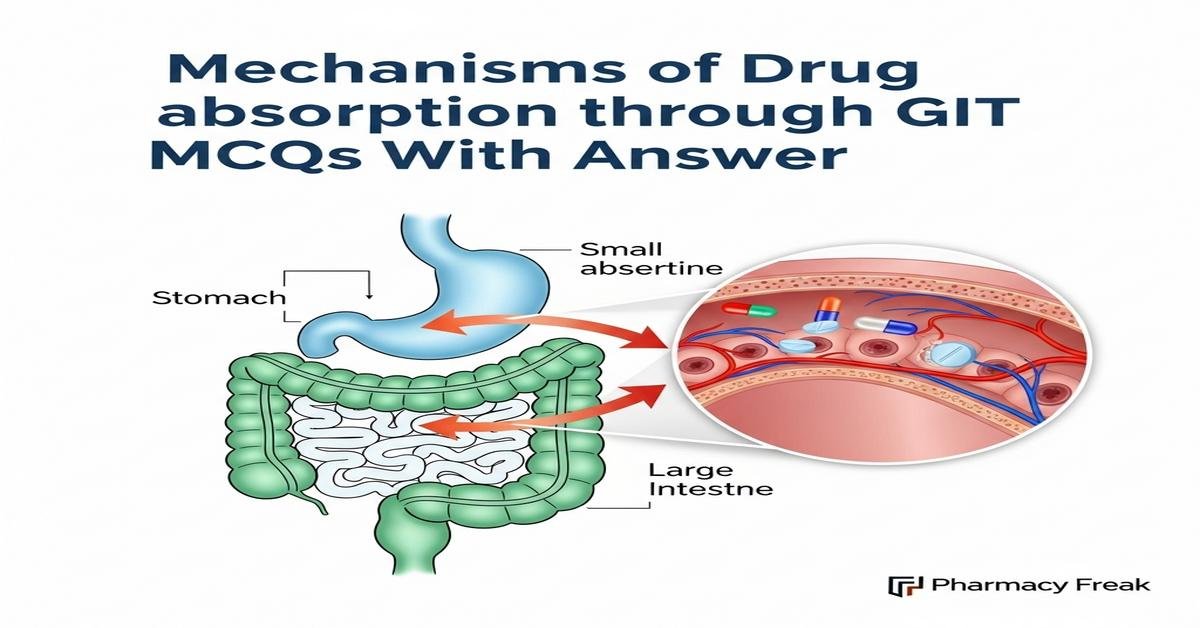
Mechanisms of drug absorption through GIT MCQs With Answer
Understanding drug absorption mechanisms across the gastrointestinal tract is essential for B. Pharm students designing effective oral therapies. This concise guide covers passive transcellular and paracellular diffusion, carrier-mediated uptake, endocytosis, lymphatic transport, and the impact of pH-partitioning, surface area, gastric emptying, bile salts, efflux transporters (e.g., P-gp), and first-pass metabolism on bioavailability. It also emphasizes experimental models (Caco-2, PAMPA) and formulation strategies (prodrugs, lipid-based systems, enteric coatings) that modulate absorption. Mastering these concepts links physicochemical properties to clinical outcomes and formulation design. Now let’s test your knowledge with 30 MCQs on this topic.
Q1. Which mechanism primarily explains the absorption of most small lipophilic drugs across enterocyte membranes?
- Paracellular diffusion through tight junctions
- Passive transcellular diffusion across lipid bilayers
- Carrier-mediated active transport
- Receptor-mediated endocytosis
Correct Answer: Passive transcellular diffusion across lipid bilayers
Q2. According to Fick’s law, which combination of factors most directly increases transcellular passive drug flux?
- Lower diffusion coefficient, thicker membrane, smaller surface area
- Increased concentration gradient, larger surface area, thinner membrane
- Higher molecular weight and increased membrane thickness
- Increased efflux transporter activity
Correct Answer: Increased concentration gradient, larger surface area, thinner membrane
Q3. The pH-partition hypothesis predicts maximal absorption when a drug is:
- Highly ionized in the lumen
- Predominantly in its unionized form at the absorption site
- Conjugated to glucuronic acid
- Bound strongly to plasma proteins
Correct Answer: Predominantly in its unionized form at the absorption site
Q4. Which site in the GIT generally provides the greatest overall surface area and is the main locus for oral drug absorption?
- Stomach
- Small intestine (duodenum and jejunum)
- Colon
- Rectum
Correct Answer: Small intestine (duodenum and jejunum)
Q5. Carrier-mediated intestinal transport is typically characterized by which property?
- Linear uptake with concentration indefinitely
- Saturability and stereospecificity
- Exclusive transcellular passive diffusion
- Complete resistance to inhibition
Correct Answer: Saturability and stereospecificity
Q6. First-pass metabolism that reduces oral bioavailability can occur in which locations?
- Only the liver
- Only the stomach
- Both the intestinal mucosa and the liver
- Only the plasma
Correct Answer: Both the intestinal mucosa and the liver
Q7. Lymphatic absorption of orally administered drugs is most favored for compounds that are:
- Highly hydrophilic with low log P
- Highly lipophilic and associate with chylomicrons
- Strongly ionized at intestinal pH
- Small polar molecules below 100 Da
Correct Answer: Highly lipophilic and associate with chylomicrons
Q8. P-glycoprotein (P-gp) expressed on enterocytes primarily:
- Enhances passive diffusion into the cell
- Effluxes substrates back into the intestinal lumen, reducing absorption
- Conjugates drugs to glucuronic acid
- Acts as a paracellular pore for ions
Correct Answer: Effluxes substrates back into the intestinal lumen, reducing absorption
Q9. The Caco-2 cell monolayer assay is widely used to predict which property of oral drugs?
- Renal clearance
- Intestinal epithelial permeability
- Hepatic metabolic clearance
- Plasma protein binding
Correct Answer: Intestinal epithelial permeability
Q10. PAMPA (Parallel Artificial Membrane Permeability Assay) is most useful for assessing:
- Carrier-mediated active transport
- Passive transcellular permeability without cellular enzymes
- P-gp mediated efflux
- Intestinal metabolism by CYP enzymes
Correct Answer: Passive transcellular permeability without cellular enzymes
Q11. Which class of enzymes in enterocytes contributes significantly to intestinal phase II metabolism?
- CYP3A4
- UDP-glucuronosyltransferases (UGTs)
- P-glycoprotein
- Monoamine oxidases
Correct Answer: UDP-glucuronosyltransferases (UGTs)
Q12. Gastric emptying is most likely to be slowed by which of the following?
- A high-fat meal
- A prokinetic agent
- Hyperthermia
- Alkaline drinks
Correct Answer: A high-fat meal
Q13. Bile salts improve oral absorption of lipophilic drugs primarily through:
- Increasing gastric pH
- Micellar solubilization and transport across the unstirred water layer
- Inhibiting CYP enzymes
- Opening tight junctions
Correct Answer: Micellar solubilization and transport across the unstirred water layer
Q14. The term “absorption window” refers to drugs that are primarily absorbed from which GIT region?
- Stomach only
- Proximal small intestine (duodenum/jejunum)
- Distal colon
- Entire GIT uniformly
Correct Answer: Proximal small intestine (duodenum/jejunum)
Q15. Designing a prodrug for oral delivery is commonly used to:
- Decrease lipophilicity and reduce permeability
- Improve permeability or stability to enhance oral absorption
- Increase renal excretion rate
- Eliminate the need for first-pass activation
Correct Answer: Improve permeability or stability to enhance oral absorption
Q16. Absolute oral bioavailability (F) is best defined as:
- The fraction of an orally administered dose that reaches systemic circulation unchanged
- The fraction metabolized by the liver
- The proportion of drug bound to plasma proteins
- The percent eliminated unchanged in urine
Correct Answer: The fraction of an orally administered dose that reaches systemic circulation unchanged
Q17. Food can alter oral drug absorption mainly by:
- Only binding drugs in the stomach
- Changing gastric emptying, luminal pH, bile secretion and possible drug–food interactions
- Completely blocking transporters
- Reducing drug molecular weight
Correct Answer: Changing gastric emptying, luminal pH, bile secretion and possible drug–food interactions
Q18. Paracellular transport across the intestinal epithelium is most important for which type of molecules?
- Large lipophilic drugs
- Small hydrophilic ions and polar molecules
- Macromolecular proteins like insulin
- Lipid-based prodrugs
Correct Answer: Small hydrophilic ions and polar molecules
Q19. Macromolecules and some particulate drug delivery systems can cross enterocytes primarily by:
- Passive diffusion through lipid bilayers
- Transcytosis (endocytosis and vesicular transport)
- Paracellular diffusion through tight junctions
- Simple aqueous diffusion in the unstirred layer
Correct Answer: Transcytosis (endocytosis and vesicular transport)
Q20. A weak acid drug with pKa 4.5 will be predominantly unionized and more readily absorbed in which region?
- Stomach (pH ~1–2)
- Small intestine (pH ~6–7.5)
- Colon (pH ~7–8)
- Urinary bladder
Correct Answer: Stomach (pH ~1–2)
Q21. According to the Noyes–Whitney equation, which factors primarily control the dissolution rate of a solid oral drug?
- Particle size (surface area), solubility, diffusion coefficient and thickness of diffusion layer
- Plasma protein binding only
- Gastric pH exclusively
- Hepatic enzyme activity
Correct Answer: Particle size (surface area), solubility, diffusion coefficient and thickness of diffusion layer
Q22. Enterohepatic recycling typically results in which pharmacokinetic effect?
- Decreased half-life and reduced exposure
- Prolonged plasma concentration and secondary peaks in drug levels
- Complete prevention of absorption
- Immediate renal clearance
Correct Answer: Prolonged plasma concentration and secondary peaks in drug levels
Q23. Uptake of certain anionic drugs across enterocytes is mediated by which transporter family?
- P-glycoprotein (P-gp)
- Organic anion transporting polypeptides (OATPs)
- CYP450 enzymes
- UDP-glucuronosyltransferases
Correct Answer: Organic anion transporting polypeptides (OATPs)
Q24. Co-administration of a P-gp inhibitor with a P-gp substrate is most likely to:
- Decrease the substrate’s oral bioavailability
- Increase the substrate’s oral bioavailability
- Have no effect on absorption
- Accelerate gastric emptying
Correct Answer: Increase the substrate’s oral bioavailability
Q25. Which GIT region contains significant CYP3A4 activity influencing intestinal first-pass metabolism?
- Stomach mucosa only
- Small intestinal enterocytes (especially proximal small intestine)
- Colon epithelium exclusively
- Pancreatic duct
Correct Answer: Small intestinal enterocytes (especially proximal small intestine)
Q26. Enteric coatings on oral dosage forms are primarily used to:
- Improve dissolution in the stomach
- Protect drug from stomach acid and release in the intestine
- Increase systemic clearance
- Enhance paracellular transport in the colon
Correct Answer: Protect drug from stomach acid and release in the intestine
Q27. Which formulation strategy is most effective to promote lymphatic drug transport?
- Immediate-release tablet with no lipids
- Lipid-based formulations containing long-chain triglycerides or self-emulsifying systems
- Highly water-soluble salt forms
- Enteric-coated hydrophilic pellets
Correct Answer: Lipid-based formulations containing long-chain triglycerides or self-emulsifying systems
Q28. In permeability studies, which marker compound is commonly used to assess paracellular permeability?
- Mannitol
- Ibuprofen
- Testosterone
- Cholesterol
Correct Answer: Mannitol
Q29. Which in vitro model specifically measures passive permeability across an artificial membrane and lacks cellular transporters and enzymes?
- Caco-2 cell monolayer
- PAMPA (Parallel Artificial Membrane Permeability Assay)
- In situ intestinal perfusion with intact mucosa
- Hepatocyte suspension assay
Correct Answer: PAMPA (Parallel Artificial Membrane Permeability Assay)
Q30. The Biopharmaceutics Classification System (BCS) groups orally administered drugs based primarily on which two properties?
- pKa and protein binding
- Solubility and intestinal permeability
- Metabolic pathway and renal clearance
- Molecular weight and melting point
Correct Answer: Solubility and intestinal permeability

