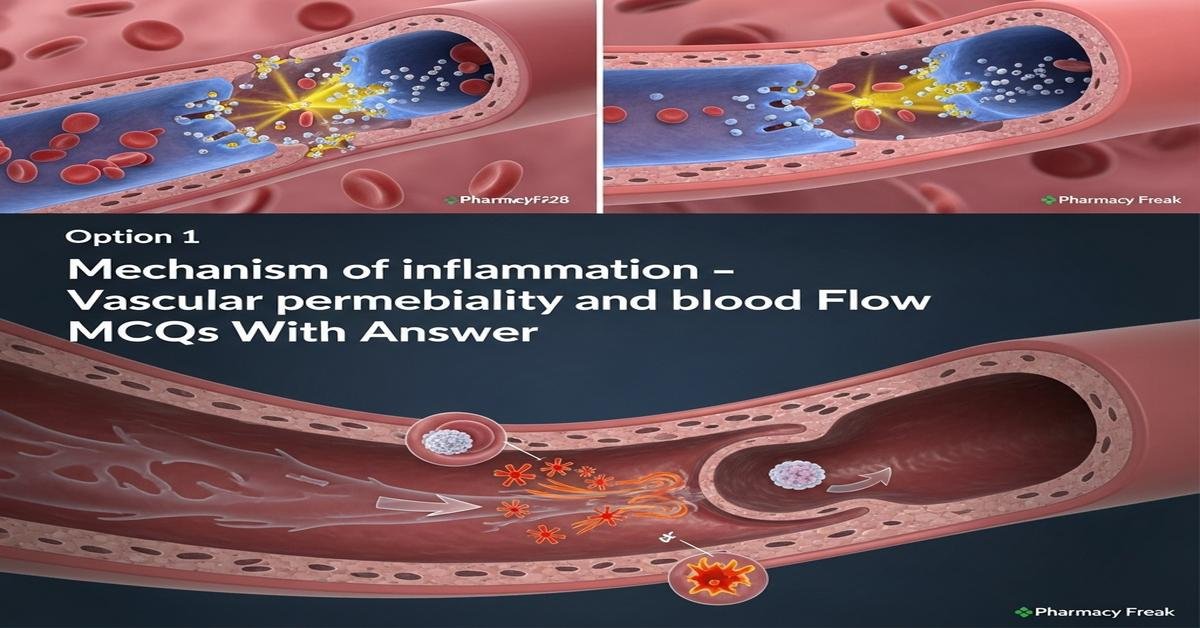
Introduction: The mechanism of inflammation involves coordinated vascular and cellular events that control blood flow and vascular permeability to eliminate injurious stimuli. For B. Pharm students, understanding how vasodilation, increased microvascular blood flow, endothelial cell contraction, and mediator-driven gaps lead to exudation and leukocyte recruitment is essential for pharmacologic modulation. Key inflammatory mediators—histamine, bradykinin, nitric oxide, leukotrienes, and VEGF—alter permeability and hemodynamics, influencing drug delivery and anti-inflammatory therapy. This concise review emphasizes practical concepts such as transudate vs exudate, Starling forces, and mediator-targeted drugs to aid clinical and exam preparation. Now let’s test your knowledge with 50 MCQs on this topic.
Q1. What is the primary vascular change during the initial phase of acute inflammation?
- Increased vascular permeability
- Vasodilation of arterioles and increased blood flow
- Angiogenesis
- Fibrosis
Correct Answer: Vasodilation of arterioles and increased blood flow
Q2. Which mediator is most responsible for immediate endothelial cell contraction leading to increased vascular permeability?
- Interleukin-10 (IL-10)
- Vascular endothelial growth factor (VEGF)
- Histamine
- Tumor necrosis factor (TNF)
Correct Answer: Histamine
Q3. Exudate differs from transudate primarily by which feature?
- Lower protein content
- Higher protein content and cellular debris
- Absence of inflammatory cells
- Lower specific gravity
Correct Answer: Higher protein content and cellular debris
Q4. Which molecule primarily mediates neutrophil rolling along the endothelium?
- Integrins
- Selectins
- Complement C3b
- Fibrinogen
Correct Answer: Selectins
Q5. Which event follows neutrophil rolling during leukocyte recruitment?
- Phagocytosis
- Firm adhesion mediated by integrins
- Apoptosis
- Opsonization
Correct Answer: Firm adhesion mediated by integrins
Q6. Which chemotactic factor is a potent attractant for neutrophils in acute inflammation?
- IL-4
- C5a
- VEGF
- Albumin
Correct Answer: C5a
Q7. Nitric oxide (NO) contributes to inflammation mainly by which mechanism?
- Promoting collagen cross-linking
- Inducing vasodilation and inhibiting platelet aggregation
- Enhancing proteoglycan synthesis
- Directly opsonizing bacteria
Correct Answer: Inducing vasodilation and inhibiting platelet aggregation
Q8. Which mediator increases vascular permeability by stimulating endothelial cell retraction and new intercellular gaps?
- Prostaglandin I2 (prostacyclin)
- Leukotriene B4 (LTB4)
- Vascular endothelial growth factor (VEGF)
- Transforming growth factor beta (TGF-β)
Correct Answer: Vascular endothelial growth factor (VEGF)
Q9. Bradykinin contributes to inflammation by causing:
- Vasoconstriction and platelet aggregation
- Vasodilation, increased vascular permeability, and pain
- Suppression of leukocyte migration
- Fibroblast apoptosis
Correct Answer: Vasodilation, increased vascular permeability, and pain
Q10. Which leukotriene is mainly responsible for chemotaxis of neutrophils?
- LTC4
- LTD4
- LTE4
- LTB4
Correct Answer: LTB4
Q11. Endothelial cell injury causing increased permeability is most typical of which type of inflammation?
- Immediate transient permeability change
- Chronic inflammation
- Severe or sustained injury (e.g., burns, infections)
- Resolution phase
Correct Answer: Severe or sustained injury (e.g., burns, infections)
Q12. Which pharmacologic agent reduces vascular permeability by stabilizing endothelial junctions and decreasing mediator release?
- Systemic corticosteroids
- Beta blockers
- ACE inhibitors
- Statins
Correct Answer: Systemic corticosteroids
Q13. Increased blood flow in inflamed tissue leads to which clinical signs?
- Pallor and cooling
- Redness (rubor) and warmth (calor)
- Fibrosis and induration
- Necrosis without hyperemia
Correct Answer: Redness (rubor) and warmth (calor)
Q14. Which of the following best describes diapedesis?
- Destruction of pathogens by free radicals
- Passage of leukocytes through intact endothelium into tissue
- Adhesion of platelets to collagen
- Formation of fibrin clot
Correct Answer: Passage of leukocytes through intact endothelium into tissue
Q15. Histamine acts on which endothelial receptor type to increase permeability?
- H1 receptors causing endothelial contraction
- Beta-2 adrenergic receptors
- H3 receptors leading to vasoconstriction
- Muscarinic M2 receptors
Correct Answer: H1 receptors causing endothelial contraction
Q16. Which complement fragment mediates increased vascular permeability and smooth muscle contraction (anaphylatoxin)?
- C3b
- C5b-9 (MAC)
- C3a and C5a
- Factor B
Correct Answer: C3a and C5a
Q17. Starling forces govern fluid movement across capillaries. Which change promotes edema in inflammation?
- Decrease in capillary hydrostatic pressure
- Increase in interstitial oncotic pressure due to proteins
- Decrease in capillary permeability
- Increased lymphatic drainage
Correct Answer: Increase in interstitial oncotic pressure due to proteins
Q18. Which cell type predominates in early acute inflammation and is first to arrive at sites of bacterial infection?
- Lymphocytes
- Macrophages
- Neutrophils
- Eosinophils
Correct Answer: Neutrophils
Q19. Which adhesion molecules on leukocytes switch from low-affinity to high-affinity state during firm adhesion?
- Selectins
- Integrins
- Immunoglobulins (IgG)
- Cadherins
Correct Answer: Integrins
Q20. Reactive oxygen species (ROS) produced by neutrophils primarily function to:
- Recruit fibroblasts
- Mediate vasodilation
- Kill phagocytosed microbes
- Form granulomas
Correct Answer: Kill phagocytosed microbes
Q21. Opsonization enhances phagocytosis by coating microbes with which of the following?
- Complement fragments and immunoglobulins
- Histamine and bradykinin
- Prostaglandins
- Lipid mediators only
Correct Answer: Complement fragments and immunoglobulins
Q22. Which mediator is the main vasodilator produced by endothelial cells during inflammation?
- Thromboxane A2
- Nitric oxide (NO)
- Leukotriene C4
- Platelet-activating factor
Correct Answer: Nitric oxide (NO)
Q23. Increased microvascular permeability allows plasma proteins to enter tissues; which protein predominantly increases interstitial oncotic pressure?
- Glucose
- Albumin
- Sodium chloride
- ATP
Correct Answer: Albumin
Q24. Which drug class directly antagonizes histamine H1 receptors to reduce vascular permeability and edema?
- Antihistamines (H1 blockers)
- Beta blockers
- ACE inhibitors
- Statins
Correct Answer: Antihistamines (H1 blockers)
Q25. Which vascular change is responsible for the slowed blood flow and margination of leukocytes in inflamed tissue?
- Increased flow velocity due to hyperemia
- Loss of endothelial glycocalyx
- Stasis from increased vessel diameter and protein-rich exudate
- Vasoconstriction of venules
Correct Answer: Stasis from increased vessel diameter and protein-rich exudate
Q26. Which mediator causes sustained increased permeability and bronchoconstriction in allergic inflammation?
- Interferon gamma (IFN-γ)
- Leukotrienes C4, D4, and E4
- Prostaglandin E1
- Thromboxane synthase
Correct Answer: Leukotrienes C4, D4, and E4
Q27. In measurement of exudate, which characteristic is typically high compared to transudate?
- Low protein concentration
- High specific gravity and high protein
- Clear straw-colored fluid with low cells
- Pure ultrafiltrate of plasma without proteins
Correct Answer: High specific gravity and high protein
Q28. Which enzyme in neutrophils generates reactive oxygen species during the respiratory burst?
- Myeloperoxidase (MPO)
- Superoxide dismutase (SOD)
- NADPH oxidase
- Catalase
Correct Answer: NADPH oxidase
Q29. Which mediator both increases vascular permeability and is a potent chemoattractant released by mast cells?
- IL-2
- Histamine
- Interferon alpha
- Fibrin
Correct Answer: Histamine
Q30. VEGF-induced permeability is clinically important in which process?
- Resolution of acute inflammation without edema
- Angiogenesis and pathological edema in tumors and inflammation
- Immediate hypersensitivity suppression
- Lymphocyte apoptosis
Correct Answer: Angiogenesis and pathological edema in tumors and inflammation
Q31. Which pharmacologic agent inhibits leukotriene synthesis by blocking 5-lipoxygenase?
- Montelukast
- Zileuton
- Aspirin
- Prednisone
Correct Answer: Zileuton
Q32. Adhesion of leukocytes to endothelium is strengthened by interaction between endothelial ICAM-1 and leukocyte _______.
- Selectins
- Integrins (e.g., LFA-1)
- Immunoglobulin M
- Toll-like receptors
Correct Answer: Integrins (e.g., LFA-1)
Q33. Platelet-activating factor (PAF) contributes to inflammation by:
- Only inhibiting platelet aggregation
- Causing vasodilation, increased permeability, and leukocyte activation
- Neutralizing histamine
- Stimulating collagen synthesis exclusively
Correct Answer: Causing vasodilation, increased permeability, and leukocyte activation
Q34. Chronic inflammation differs from acute inflammation in that it typically features:
- Predominant neutrophil infiltration
- Prominent macrophages, lymphocytes, and fibrosis
- Immediate vasodilation without tissue destruction
- Purely reversible endothelial contraction
Correct Answer: Prominent macrophages, lymphocytes, and fibrosis
Q35. Which laboratory marker reflects systemic acute-phase response rather than local vascular permeability?
- C-reactive protein (CRP)
- Capillary hydrostatic pressure
- Local tissue albumin extravasation
- Histamine level in synovial fluid only
Correct Answer: C-reactive protein (CRP)
Q36. Which process describes the sealing of endothelial gaps and restoration of barrier function after transient permeability increase?
- Endothelial retraction permanence
- Endothelial cell contraction recovery and cytoskeletal reorganization
- Fibrosis of microvessels
- Ongoing leukocyte extravasation
Correct Answer: Endothelial cell contraction recovery and cytoskeletal reorganization
Q37. Which mediator is a potent stimulant of vascular permeability and is produced from arachidonic acid via cyclooxygenase pathway?
- Leukotriene B4 (LTB4)
- Prostaglandin I2 (prostacyclin) and prostaglandin E2 (PGE2)
- Complement C5a
- Bradykinin
Correct Answer: Prostaglandin I2 (prostacyclin) and prostaglandin E2 (PGE2)
Q38. Which cell-derived mediator increases endothelial permeability and also promotes pain and fever?
- Transforming growth factor beta (TGF-β)
- Prostaglandin E2 (PGE2)
- Fibrinogen
- Albumin
Correct Answer: Prostaglandin E2 (PGE2)
Q39. Which mechanism explains increased interstitial fluid accumulation when lymphatic drainage is impaired in inflamed tissue?
- Enhanced endothelial barrier function
- Failure to remove excess protein-rich fluid leading to edema
- Increased lymphatic uptake of albumin
- Decreased capillary hydrostatic pressure
Correct Answer: Failure to remove excess protein-rich fluid leading to edema
Q40. Which anti-inflammatory drug class reduces production of prostaglandins and thromboxanes by inhibiting cyclooxygenase?
- Nitric oxide donors
- Nonsteroidal anti-inflammatory drugs (NSAIDs)
- Leukotriene receptor antagonists
- Monoclonal anti-VEGF antibodies
Correct Answer: Nonsteroidal anti-inflammatory drugs (NSAIDs)
Q41. Which laboratory finding is expected in exudative pleural effusion compared to transudative?
- Low LDH and low protein
- High protein and high LDH relative to serum
- Identical composition to plasma ultrafiltrate
- Purely serous fluid with no cells
Correct Answer: High protein and high LDH relative to serum
Q42. Which factor promotes resolution and repair following acute inflammation rather than progression to chronic inflammation?
- Persistent infection
- Removal of injurious stimulus and clearance of mediators and debris
- Continuous exposure to irritants
- Ongoing autoimmune response
Correct Answer: Removal of injurious stimulus and clearance of mediators and debris
Q43. Which mediator derived from platelets contributes to vasoconstriction and platelet aggregation in inflammation?
- Prostacyclin (PGI2)
- Thromboxane A2 (TXA2)
- Nitric oxide
- Interleukin-10 (IL-10)
Correct Answer: Thromboxane A2 (TXA2)
Q44. Which structural change in post-capillary venules is most important for leukocyte emigration?
- Thickening of basement membrane
- Expression of adhesion molecules and endothelial retraction creating gaps
- Deposition of collagen IV
- Endothelial apoptosis only
Correct Answer: Expression of adhesion molecules and endothelial retraction creating gaps
Q45. Which mediator released by macrophages amplifies vascular permeability and recruits additional inflammatory cells?
- Interleukin-1 (IL-1) and tumor necrosis factor (TNF)
- Insulin
- Erythropoietin
- Albumin
Correct Answer: Interleukin-1 (IL-1) and tumor necrosis factor (TNF)
Q46. Which change in Starling forces will increase net filtration from capillaries into tissue?
- Decrease in capillary hydrostatic pressure
- Increase in capillary hydrostatic pressure
- Decrease in interstitial oncotic pressure
- Increase in plasma oncotic pressure
Correct Answer: Increase in capillary hydrostatic pressure
Q47. Which mediator is primarily responsible for increased vascular permeability in allergic anaphylaxis?
- Interferon gamma
- Histamine released from mast cells
- Thromboxane B2
- Albumin
Correct Answer: Histamine released from mast cells
Q48. Which therapeutic strategy directly targets vascular endothelial growth factor (VEGF) to reduce pathological permeability?
- Anti-VEGF monoclonal antibodies (e.g., bevacizumab)
- ACE inhibitors
- Beta adrenergic agonists
- Statins only
Correct Answer: Anti-VEGF monoclonal antibodies (e.g., bevacizumab)
Q49. Which cellular process is essential for clearance of debris and promotion of tissue repair after inflammation?
- Neutrophil extracellular trap (NET) formation only
- Macrophage-mediated phagocytosis of apoptotic cells and matrix turnover
- Permanent endothelial gap formation
- Continuous activation of complement C5b-9
Correct Answer: Macrophage-mediated phagocytosis of apoptotic cells and matrix turnover
Q50. Which drug reduces inflammatory cytokine production by inhibiting NF-κB activation and is widely used for its immunosuppressive effects?
- Glucocorticoids (corticosteroids)
- Acetaminophen
- Metformin
- Probenecid
Correct Answer: Glucocorticoids (corticosteroids)


I am a Registered Pharmacist under the Pharmacy Act, 1948, and the founder of PharmacyFreak.com. I hold a Bachelor of Pharmacy degree from Rungta College of Pharmaceutical Science and Research. With a strong academic foundation and practical knowledge, I am committed to providing accurate, easy-to-understand content to support pharmacy students and professionals. My aim is to make complex pharmaceutical concepts accessible and useful for real-world application.
Mail- Sachin@pharmacyfreak.com