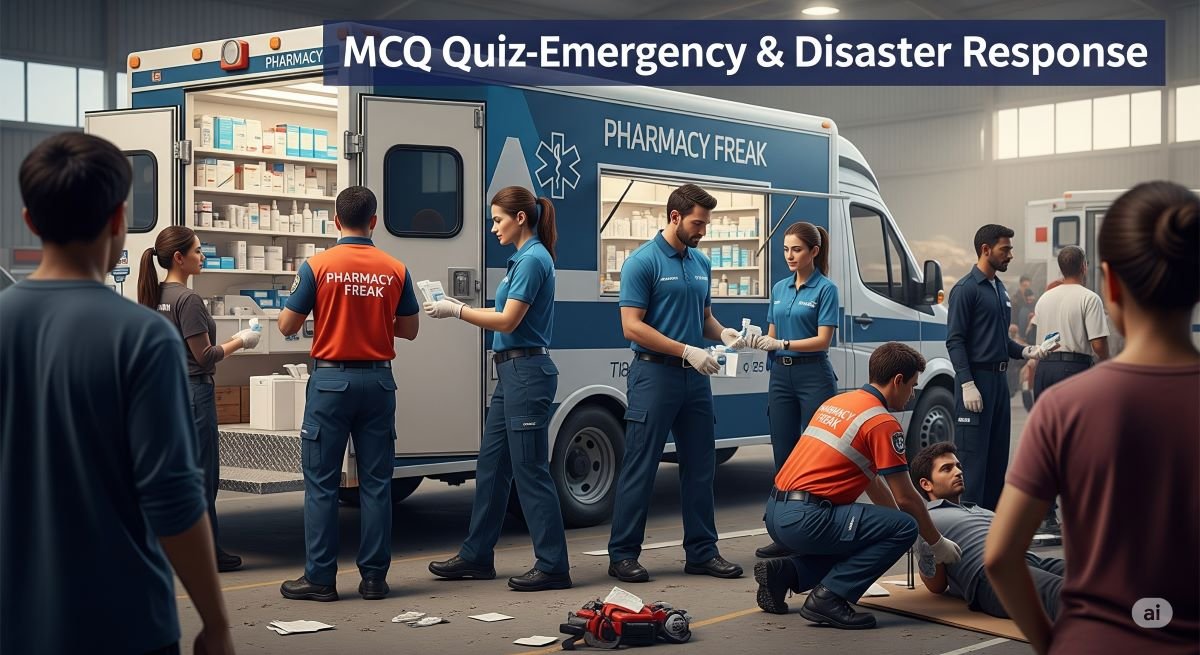
The “Response” phase of a disaster involves the immediate actions taken to save lives, meet basic human needs, and reduce the event’s overall impact. Pharmacists are critical front-line members of this response,This quiz covers the general principles of a pharmacist’s role and responsibilities during the response to an emergency or disaster.
1. The “Response” phase of emergency management is best described as:
- a. Actions taken to prevent a disaster from occurring.
- b. Actions taken immediately during and after a disaster to save lives and provide assistance.
- c. The long-term rebuilding process after a disaster.
- d. Writing a report about what happened.
Answer: b. Actions taken immediately during and after a disaster to save lives and provide assistance.
2. During a declared state of emergency, a pharmacist’s ability to dispense emergency refills is typically governed by:
- a. The pharmacist’s personal judgment only.
- b. Federal law exclusively.
- c. State-specific laws and emergency orders.
- d. The patient’s insurance company.
Answer: c. State-specific laws and emergency orders.
3. The Incident Command System (ICS) is a standardized approach used to manage the response to an emergency. Its primary purpose is to:
- a. Ensure responders from different agencies can work together effectively.
- b. Assign blame after the event.
- c. Manage financial resources only.
- d. Communicate with the media.
Answer: a. Ensure responders from different agencies can work together effectively.
4. A Point of Dispensing (POD) is a site set up during a public health emergency to rapidly provide what to a large population?
- a. Primary care services
- b. Mental health counseling
- c. Medications or vaccines
- d. Food and water
Answer: c. Medications or vaccines
5. A pharmacist working at a POD during an anthrax exposure event would primarily be responsible for dispensing:
- a. Pain relievers
- b. Prophylactic antibiotics like doxycycline or ciprofloxacin.
- c. Antivirals
- d. Saline solution
Answer: b. Prophylactic antibiotics like doxycycline or ciprofloxacin.
6. What is the most critical immediate concern for a patient with Type 1 Diabetes who has been evacuated from their home during a flood?
- a. Obtaining a new glucometer.
- b. Accessing insulin and keeping it at a safe temperature.
- c. Scheduling their next A1c test.
- d. Finding low-carbohydrate food.
Answer: b. Accessing insulin and keeping it at a safe temperature.
7. A “triage” process is used during a mass casualty incident to:
- a. Treat all patients in the order they arrived.
- b. Prioritize treatment for those with the most severe, life-threatening injuries.
- c. Provide comfort care only.
- d. Document patient information.
Answer: b. Prioritize treatment for those with the most severe, life-threatening injuries.
8. In the immediate response to a disaster, a community pharmacy often becomes a crucial hub for:
- a. Reliable health information.
- b. First aid supplies.
- c. Emergency refills of chronic medications.
- d. All of the above.
Answer: d. All of the above.
9. What is a primary challenge for pharmacy operations during a large-scale power outage?
- a. An increase in customers.
- b. Maintaining the cold chain for refrigerated medications.
- c. Operating computers, printers, and phones.
- d. Both b and c.
Answer: d. Both b and c.
10. After a natural disaster, patients with chronic conditions like hypertension and heart failure are at increased risk due to:
- a. Interruption of their medication therapy.
- b. Increased stress.
- c. Potential lack of access to healthy food and clean water.
- d. All of the above.
Answer: d. All of the above.
11. A key role for a pharmacist in a disaster shelter is:
- a. To act as the shelter manager.
- b. To perform medication reconciliation for residents and assist in obtaining necessary medications.
- c. To cook meals for the residents.
- d. To provide long-term psychiatric care.
Answer: b. To perform medication reconciliation for residents and assist in obtaining necessary medications.
12. During the response phase, it is critical for pharmacists to have access to reliable:
- a. Social media feeds.
- b. Communication channels with public health officials and other emergency responders.
- c. News reports.
- d. The pharmacy’s financial records.
Answer: b. Communication channels with public health officials and other emergency responders.
13. A patient brings a medication bottle to the pharmacy that has been submerged in floodwater. The pharmacist should advise the patient to:
- a. Use the medication if the tablets look dry.
- b. Discard the medication as it may be contaminated, and assist the patient in obtaining a replacement.
- c. Wash the tablets off and take them.
- d. Take a double dose to be safe.
Answer: b. Discard the medication as it may be contaminated, and assist the patient in obtaining a replacement.
14. The Strategic National Stockpile (SNS) contains “push packs.” What are these?
- a. Kits for pushing stalled vehicles.
- b. Pre-packaged caches of broad-spectrum supplies and medications that can be deployed within 12 hours.
- c. Backpacks for first responders.
- d. Marketing materials from drug companies.
Answer: b. Pre-packaged caches of broad-spectrum supplies and medications that can be deployed within 12 hours.
15. A pharmacist volunteering with an organization like the Medical Reserve Corps (MRC) would be part of the:
- a. Preparedness phase.
- b. Response phase.
- c. Recovery phase.
- d. All of the above.
Answer: d. All of the above.
16. A key principle of disaster response is to work within your scope of practice.
- a. True
- b. False
Answer: a. True
17. Why is it important for a pharmacist to have a personal emergency plan?
- a. So they can take care of their own family’s safety, allowing them to assist in the community response if able.
- b. It is a legal requirement to practice pharmacy.
- c. It is not important.
- d. To ensure they can get to the pharmacy first.
Answer: a. So they can take care of their own family’s safety, allowing them to assist in the community response if able.
18. During a widespread emergency, a pharmacist’s ability to verify a prescription with a prescriber may be compromised due to:
- a. Downed phone lines.
- b. Overwhelmed clinics and hospitals.
- c. Power outages affecting EHRs.
- d. All of the above.
Answer: d. All of the above.
19. What is NOT a primary focus during the immediate response phase?
- a. Saving lives
- b. Stabilizing the incident
- c. Conducting a long-term economic impact study
- d. Providing for basic human needs (water, food, shelter)
Answer: c. Conducting a long-term economic impact study
20. A pharmacist’s knowledge of _________ is critical when an emergency formulary or assets from the SNS arrive.
- a. therapeutics and drug interchange
- b. pharmacy law
- c. logistics and inventory management
- d. all of the above
Answer: d. all of the above
21. A patient needs an emergency 3-day supply of their lisinopril after a disaster. This is an example of what kind of response activity?
- a. Promoting public health.
- b. Ensuring continuity of care.
- c. Triaging patients.
- d. Compounding.
Answer: b. Ensuring continuity of care.
22. During a pandemic response, pharmacists are crucial for:
- a. Administering vaccines.
- b. Dispensing antiviral medications.
- c. Combating medical misinformation.
- d. All of the above.
Answer: d. All of the above.
23. The first step in responding to a chemical spill near the pharmacy is to:
- a. Go outside to investigate.
- b. Consult with authorities and follow shelter-in-place or evacuation orders.
- c. Continue operating as normal.
- d. Start compounding antidotes.
Answer: b. Consult with authorities and follow shelter-in-place or evacuation orders.
24. A major challenge during disaster response is managing:
- a. A surge of patients with acute and chronic conditions.
- b. The mental and physical health of the responders themselves.
- c. Limited resources and supplies.
- d. All of the above.
Answer: d. All of the above.
25. A pharmacist can assist in the response to a radiation emergency by helping to dispense:
- a. Potassium iodide (KI).
- b. Ciprofloxacin.
- c. Atropine.
- d. Naloxone.
Answer: a. Potassium iodide (KI).
26. The purpose of potassium iodide (KI) in a radiation emergency is to:
- a. Treat radiation sickness.
- b. Block the thyroid gland’s uptake of radioactive iodine.
- c. Act as a broad-spectrum antidote.
- d. Protect the skin from radiation.
Answer: b. Block the thyroid gland’s uptake of radioactive iodine.
27. A key to effective interprofessional disaster response is:
- a. Each profession working independently.
- b. Clear communication and a shared understanding of each other’s roles and capabilities.
- c. A strict hierarchy with one profession in charge of all others.
- d. Waiting for orders before taking any action.
Answer: b. Clear communication and a shared understanding of each other’s roles and capabilities.
28. After a disaster, there is often an increased need for what type of vaccination?
- a. HPV
- b. Tetanus
- c. Yellow fever
- d. Shingles
Answer: b. Tetanus
29. The pharmacist’s most accessible position in the community makes them a vital part of any emergency response plan.
- a. True
- b. False
Answer: a. True
30. A key part of the response phase is:
- a. Mitigation
- b. Preparedness
- c. Damage assessment
- d. Recovery planning
Answer: c. Damage assessment
31. In a mass dispensing scenario (POD), a pharmacist’s role may shift from individual patient counseling to:
- a. Rapid screening and providing essential information to large groups of people.
- b. Compounding individual prescriptions.
- c. Performing detailed medication reconciliation on every person.
- d. There is no shift in role.
Answer: a. Rapid screening and providing essential information to large groups of people.
32. What is a major ethical challenge during a disaster response?
- a. Deciding who to help first with limited resources (triage).
- b. Ensuring patient confidentiality in a chaotic environment.
- c. Balancing professional duties with personal and family safety.
- d. All of the above.
Answer: d. All of the above.
33. The main goal of “search and rescue” operations is part of which phase?
- a. Mitigation
- b. Preparedness
- c. Response
- d. Recovery
Answer: c. Response
34. A pharmacy’s continuity of operations plan (COOP) is part of:
- a. The response phase.
- b. The preparedness phase.
- c. The recovery phase.
- d. The mitigation phase.
Answer: b. The preparedness phase.
35. A pharmacist asked to volunteer in a disaster should first:
- a. Go directly to the disaster site.
- b. Ensure they are affiliated with a recognized response organization (like MRC) and wait to be deployed.
- c. Post on social media that they are available.
- d. Start collecting donations.
Answer: b. Ensure they are affiliated with a recognized response organization (like MRC) and wait to be deployed.
36. During an emergency response, documentation of actions taken is:
- a. Not important.
- b. Important, but secondary to life-saving actions.
- c. The most important initial action.
- d. Only for billing purposes.
Answer: b. Important, but secondary to life-saving actions.
37. What is a key consideration for managing controlled substances in an emergency shelter?
- a. They can be dispensed without a prescription.
- b. Maintaining security and proper documentation is critical.
- c. They should be stored with all other medications.
- d. All patients should receive them.
Answer: b. Maintaining security and proper documentation is critical.
38. The immediate response to a bioterrorism event would likely be managed by:
- a. The hospital pharmacy alone.
- b. Public health departments in collaboration with law enforcement and healthcare systems.
- c. The CDC alone.
- d. The WHO.
Answer: b. Public health departments in collaboration with law enforcement and healthcare systems.
39. A pharmacist providing first aid at the scene of an accident is protected by:
- a. Their malpractice insurance only.
- b. Good Samaritan laws in most jurisdictions.
- c. A federal mandate.
- d. Nothing; they are fully liable.
Answer: b. Good Samaritan laws in most jurisdictions.
40. A key component of responding to a pandemic is:
- a. Rapid development and distribution of diagnostics.
- b. Rapid development and distribution of vaccines.
- c. Clear public health communication.
- d. All of the above.
Answer: d. All of the above.
41. The immediate psychological impact on victims of a disaster is often:
- a. Relief
- b. Anger
- c. Shock and disbelief
- d. Happiness
Answer: c. Shock and disbelief
42. A “reverse distributor” is a company that a pharmacy might work with during the ____ phase to handle damaged or expired stock.
- a. preparedness
- b. response
- c. recovery
- d. mitigation
Answer: c. recovery
43. A pharmacist’s response during a disaster should be guided by:
- a. Their own judgment only.
- b. Their pharmacy’s emergency plan and directives from public health officials.
- c. What they see on the news.
- d. Instructions from patients.
Answer: b. Their pharmacy’s emergency plan and directives from public health officials.
44. If a pharmacy’s primary wholesaler cannot deliver after a disaster, this represents a failure in:
- a. The supply chain.
- b. The prescribing process.
- c. The dispensing process.
- d. The administration process.
Answer: a. The supply chain.
45. During a disaster, medication errors can increase due to:
- a. Stress and fatigue.
- b. Unfamiliar medications or volunteers.
- c. Chaotic environments.
- d. All of the above.
Answer: d. All of the above.
46. A critical role for pharmacists in the immediate aftermath is helping patients create a usable, accurate medication list if their original medications were lost.
- a. True
- b. False
Answer: a. True
47. A core part of any disaster response is establishing a functional:
- a. Hierarchy and chain of command.
- b. Communication system.
- c. Triage system.
- d. All of the above.
Answer: d. All of the above.
48. In a response scenario with limited resources, a pharmacist may need to help providers choose therapies based on:
- a. What is available in the emergency caches.
- b. The patient’s ability to pay.
- c. The brand name of the drug.
- d. The most expensive option.
Answer: a. What is available in the emergency caches.
49. The overall goal of the emergency response phase is to:
- a. Return everything to normal immediately.
- b. Stabilize the situation and provide for the immediate needs of the population.
- c. Plan for the next disaster.
- d. Write a detailed report.
Answer: b. Stabilize the situation and provide for the immediate needs of the population.
50. The ultimate reason to learn about emergency and disaster response is to:
- a. Be prepared to effectively serve and protect the community’s public health in a time of crisis.
- b. Pass a certification exam.
- c. Know how to operate a shortwave radio.
- d. Be able to manage a large-scale incident command post.
Answer: a. Be prepared to effectively serve and protect the community’s public health in a time of crisis.

