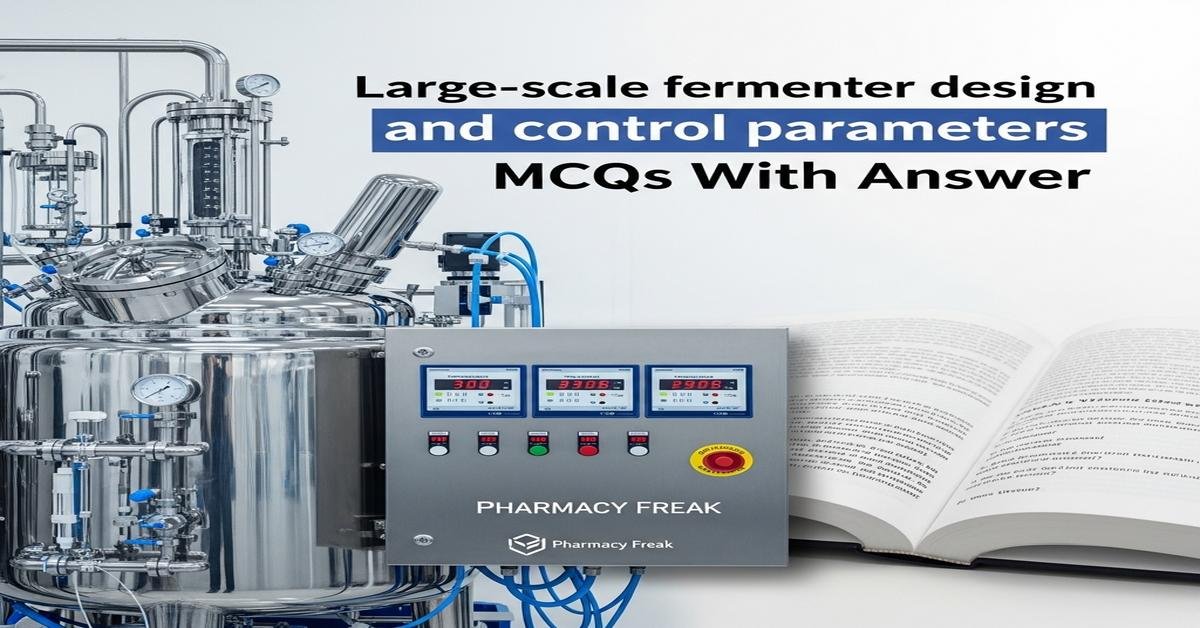
Introduction: Large-scale fermenter design and control parameters are essential for producing safe, high-yield bioproducts in the pharmaceutical industry. This topic covers fermenter types (stirred-tank, airlift, bubble column), scale-up criteria, agitation and impeller selection, aeration and kLa (oxygen transfer), dissolved oxygen (DO) control, pH and temperature regulation, foaming and antifoam strategies, sterilization (CIP/SIP), sensors (pH, DO, temperature, pressure) and process monitoring. Understanding mass and heat transfer, shear sensitivity, aseptic design, and cascade control loops helps B.Pharm students optimize productivity and reproducibility. You will learn to calculate oxygen uptake rate (OUR), kLa, power per unit volume and mixing time, and apply PID tuning and cascade control strategies. Now let’s test your knowledge with 30 MCQs on this topic.
Q1. What is the primary purpose of a large-scale fermenter in pharmaceutical production?
- Provide a controlled, sterile environment for microbial or cell growth and product formation
- Serve as a storage tank for finished drug products
- Act as a pressure vessel for chemical synthesis unrelated to biology
- Replace downstream purification steps
Correct Answer: Provide a controlled, sterile environment for microbial or cell growth and product formation
Q2. Which fermenter type is most commonly used in industrial biopharmaceutical production for suspension cultures?
- Stirred-tank (mechanically agitated) fermenter
- Packed-bed reactor
- Flat-panel photobioreactor
- Membrane bioreactor
Correct Answer: Stirred-tank (mechanically agitated) fermenter
Q3. What does the term kLa represent in bioprocess engineering?
- The volumetric oxygen mass transfer coefficient (kLa), combining kL and interfacial area a
- Rate constant for substrate consumption by cells
- Coefficient of thermal conductivity of broth
- Dimensionless impeller efficiency factor
Correct Answer: The volumetric oxygen mass transfer coefficient (kLa), combining kL and interfacial area a
Q4. Which operational parameters most directly increase kLa in an aerobic fermenter?
- Increasing agitation speed and increasing aeration (gas flow) rate
- Reducing temperature and lowering pressure
- Adding more antifoam and removing spargers
- Decreasing impeller diameter while lowering agitation speed
Correct Answer: Increasing agitation speed and increasing aeration (gas flow) rate
Q5. Which impeller is commonly used for gas dispersion and high oxygen transfer in stirred tanks?
- Rushton turbine (radial-flow) impeller
- Pitched-blade axial-flow impeller exclusively for low-shear cells
- Propeller impeller only used in anaerobic processes
- Ladle-type impeller for membrane aeration
Correct Answer: Rushton turbine (radial-flow) impeller
Q6. When scaling up an oxygen-limited aerobic fermentation, which criterion is often prioritized to maintain similar performance?
- Maintain a constant volumetric oxygen transfer coefficient (kLa)
- Keep geometric scale identical irrespective of power
- Ensure identical impeller tip speed only
- Maintain the same absolute agitator rpm
Correct Answer: Maintain a constant volumetric oxygen transfer coefficient (kLa)
Q7. What does OUR stand for and indicate?
- Oxygen uptake rate: the rate at which the culture consumes oxygen per unit reactor volume
- Overall usage rate: total nutrient consumption rate
- Operating unit rotation: impeller rotational speed
- Osmotic uptake ratio: measure of osmotic stress
Correct Answer: Oxygen uptake rate: the rate at which the culture consumes oxygen per unit reactor volume
Q8. What is a typical cascade control strategy for maintaining dissolved oxygen (DO) in a fermenter?
- Use DO as the primary sensor, then automatically increase agitation speed and, if needed, increase gas flow or oxygen enrichment
- Only change broth temperature to affect DO
- Manually open the vent to atmosphere until DO stabilizes
- Decrease pH to increase oxygen solubility as first action
Correct Answer: Use DO as the primary sensor, then automatically increase agitation speed and, if needed, increase gas flow or oxygen enrichment
Q9. In PID control for fermenter variables, increasing which parameter typically increases the controller’s immediate corrective action?
- Proportional gain (Kp)
- Integral time (Ti)
- Derivative time (Td)
- Filter constant only
Correct Answer: Proportional gain (Kp)
Q10. What is the most common approach to control excessive foaming in aerobic fermentations?
- Combine antifoam addition with mechanical foam breakers or controlled spray to remove foam
- Increase aeration to burst foam bubbles
- Raise temperature rapidly to collapse foam
- Remove spargers to stop gas flow entirely
Correct Answer: Combine antifoam addition with mechanical foam breakers or controlled spray to remove foam
Q11. Which sterilization method is standard for large stainless-steel fermenters prior to operation?
- Steam-in-place (SIP) at validated temperature and time (e.g., 121°C for appropriate duration)
- Ultraviolet irradiation through a glass window
- Cold ethylene oxide flush as sole method
- Rinse with sterile water only
Correct Answer: Steam-in-place (SIP) at validated temperature and time (e.g., 121°C for appropriate duration)
Q12. What does CIP stand for and why is it important in fermenter operation?
- Cleaning-in-place: automated cleaning of internal surfaces without disassembly to prevent contamination
- Control-in-progress: temporary override of automation
- Calibration-in-place: sensor calibration inside the vessel
- Cross-inoculation prevention: manual cleaning between batches
Correct Answer: Cleaning-in-place: automated cleaning of internal surfaces without disassembly to prevent contamination
Q13. Which construction material is most widely used for pharmaceutical fermenters to meet corrosion resistance and GMP?
- Stainless steel 316L
- Aluminum alloy
- Polyvinyl chloride (PVC)
- Untreated carbon steel
Correct Answer: Stainless steel 316L
Q14. Which DO sensor technology is preferred for long-term stability and low drift in modern fermenters?
- Optical (luminescent) DO probes
- Clark-type polarographic probes only
- pH electrodes repurposed for DO
- Thermocouple-based DO measurement
Correct Answer: Optical (luminescent) DO probes
Q15. The power number (Np) of an impeller is best described as:
- A dimensionless number relating impeller power to fluid density, speed and impeller diameter
- The electrical power consumption of the fermenter heater
- The ratio of aeration to agitation rates
- A measure of broth viscosity only
Correct Answer: A dimensionless number relating impeller power to fluid density, speed and impeller diameter
Q16. Excessive shear in a stirred fermenter primarily affects which cell type most severely?
- Mammalian cells, causing membrane damage and loss of viability
- Most bacteria, which are completely shear-insensitive
- Fungal spores that always thrive under shear
- All cell types equally benefit from high shear
Correct Answer: Mammalian cells, causing membrane damage and loss of viability
Q17. Which sparger type is best suited to produce fine bubbles and high interfacial area for oxygen transfer?
- Sintered or micro-sparger producing fine bubbles
- Large-orifice sparger producing coarse jets
- Open-top vent without sparger
- Pneumatic diffuser placed outside the vessel
Correct Answer: Sintered or micro-sparger producing fine bubbles
Q18. In a chemostat (continuous culture), what happens when the dilution rate (D) exceeds the maximum specific growth rate (μmax) of the organism?
- Washout occurs: the culture is diluted faster than cells can replicate and biomass declines
- The culture goes into sporulation and increases biomass
- pH automatically corrects and maintains biomass
- kLa increases to compensate and prevents washout
Correct Answer: Washout occurs: the culture is diluted faster than cells can replicate and biomass declines
Q19. Which design features are commonly used for heat removal in large fermenters?
- External cooling jackets and internal cooling coils or plates
- Only air cooling with no liquid circuit
- Heating elements submerged to cool the broth
- Use of dry ice blocks inside the vessel
Correct Answer: External cooling jackets and internal cooling coils or plates
Q20. How does increasing impeller speed typically affect oxygen transfer and mixing time?
- Increases oxygen transfer (kLa) and reduces mixing time
- Decreases oxygen transfer while increasing mixing time
- Has no effect on either parameter
- Always causes foaming to stop entirely
Correct Answer: Increases oxygen transfer (kLa) and reduces mixing time
Q21. What experimental method is commonly used to measure mixing time in a fermenter?
- Tracer (dye or conductivity) injection and monitoring concentration homogenization over time
- Measuring pH at a single location only
- Counting bubbles visually for a fixed period
- Measuring impeller rpm as proxy for mixing time
Correct Answer: Tracer (dye or conductivity) injection and monitoring concentration homogenization over time
Q22. Which design element ensures safe aseptic sampling from a working fermenter?
- A dedicated aseptic sampling port with sterile valves or closed sampling devices
- Opening the vessel lid briefly to insert a pipette
- Removing the bottom drain and collecting a sample directly
- Sampling through an unfiltered vent line
Correct Answer: A dedicated aseptic sampling port with sterile valves or closed sampling devices
Q23. How is biofilm risk inside fermenter piping most effectively reduced?
- Appropriate surface finish (polish), validated CIP procedures and regular monitoring
- Never cleaning lines to preserve microbial communities
- Using porous materials that encourage biofilm formation
- Operating at very low temperatures only
Correct Answer: Appropriate surface finish (polish), validated CIP procedures and regular monitoring
Q24. Which device provides precise control of gas flow to a fermenter for aeration control?
- Mass flow controller (MFC)
- Simple rotameter without calibration
- Manual valve without flow measurement
- Pressure relief valve only
Correct Answer: Mass flow controller (MFC)
Q25. What is a common effect of adding antifoam agents on oxygen transfer?
- Antifoams often reduce kLa by decreasing gas-liquid interfacial area
- Antifoams always increase kLa significantly
- Antifoams have no interaction with mass transfer
- Antifoams convert oxygen into ozone improving transfer
Correct Answer: Antifoams often reduce kLa by decreasing gas-liquid interfacial area
Q26. For steam sterilization (SIP) of a fermenter, what is a commonly validated condition?
- 121°C for a validated time period (commonly 15–30 minutes depending on vessel and protocol)
- 60°C for 5 minutes as a universal standard
- Dry heat at 200°C for 1 minute
- Soaking in sterile water at room temperature overnight
Correct Answer: 121°C for a validated time period (commonly 15–30 minutes depending on vessel and protocol)
Q27. What filtration is commonly applied to inlet gas and exhaust vent lines to maintain sterility?
- 0.2 μm sterile filters (HEPA or PTFE vent filters) on inlet and exhaust lines
- Coarse mesh filters only
- No filtration, open vents are preferred
- Using carbon filters meant for odors only
Correct Answer: 0.2 μm sterile filters (HEPA or PTFE vent filters) on inlet and exhaust lines
Q28. In fed-batch fermentations, what feedback signal is commonly used to control substrate feed rate to avoid overflow or substrate inhibition?
- Dissolved oxygen (DO) spikes or online glucose sensors to modulate feed
- Fixed timed addition irrespective of culture state
- Manual observations only without sensors
- Using only pH as direct measure of oxygen uptake
Correct Answer: Dissolved oxygen (DO) spikes or online glucose sensors to modulate feed
Q29. What is the main objective when designing a scale-down model of a large fermenter?
- Replicate critical parameters (kLa, shear, mixing time) to study performance and troubleshoot at smaller scale
- Reduce costs by ignoring mass transfer and mixing characteristics
- Use identical materials but ignore instrumentation
- Match only the vessel height without considering hydrodynamics
Correct Answer: Replicate critical parameters (kLa, shear, mixing time) to study performance and troubleshoot at smaller scale
Q30. Which documented qualifications are essential during fermenter commissioning and validation in GMP environments?
- IQ (Installation Qualification), OQ (Operational Qualification), PQ (Performance Qualification)
- Only a verbal approval from the operator
- Just a single pressure test with no documentation
- Calibration certificate for a thermometer only
Correct Answer: IQ (Installation Qualification), OQ (Operational Qualification), PQ (Performance Qualification)

