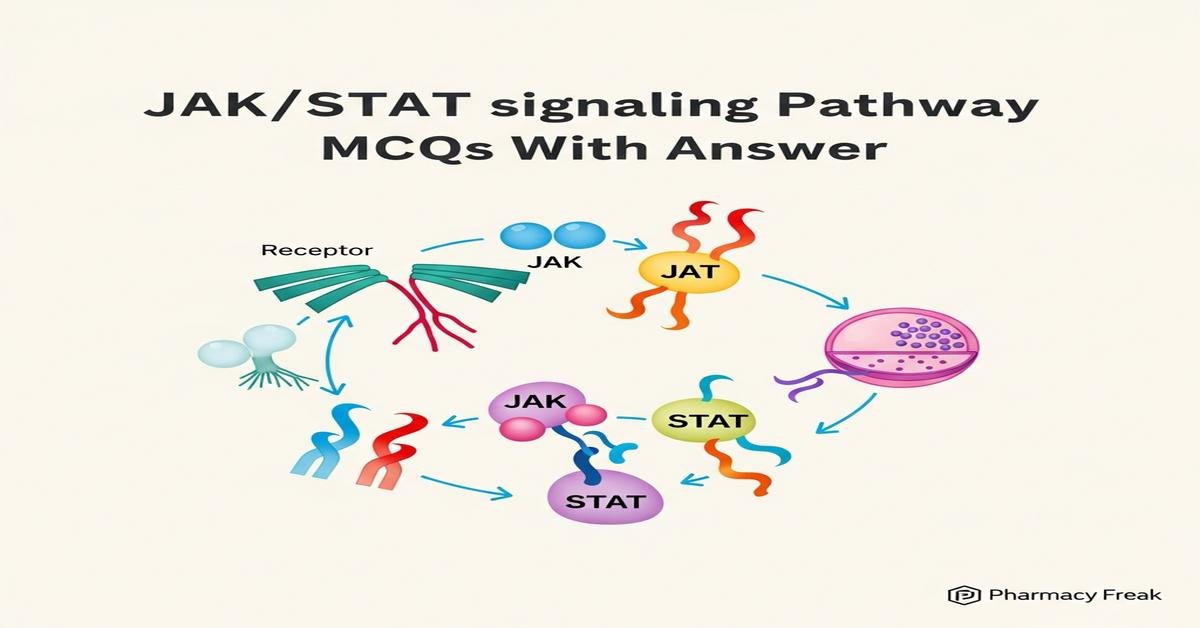
Introduction: The JAK/STAT signaling pathway is a central mechanism by which cytokines, growth factors, and some hormones transmit signals from cell-surface receptors to the nucleus, regulating gene expression critical for immunity, hematopoiesis, and cell growth. For M.Pharm students, mastering this pathway is essential for understanding disease mechanisms, rational drug design, and the pharmacology of targeted therapies such as JAK inhibitors. This blog presents focused multiple-choice questions with answers to reinforce key concepts: receptor activation, JAK and STAT family members, phosphorylation events, negative regulators (SOCS, PIAS, PTPs), clinical implications, and experimental assays. Use these MCQs to test and deepen your mechanistic and therapeutic knowledge of JAK/STAT signaling.
Q1. Which molecular event directly follows ligand binding to a type I cytokine receptor in the canonical JAK/STAT pathway?
- Recruitment and transphosphorylation of receptor-associated JAKs
- Dimerization of STAT proteins in the nucleus
- Ubiquitination of the receptor leading to degradation
- Immediate activation of MAP kinase cascade independent of JAKs
Correct Answer: Recruitment and transphosphorylation of receptor-associated JAKs
Q2. Which of the following STAT proteins is most commonly phosphorylated on a tyrosine residue that corresponds to Y701 numbering in the canonical STAT1 sequence?
- STAT1
- STAT3
- STAT5A
- STAT6
Correct Answer: STAT1
Q3. The JAK2 V617F mutation is best associated with which clinical condition?
- Myeloproliferative neoplasms such as polycythemia vera
- Rheumatoid arthritis
- Type I diabetes mellitus
- Alzheimer’s disease
Correct Answer: Myeloproliferative neoplasms such as polycythemia vera
Q4. Which domain of STAT proteins is primarily responsible for dimerization via reciprocal phosphotyrosine–SH2 interactions?
- SH2 domain
- DNA-binding domain
- N-terminal oligomerization domain
- Transactivation domain
Correct Answer: SH2 domain
Q5. SOCS proteins negatively regulate JAK/STAT signaling predominantly by which mechanism?
- Binding to JAKs or receptors and promoting ubiquitin-mediated proteasomal degradation
- Phosphorylating STATs on serine residues
- Enhancing receptor dimerization
- Directly blocking STAT DNA-binding sites in the nucleus
Correct Answer: Binding to JAKs or receptors and promoting ubiquitin-mediated proteasomal degradation
Q6. Which assay is most commonly used to demonstrate STAT DNA-binding activity in vitro?
- Electrophoretic mobility shift assay (EMSA)
- ELISA for cytokine concentration
- Chromatin immunoprecipitation followed by sequencing (ChIP-seq)
- Flow cytometry for surface receptors
Correct Answer: Electrophoretic mobility shift assay (EMSA)
Q7. Which JAK family member is primarily associated with signaling through erythropoietin and thrombopoietin receptors?
- JAK2
- JAK1
- JAK3
- TYK2
Correct Answer: JAK2
Q8. A small-molecule JAK inhibitor that competes with ATP at the kinase active site is best described as which type of inhibitor?
- ATP-competitive type I kinase inhibitor
- Covalent irreversible inhibitor targeting receptor cysteines
- Allosteric inhibitor binding the pseudokinase domain exclusively
- Proteolysis-targeting chimera (PROTAC)
Correct Answer: ATP-competitive type I kinase inhibitor
Q9. Which negative regulator directly prevents STAT-mediated transcription by inhibiting STAT:DNA interactions in the nucleus?
- PIAS proteins (Protein inhibitors of activated STAT)
- Receptor tyrosine phosphatases
- SOCS box proteins that recruit E3 ligases
- Heat shock proteins that sequester JAKs
Correct Answer: PIAS proteins (Protein inhibitors of activated STAT)
Q10. Phosphorylation of STAT proteins on a conserved serine residue (e.g., S727 in STAT1) primarily modulates which aspect of STAT function?
- Transcriptional activation potency and recruitment of co-activators
- DNA-binding sequence specificity
- SH2-mediated dimerization fidelity
- Receptor localization to lipid rafts
Correct Answer: Transcriptional activation potency and recruitment of co-activators
Q11. Which experimental evidence would best indicate that a cytokine receptor is pre-dimerized prior to ligand binding?
- Co-immunoprecipitation of receptor subunits in the absence of ligand
- Increased mRNA of receptor after ligand treatment
- Enhanced receptor ubiquitination only after stimulation
- Loss of STAT phosphorylation when JAKs are overexpressed
Correct Answer: Co-immunoprecipitation of receptor subunits in the absence of ligand
Q12. Which STAT family member is most frequently implicated in oncogenic signaling and is a common target for anticancer strategies?
- STAT3
- STAT4
- STAT2
- STAT6
Correct Answer: STAT3
Q13. Which of the following is a clinically used JAK inhibitor indicated for rheumatoid arthritis and targets JAK1/3 with some JAK2 activity?
- Tofacitinib
- Imatinib
- Trastuzumab
- Sunitinib
Correct Answer: Tofacitinib
Q14. Tyrosine phosphatases regulate JAK/STAT signaling by which direct action?
- Dephosphorylating activated JAKs or STATs to terminate signaling
- Enhancing STAT dimerization by phosphorylation
- Ubiquitinating receptors for lysosomal degradation
- Recruiting co-activators to STAT-bound promoters
Correct Answer: Dephosphorylating activated JAKs or STATs to terminate signaling
Q15. The canonical DNA recognition element for many STAT dimers is known as:
- Gamma-activated sequence (GAS)
- cAMP response element (CRE)
- Estrogen response element (ERE)
- NF-κB consensus site
Correct Answer: Gamma-activated sequence (GAS)
Q16. Which domain of JAK kinases is considered catalytically active?
- JH1 (kinase) domain
- FERM-like domain
- Pseudokinase (JH2) domain
- SH3 domain
Correct Answer: JH1 (kinase) domain
Q17. In a pathway crosstalk context, activation of which pathway is commonly observed downstream of JAK/STAT signaling and promotes cell survival?
- PI3K/AKT pathway
- NOTCH signaling
- Wnt/β-catenin exclusively in all cells
- Classical complement cascade
Correct Answer: PI3K/AKT pathway
Q18. Which laboratory technique is most appropriate to confirm phosphorylation of STAT proteins at specific residues in cell lysates?
- Western blot with phospho-specific antibodies
- qPCR for STAT target gene transcripts
- Immunofluorescence without phosphorylation-specific probes
- Mass spectrometry of genomic DNA
Correct Answer: Western blot with phospho-specific antibodies
Q19. A pharmacological side effect commonly associated with broad JAK inhibition is:
- Increased susceptibility to infections due to immunosuppression
- Hyperactivation of T-cell responses leading to autoimmunity
- Excessive bone formation and osteopetrosis
- Enhanced insulin sensitivity causing hypoglycemia
Correct Answer: Increased susceptibility to infections due to immunosuppression
Q20. Which experimental observation would indicate that a STAT mutant lacking the SH2 domain cannot function in canonical signaling?
- Absence of tyrosine-dependent dimer formation and nuclear translocation despite phosphorylation attempts
- Enhanced DNA-binding affinity to GAS elements in EMSA
- Increased basal transcriptional activity in luciferase reporter assays
- Prolonged receptor phosphorylation after ligand withdrawal
Correct Answer: Absence of tyrosine-dependent dimer formation and nuclear translocation despite phosphorylation attempts

