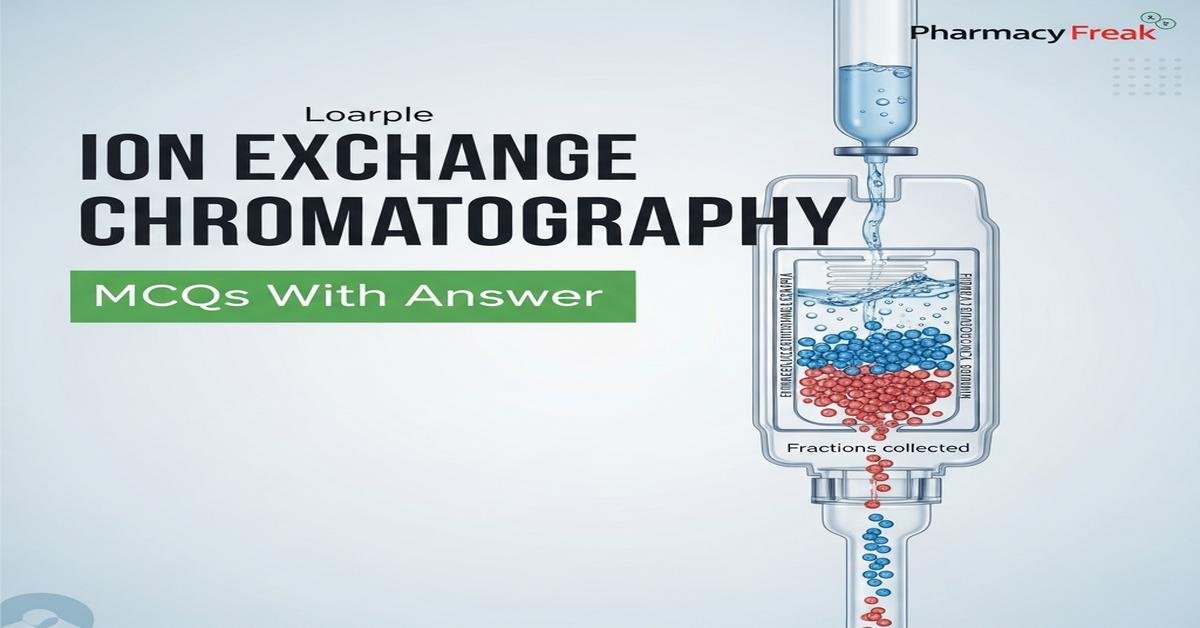
Introduction: Ion exchange chromatography MCQs With Answer is a targeted quiz resource designed for M.Pharm students studying Advanced Instrumental Analysis (MPA 201T). This set focuses on the principles, resins, selectivity, kinetics, elution strategies, detection methods and practical applications of ion exchange chromatography in pharmaceutical analysis and purification. Questions emphasize conceptual understanding and problem-solving relevant to laboratory practice and process development, including buffer selection, capacity measurements, regeneration, and coupling with other techniques. Each MCQ includes plausible alternatives and the correct answer to help prepare for examinations and practical work. Use these questions to test knowledge depth and reinforce critical aspects of ion exchange separations.
Q1. What is the primary separation principle of ion exchange chromatography?
- Reversible adsorption of solutes via hydrophobic interactions
- Reversible exchange of ions between the mobile phase and oppositely charged sites on the stationary phase
- Size-based sieving through a porous stationary phase
- Partitioning between two immiscible liquid phases
Correct Answer: Reversible exchange of ions between the mobile phase and oppositely charged sites on the stationary phase
Q2. Which functional group is characteristic of a strong cation-exchange resin?
- Carboxylic acid groups
- Sulfonic acid groups
- Primary amine groups
- Hydroxyl groups
Correct Answer: Sulfonic acid groups
Q3. Which functional group defines a strong anion-exchange resin?
- Carboxylate groups
- Sulfonate groups
- Quaternary ammonium groups
- Phenolic hydroxyl groups
Correct Answer: Quaternary ammonium groups
Q4. In what units is the ion-exchange capacity of a resin most commonly reported?
- Milligrams per milliliter (mg/mL)
- Milliequivalents per gram (meq/g)
- Micromoles per liter (µmol/L)
- Percent weight/weight (% w/w)
Correct Answer: Milliequivalents per gram (meq/g)
Q5. Which factors primarily determine selectivity of ions on a cation-exchange resin?
- Ion charge and hydrated radius (charge density)
- Ion color and optical rotation
- Viscosity of the mobile phase and column length
- Stationary phase pore size only
Correct Answer: Ion charge and hydrated radius (charge density)
Q6. What is the most commonly used elution strategy to displace strongly bound ions from an ion-exchange column?
- Decreasing the column temperature
- Increasing ionic strength of the eluent (salt gradient)
- Adding organic modifiers like methanol
- Reducing flow rate to near zero
Correct Answer: Increasing ionic strength of the eluent (salt gradient)
Q7. Which reagent is typically used to regenerate a cation-exchange resin into the hydrogen (H+) form?
- Sodium chloride (NaCl)
- Sodium hydroxide (NaOH)
- Hydrochloric acid (HCl)
- Ammonium acetate (NH4OAc)
Correct Answer: Hydrochloric acid (HCl)
Q8. What does a breakthrough curve in ion exchange chromatography represent?
- The point where column pressure begins to increase rapidly
- The point at which the analyte first appears in the effluent, indicating resin capacity is being exceeded
- A plot of particle size distribution in the resin bed
- The time required for complete chemical regeneration
Correct Answer: The point at which the analyte first appears in the effluent, indicating resin capacity is being exceeded
Q9. Which expression defines the chromatographic capacity factor (k’)?
- k’ = t0 / tR
- k’ = (tR − t0) / t0
- k’ = tR × t0
- k’ = tR + t0
Correct Answer: k’ = (tR − t0) / t0
Q10. How does the isoelectric point (pI) of a protein determine its behavior on ion exchange columns?
- Protein is positively charged below its pI and will bind to cation exchangers
- Protein is neutral at all pH values relative to its pI
- Protein is negatively charged below its pI and will bind to anion exchangers
- pI does not influence ion exchange behavior
Correct Answer: Protein is positively charged below its pI and will bind to cation exchangers
Q11. Why is suppressed conductivity detection used in ion chromatography?
- It increases the conductivity of the eluent background
- It reduces background eluent conductivity, enhancing sensitivity for analyte ions
- It suppresses the ionic analytes to neutral species for UV detection
- It is required only for organic solvents
Correct Answer: It reduces background eluent conductivity, enhancing sensitivity for analyte ions
Q12. Which buffer is commonly preferred when coupling ion exchange chromatography to mass spectrometry?
- Sodium phosphate buffer
- Ammonium acetate buffer
- Potassium chloride buffer
- Tris-HCl buffer with high ionic strength
Correct Answer: Ammonium acetate buffer
Q13. Which theoretical model accounts for the distribution of ions between resin and solution including electrostatic interactions?
- Langmuir adsorption model only
- Donnan equilibrium model
- Einstein diffusion model
- Henderson-Hasselbalch model
Correct Answer: Donnan equilibrium model
Q14. How do strong ion-exchangers differ from weak ion-exchangers in pH behavior?
- Strong exchangers retain ionization over a wide pH range; weak exchangers change ionization with pH
- Strong exchangers lose ionization at neutral pH while weak exchangers remain ionized
- Both classes are completely insensitive to pH
- Weak exchangers are stable over a broader pH range than strong exchangers
Correct Answer: Strong exchangers retain ionization over a wide pH range; weak exchangers change ionization with pH
Q15. How does hydrated ionic radius affect ion-exchange kinetics?
- Smaller hydrated radius generally leads to slower exchange kinetics
- Hydrated radius has no effect on kinetics
- Smaller hydrated radius generally leads to faster exchange kinetics
- Larger hydrated radius always increases selectivity but not kinetics
Correct Answer: Smaller hydrated radius generally leads to faster exchange kinetics
Q16. Which three factors primarily determine resolution (Rs) in ion exchange chromatography?
- Column length, detector type, and pH
- Selectivity (α), efficiency (plate number, N), and retention factor (k)
- Resin color, flow direction, and buffer osmolality
- Only column temperature and sample concentration
Correct Answer: Selectivity (α), efficiency (plate number, N), and retention factor (k)
Q17. What does dynamic capacity of an ion-exchange resin mean?
- Total theoretical binding sites determined at equilibrium
- Operational capacity measured at breakthrough under flow conditions
- Amount of resin required to pack a column of fixed diameter
- Maximum pressure the resin bed can tolerate
Correct Answer: Operational capacity measured at breakthrough under flow conditions
Q18. Which chemical is typically used to regenerate an anion-exchange resin to the hydroxide (OH−) form?
- Hydrochloric acid (HCl)
- Sodium chloride (NaCl)
- Sodium hydroxide (NaOH)
- Ammonium sulfate ((NH4)2SO4)
Correct Answer: Sodium hydroxide (NaOH)
Q19. What is the typical effect of increasing column temperature on ion exchange separations?
- Increases viscosity and broadens peaks while increasing retention
- Generally increases mass transfer rates and peak sharpness but may reduce retention due to weaker equilibrium constants
- Has no effect on kinetics or retention
- Always increases selectivity between ions regardless of other conditions
Correct Answer: Generally increases mass transfer rates and peak sharpness but may reduce retention due to weaker equilibrium constants
Q20. Which of the following is a common pharmaceutical application of ion exchange chromatography?
- Sterilization of injectable solutions
- Purification of proteins and removal of charge variants during biopharmaceutical processing
- Measuring particle size distributions in suspensions
- Determining lipid content by solvent extraction
Correct Answer: Purification of proteins and removal of charge variants during biopharmaceutical processing

