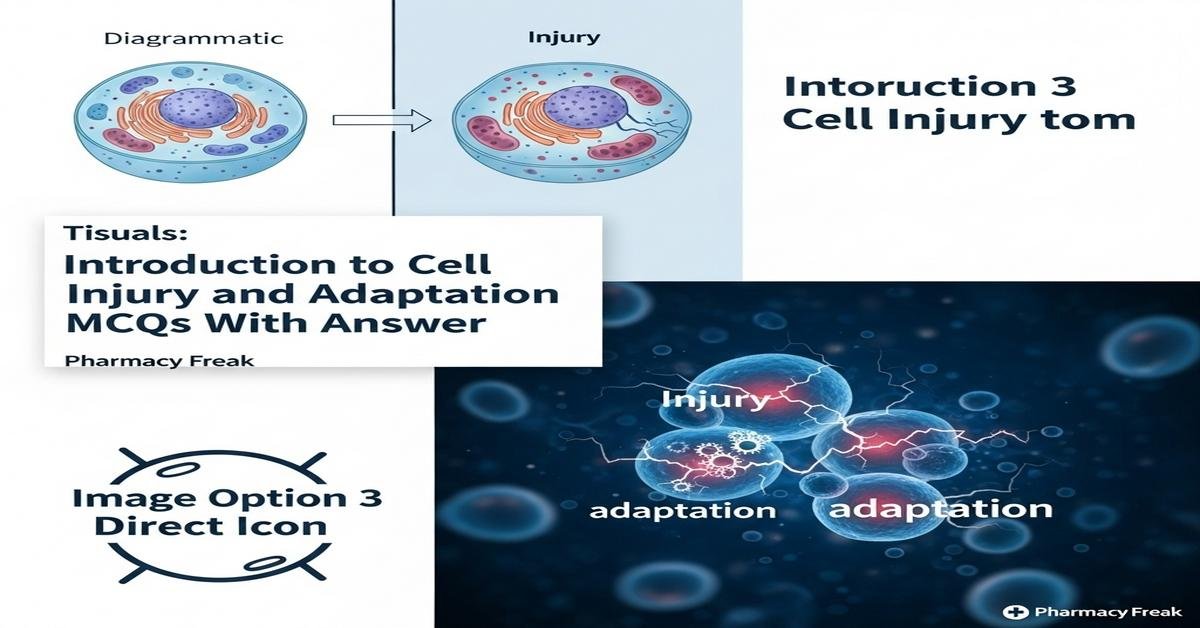
Introduction: This concise, Student-friendly post explains cell injury and adaptation MCQs for B. Pharm students, focusing on mechanisms, examples, and clinical relevance. Learn essential keywords such as cell injury and adaptation MCQs, reversible and irreversible injury, apoptosis, necrosis, oxidative stress, mitochondrial dysfunction, hypertrophy, hyperplasia, metaplasia, and drug-induced toxicity. The material links basic pathology with pharmacology—highlighting how drugs cause or modulate injury, biomarkers, and therapeutic strategies. Designed to build conceptual depth and exam readiness, these practice questions emphasize pathways, morphological changes, and laboratory correlations crucial for pharmacy practice and therapeutics. Now let’s test your knowledge with 50 MCQs on this topic.
Q1. Which feature best distinguishes apoptosis from necrosis?
- Cell swelling and plasma membrane rupture
- Chromatin condensation and formation of apoptotic bodies
- Inflammatory cell infiltration at the site
- Enzymatic digestion of cytoplasmic organelles with tissue liquefaction
Correct Answer: Chromatin condensation and formation of apoptotic bodies
Q2. The primary early biochemical event in ischemic cell injury is:
- Activation of caspases
- ATP depletion leading to failure of ion pumps
- Massive lipid accumulation in cytoplasm
- Activation of lysosomal hydrolases
Correct Answer: ATP depletion leading to failure of ion pumps
Q3. Which intracellular organelle is most critical in initiating apoptosis via the intrinsic pathway?
- Golgi apparatus
- Mitochondrion
- Endoplasmic reticulum
- Lysosome
Correct Answer: Mitochondrion
Q4. Lipid peroxidation in cell membranes is principally caused by:
- Excess ATP synthesis
- Reactive oxygen species (ROS)
- Elevated intracellular calcium binding to membranes
- Protein ubiquitination
Correct Answer: Reactive oxygen species (ROS)
Q5. A reversible cellular change typically seen early in hypoxic injury is:
- Pyknosis of the nucleus
- Cell swelling with blebbing of the plasma membrane
- Coagulative necrosis
- Autolysis with loss of nuclear staining
Correct Answer: Cell swelling with blebbing of the plasma membrane
Q6. Which enzyme is a sensitive marker of myocardial cell injury used in clinical practice?
- Alanine aminotransferase (ALT)
- Lactate dehydrogenase (LDH)
- Troponin I
- Alkaline phosphatase (ALP)
Correct Answer: Troponin I
Q7. Cellular adaptation defined by an increase in cell size in response to increased workload is called:
- Hyperplasia
- Hypertrophy
- Metaplasia
- Dysplasia
Correct Answer: Hypertrophy
Q8. Barrett’s esophagus is an example of which adaptive change?
- Hypertrophy of squamous epithelium
- Metaplasia from squamous to columnar epithelium
- Hyperplasia of basal cells
- Dysplasia leading directly to carcinoma
Correct Answer: Metaplasia from squamous to columnar epithelium
Q9. Which of the following best describes reperfusion injury?
- Tissue repair following ischemia without ROS involvement
- An exacerbation of injury due to sudden restoration of blood flow and ROS generation
- Purely immune-mediated damage unrelated to ischemia
- A form of metaplasia due to hypoxia
Correct Answer: An exacerbation of injury due to sudden restoration of blood flow and ROS generation
Q10. Which drug overdose causes hepatocellular necrosis via reactive metabolite formation and glutathione depletion?
- Ibuprofen
- Acetaminophen (paracetamol)
- Amoxicillin
- Metformin
Correct Answer: Acetaminophen (paracetamol)
Q11. Which intracellular accumulation often signals chronic cell injury and can impair cell function?
- Glycogen only in skeletal muscle after exercise
- Excessive lipid accumulation (steatosis) in hepatocytes
- Transient calcium uptake during excitation
- Brief metrial swelling in mitochondria
Correct Answer: Excessive lipid accumulation (steatosis) in hepatocytes
Q12. Which molecular event most directly leads to loss of membrane phospholipids in severe cell injury?
- Overactivation of ubiquitin-proteasome system
- Activation of phospholipases due to increased intracellular calcium
- Excessive DNA repair enzyme activity
- Upregulation of heat shock proteins
Correct Answer: Activation of phospholipases due to increased intracellular calcium
Q13. A hallmark morphological change of irreversible cell injury is:
- Cellular swelling that is fully reversible
- Nuclear pyknosis, karyorrhexis, and karyolysis
- Transient ER dilation with polysome detachment
- Increased glycogen stores
Correct Answer: Nuclear pyknosis, karyorrhexis, and karyolysis
Q14. Which caspase group is primarily responsible for execution-phase apoptosis?
- Initiator caspases (e.g., caspase-8, -9)
- Executioner caspases (e.g., caspase-3, -6, -7)
- Inflammatory caspases (e.g., caspase-1)
- DNA repair caspases
Correct Answer: Executioner caspases (e.g., caspase-3, -6, -7)
Q15. Chronic exposure to cigarette smoke causing squamous metaplasia in bronchi is an example of an adaptation that:
- Is always permanent and irreversible
- May be protective but predisposes to dysplasia and cancer
- Does not alter regeneration potential
- Is a form of apoptosis
Correct Answer: May be protective but predisposes to dysplasia and cancer
Q16. Which mediator released from necrotic cells activates inflammation by binding pattern recognition receptors?
- ATP as a DAMP (damage-associated molecular pattern)
- Insulin
- Mitochondrial DNA that acts as a DAMP
- Cytochrome P450 enzymes
Correct Answer: Mitochondrial DNA that acts as a DAMP
Q17. Which type of necrosis is typically seen in ischemic infarcts in solid organs like the kidney?
- Liquefactive necrosis
- Coagulative necrosis
- Caseous necrosis
- Fat necrosis
Correct Answer: Coagulative necrosis
Q18. Endoplasmic reticulum stress leading to unfolded protein response (UPR) can result in:
- Restoration of homeostasis or apoptosis if stress is severe
- Guaranteed cell proliferation
- Immediate necrosis without signaling
- Increased mitochondrial ATP synthesis only
Correct Answer: Restoration of homeostasis or apoptosis if stress is severe
Q19. Which intracellular ion increase is most directly implicated in activating degradative enzymes during cell injury?
- Sodium
- Potassium
- Calcium
- Chloride
Correct Answer: Calcium
Q20. Autophagy is best described as:
- A form of necrosis causing inflammation
- A regulated lysosomal degradation pathway that can be protective under stress
- Uncontrolled protein aggregation without degradation
- A process exclusively leading to apoptosis
Correct Answer: A regulated lysosomal degradation pathway that can be protective under stress
Q21. Which of the following is a common biochemical marker elevated early in hepatic cell necrosis?
- Serum creatinine
- Alanine aminotransferase (ALT)
- Serum amylase only in pancreatitis
- Troponin T
Correct Answer: Alanine aminotransferase (ALT)
Q22. The key event in oxidative stress-mediated cell injury is imbalance between:
- DNA synthesis and repair
- Protein synthesis and degradation
- Reactive oxygen species generation and antioxidant defenses
- Calcium influx and sodium efflux only
Correct Answer: Reactive oxygen species generation and antioxidant defenses
Q23. Which pharmacologic agent can reduce free radical-mediated injury by replenishing glutathione stores in acetaminophen toxicity?
- N-acetylcysteine
- Activated charcoal
- Vitamin K
- Erythropoietin
Correct Answer: N-acetylcysteine
Q24. Which genetic defect would most likely impair apoptosis and predispose to cancer?
- Overexpression of pro-apoptotic BAX protein
- Loss-of-function mutation in p53 tumor suppressor
- Gain-of-function mutation in caspase-3
- Enhanced cytochrome c release from mitochondria
Correct Answer: Loss-of-function mutation in p53 tumor suppressor
Q25. Which pattern of necrosis is characteristically associated with tuberculosis?
- Coagulative necrosis
- Liquefactive necrosis
- Caseous necrosis
- Fat necrosis
Correct Answer: Caseous necrosis
Q26. In drug-induced liver injury, centrilobular (zone 3) hepatocyte necrosis is often due to:
- Higher oxygen tension in zone 1
- Greater expression of cytochrome P450 enzymes and reactive metabolites
- Immunity-mediated bile duct injury only
- Excessive glycogen storage in zone 3
Correct Answer: Greater expression of cytochrome P450 enzymes and reactive metabolites
Q27. Which laboratory test elevation is most specific for acute pancreatic cell injury?
- AST (aspartate aminotransferase)
- Serum amylase and lipase, with lipase more specific
- Alkaline phosphatase
- Troponin I
Correct Answer: Serum amylase and lipase, with lipase more specific
Q28. Which cellular adaptation involves an increase in cell number due to growth factor stimulation?
- Hypertrophy
- Hyperplasia
- Metaplasia
- Aging
Correct Answer: Hyperplasia
Q29. What is the role of heat shock proteins (HSPs) in cell stress?
- They act as chaperones to refold denatured proteins and protect cells
- They directly lyse damaged cells
- They permanently block apoptosis
- They increase ROS production
Correct Answer: They act as chaperones to refold denatured proteins and protect cells
Q30. Lipofuscin pigment accumulation in aging cells indicates:
- Active necrosis
- Previous free radical injury and impaired degradation—“wear-and-tear” pigment
- Acute viral infection
- Elevated mitochondrial biogenesis only
Correct Answer: Previous free radical injury and impaired degradation—“wear-and-tear” pigment
Q31. Which process involves replacement of one differentiated cell type by another better suited to the new stress?
- Dysplasia
- Metaplasia
- Apoptosis
- Necrosis
Correct Answer: Metaplasia
Q32. Which feature is characteristic of coagulative necrosis on histology?
- Preservation of tissue architecture with loss of nuclei
- Complete digestion of tissue with pus formation
- Cheesy-white debris with granulomatous inflammation
- Fatty saponification
Correct Answer: Preservation of tissue architecture with loss of nuclei
Q33. In ischemic injury, mitochondrial permeability transition pore opening leads to:
- Enhanced ATP synthesis
- Loss of mitochondrial membrane potential and ATP depletion
- Immediate restoration of calcium homeostasis
- Decreased ROS formation only
Correct Answer: Loss of mitochondrial membrane potential and ATP depletion
Q34. Which measurement is most useful to monitor rhabdomyolysis-related muscle cell injury?
- Serum amylase
- Creatine kinase (CK), especially CK-MM or CK-total
- ALT only
- Serum bilirubin
Correct Answer: Creatine kinase (CK), especially CK-MM or CK-total
Q35. Which of the following best explains cellular calcification in necrotic tissue?
- Dystrophic calcification occurs in dead or dying tissues with normal serum calcium
- Metastatic calcification only occurs in localized necrosis
- Calcification always indicates systemic hypercalcemia
- Calcification is a reversible adaptive response
Correct Answer: Dystrophic calcification occurs in dead or dying tissues with normal serum calcium
Q36. Which transcription factor is activated by hypoxia and mediates adaptive responses including angiogenesis?
- NF-κB
- HIF-1α (hypoxia-inducible factor 1-alpha)
- p53 exclusively for apoptosis
- c-Jun only in proliferation
Correct Answer: HIF-1α (hypoxia-inducible factor 1-alpha)
Q37. Which cellular adaptation is commonly induced by increased endocrine stimulation, such as in the female breast during pregnancy?
- Atrophy
- Hyperplasia
- Metaplasia
- Irreversible necrosis
Correct Answer: Hyperplasia
Q38. Which free radical-generating reaction is catalyzed by iron via the Fenton reaction?
- Superoxide dismutase producing H2O2
- Conversion of H2O2 to hydroxyl radical (•OH)
- Reduction of glutathione
- Formation of nitric oxide from arginine
Correct Answer: Conversion of H2O2 to hydroxyl radical (•OH)
Q39. A decrease in cell size due to reduced workload or loss of innervation is termed:
- Hypertrophy
- Atrophy
- Hyperplasia
- Metaplasia
Correct Answer: Atrophy
Q40. Which cellular event is a feature of apoptosis detectable by TUNEL assay?
- Membrane rupture with release of intracellular enzymes
- DNA fragmentation with internucleosomal cleavage
- Massive cell swelling only
- Extracellular accumulation of lipids
Correct Answer: DNA fragmentation with internucleosomal cleavage
Q41. In the extrinsic apoptosis pathway, which receptor-ligand interaction is central?
- TNF family receptor binding (e.g., Fas-FasL)
- Insulin receptor activation
- EGF receptor binding causing proliferation
- Integrin-ligand adhesion only
Correct Answer: TNF family receptor binding (e.g., Fas-FasL)
Q42. Which of the following is a common mechanism of drug-induced nephrotoxicity leading to tubular cell injury?
- Excessive hepatic glycogen deposition
- Direct tubular epithelial toxicity and ischemia
- Stimulation of erythropoiesis
- Enhanced bile flow causing cholestasis
Correct Answer: Direct tubular epithelial toxicity and ischemia
Q43. Which morphological change is typical of irreversible mitochondrial damage?
- Mild mitochondrial swelling reversible with reperfusion
- Profound mitochondrial swelling with loss of cristae and rupture
- Transient increase in cristae number
- Complete preservation of structure despite ATP loss
Correct Answer: Profound mitochondrial swelling with loss of cristae and rupture
Q44. Which pattern of cell death often elicits minimal inflammatory response due to rapid phagocytosis?
- Necrosis
- Apoptosis
- Coagulative necrosis with calcification
- Liquefactive necrosis with pus
Correct Answer: Apoptosis
Q45. Chronic inflammation and repeated injury to epithelium increases the risk of progression to:
- Regenerative hyperplasia only
- Dysplasia and eventual neoplasia
- Immediate apoptosis with no long-term effects
- Complete restoration to original tissue without mutation risk
Correct Answer: Dysplasia and eventual neoplasia
Q46. Which event best characterizes fatty change (steatosis) in hepatocytes?
- Increased triglyceride accumulation within cytoplasmic lipid vacuoles
- Excessive protein aggregation in the nucleus
- Mineral deposition in necrotic tissue
- Massive glycogen loss from cells
Correct Answer: Increased triglyceride accumulation within cytoplasmic lipid vacuoles
Q47. Which cellular mechanism is responsible for removal of damaged organelles and long-lived proteins to maintain cell homeostasis?
- Necrosis
- Autophagy-lysosomal pathway
- Glycolysis upregulation only
- Immediate apoptosis without recycling
Correct Answer: Autophagy-lysosomal pathway
Q48. Which of the following is NOT typically an outcome of chronic oxidative stress in tissues?
- Lipid peroxidation and membrane damage
- DNA strand breaks and mutations
- Reversible restoration without any protein modification
- Activation of pro-inflammatory signaling pathways
Correct Answer: Reversible restoration without any protein modification
Q49. In the context of pharmacology, inhibition of mitochondrial complex I can cause cell injury mainly by:
- Increasing ATP production
- Decreasing ROS generation exclusively
- Impairing oxidative phosphorylation leading to ATP depletion
- Stimulating protein synthesis
Correct Answer: Impairing oxidative phosphorylation leading to ATP depletion
Q50. Which cellular adaptation involves both increased cell size and enhanced synthesis of sarcomeric proteins in response to chronic hemodynamic overload?
- Cardiac hypertrophy
- Cardiac hyperplasia
- Cardiac metaplasia
- Cardiac dysplasia
Correct Answer: Cardiac hypertrophy

