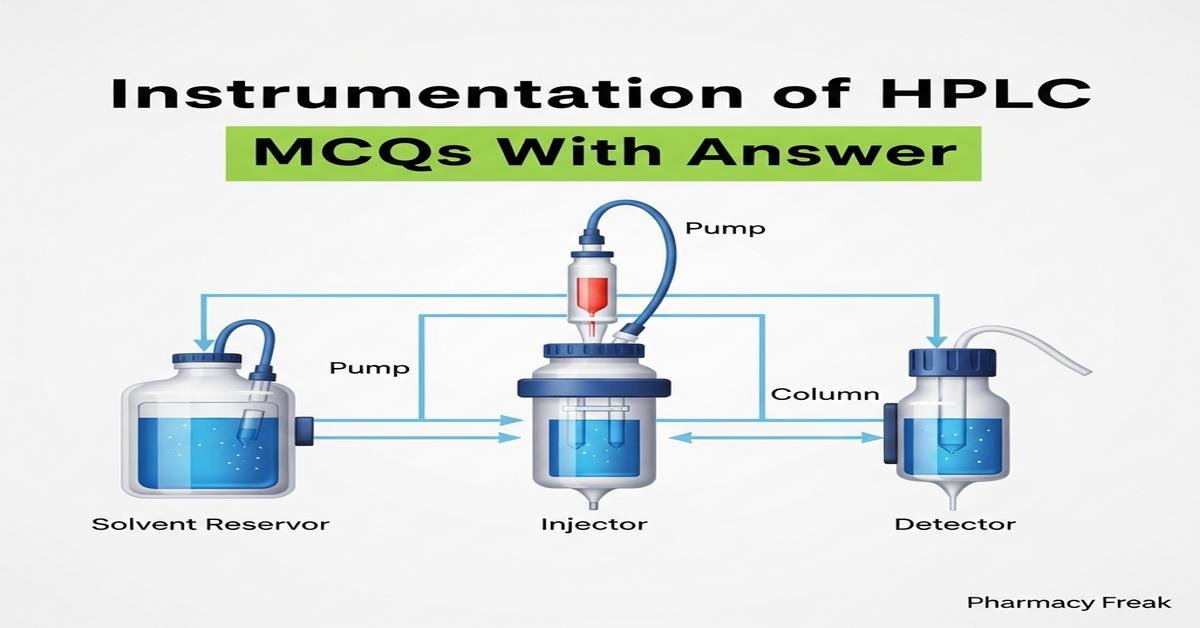
Instrumentation of HPLC MCQs With Answer is designed to strengthen M.Pharm students’ understanding of high-performance liquid chromatography hardware and practical considerations. This set focuses on instrumentation: pumps, degassers, injection systems, columns, detectors (UV, PDA, RI, ELSD, MS interfaces), gradient formation, extra-column effects, and system troubleshooting. Each question emphasizes real-world operational principles, component roles, and the impact of instrument choices on separation performance and data quality. Practicing these MCQs will help students prepare for exams and laboratory work by reinforcing critical concepts needed to design, operate, and troubleshoot modern HPLC systems.
Q1. What is the primary purpose of the HPLC pump in an analytical system?
- To mix solvents in the reservoir
- To deliver the mobile phase at a constant flow rate and pressure
- To detect analytes based on absorbance
- To control the column temperature
Correct Answer: To deliver the mobile phase at a constant flow rate and pressure
Q2. Why is an online degasser used in HPLC systems?
- To remove particulate matter from the mobile phase
- To remove dissolved gases that cause bubble formation and baseline noise
- To increase the viscosity of the mobile phase
- To adjust the pH of aqueous solvents
Correct Answer: To remove dissolved gases that cause bubble formation and baseline noise
Q3. What is the main function of a guard column placed upstream of the analytical column?
- To improve detector sensitivity
- To increase column temperature stability
- To protect the analytical column from particulates and strongly retained contaminants
- To reduce column backpressure
Correct Answer: To protect the analytical column from particulates and strongly retained contaminants
Q4. How does reducing stationary phase particle size affect column performance and system pressure?
- Decreases efficiency and decreases backpressure
- Increases efficiency and increases backpressure
- Has no effect on efficiency but reduces backpressure
- Increases efficiency and decreases backpressure
Correct Answer: Increases efficiency and increases backpressure
Q5. What advantage does a fixed-loop autosampler provide for injections?
- Variable sample volumes without carryover
- Accurate, reproducible sample volume delivery independent of syringe precision
- Online sample dilution capabilities only
- Reduced extra-column volume compared to direct injection only
Correct Answer: Accurate, reproducible sample volume delivery independent of syringe precision
Q6. Which detector measures changes in the refractive index of the mobile phase to detect analytes?
- Diode array detector (PDA)
- Ultraviolet-visible (UV-Vis) detector
- Refractive index (RI) detector
- Evaporative light scattering detector (ELSD)
Correct Answer: Refractive index (RI) detector
Q7. What is a key advantage of a photodiode array (PDA) detector over a single-wavelength UV detector?
- Lower cost and simpler optics
- Ability to acquire full spectral data across wavelengths for peak identification and purity assessment
- Insensitive to baseline drift from mobile phase changes
- Higher sensitivity for non-UV active compounds
Correct Answer: Ability to acquire full spectral data across wavelengths for peak identification and purity assessment
Q8. Why is a column oven used in HPLC instrumentation?
- To allow operation under vacuum conditions
- To control column temperature, improving retention reproducibility and selectivity
- To cool the detector cell for increased sensitivity
- To reduce solvent evaporation in the mobile phase reservoir
Correct Answer: To control column temperature, improving retention reproducibility and selectivity
Q9. How is the gradient dwell (delay) volume defined in an HPLC system?
- The volume inside the column packing
- The volume between the detector and waste line
- The system volume between the point where the gradient is formed and the head of the column
- The total volume of mobile phase in the solvent reservoirs
Correct Answer: The system volume between the point where the gradient is formed and the head of the column
Q10. Which gradient formation approach mixes solvents after the high-pressure pumps, close to the column?
- Low-pressure mixing
- Post-column mixing
- High-pressure mixing
- Isocratic mixing only
Correct Answer: High-pressure mixing
Q11. What is meant by extra-column volume and why is it important?
- Volume of mobile phase in the reservoir; it affects solvent stability
- Volume inside the column; it determines retention factor
- Volume in system components outside the column that contributes to band broadening and reduced resolution
- Volume of detector flow cell only; it controls sensitivity
Correct Answer: Volume in system components outside the column that contributes to band broadening and reduced resolution
Q12. Which wavelength is commonly used as a general monitoring wavelength for aromatic pharmaceutical compounds in UV detection?
- 210 nm
- 254 nm
- 400 nm
- 600 nm
Correct Answer: 254 nm
Q13. How does an evaporative light scattering detector (ELSD) detect analytes?
- By measuring refractive index changes
- By detecting residual ions generated in the gas phase
- By nebulizing the eluent, evaporating solvent, and measuring light scattered by non-volatile particles
- By measuring UV absorbance at variable wavelengths
Correct Answer: By nebulizing the eluent, evaporating solvent, and measuring light scattered by non-volatile particles
Q14. Which pump design is most commonly used in analytical HPLC for accurate, high-pressure delivery: piston reciprocating or peristaltic?
- Peristaltic pump
- Reciprocating piston pump
- Syringe pump only
- Gravity-fed pump
Correct Answer: Reciprocating piston pump
Q15. Why might an HPLC system include a backpressure regulator on the detector waste line?
- To increase detector sensitivity at low flow
- To maintain a constant system pressure and prevent mobile-phase boiling or gas release
- To reduce solvent consumption
- To change the mobile phase composition automatically
Correct Answer: To maintain a constant system pressure and prevent mobile-phase boiling or gas release
Q16. Which system suitability parameter directly assesses peak symmetry and the presence of tailing?
- Number of theoretical plates (N)
- Resolution (Rs)
- Tailing factor (T)
- Retention time (tR)
Correct Answer: Tailing factor (T)
Q17. What is the correct expression for the chromatographic retention (capacity) factor k?
- k = t0 / (tR – t0)
- k = tR / t0
- k = (tR – t0) / t0
- k = tR – t0
Correct Answer: k = (tR – t0) / t0
Q18. Which mass spectrometry ionization source is considered a “soft” technique suitable for polar, thermally labile pharmaceutical analytes?
- Electron impact ionization (EI)
- Electrospray ionization (ESI)
- Matrix-assisted laser desorption (MALDI)
- Fast atom bombardment (FAB)
Correct Answer: Electrospray ionization (ESI)
Q19. Which detector type requires analytes to possess UV-absorbing chromophores to be detected effectively?
- Refractive index detector (RI)
- Evaporative light scattering detector (ELSD)
- Fluorescence detector
- Ultraviolet-visible (UV-Vis) detector
Correct Answer: Ultraviolet-visible (UV-Vis) detector
Q20. According to the van Deemter relationship, which adjustment will predominantly reduce band broadening caused by longitudinal diffusion?
- Decrease linear flow velocity
- Increase linear flow velocity
- Increase particle size of packing
- Cool the column to a lower temperature
Correct Answer: Increase linear flow velocity

