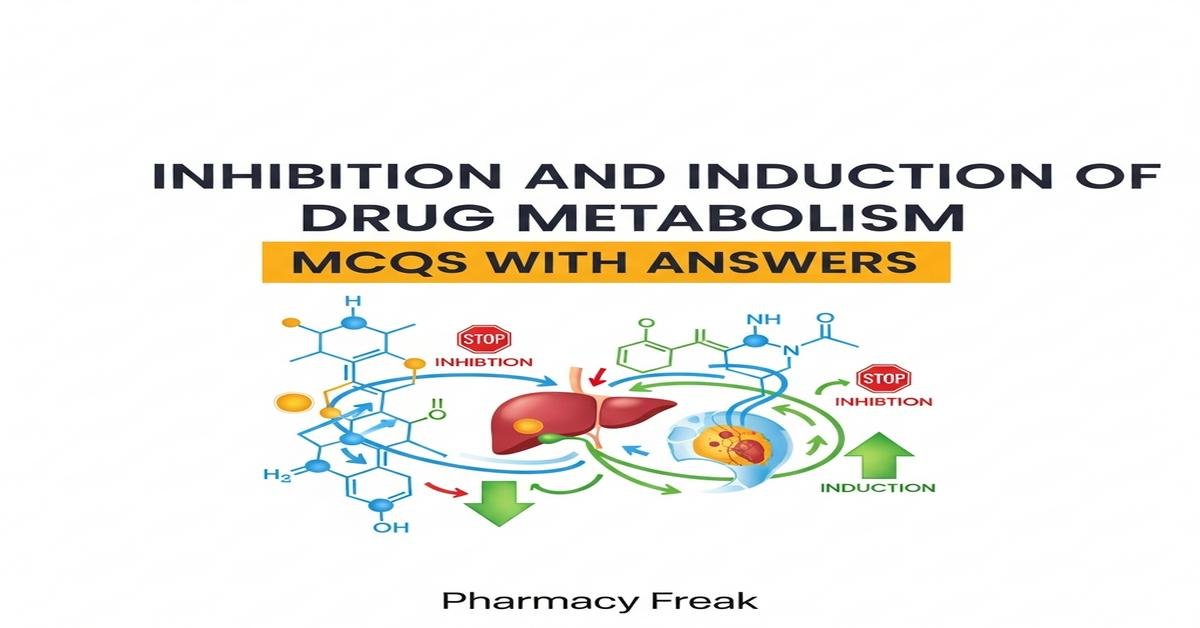
Introduction: This quiz set on Inhibition and Induction of Drug Metabolism is designed for M.Pharm students preparing for advanced topics in Clinical Pharmacokinetics and Therapeutic Drug Monitoring. The questions emphasize mechanisms (competitive, noncompetitive, mechanism‑based), major enzyme systems (CYP families, UGTs), clinical examples (rifampin, ketoconazole, grapefruit juice, St. John’s wort), time courses of induction/inhibition, and practical implications for therapeutic drug monitoring and dose adjustments. Expect scenario‑based items that probe how induction or inhibition alters clearance, AUC, prodrug activation, adverse reactions, and monitoring strategies. These MCQs will help consolidate mechanistic understanding and clinical decision‑making for managing drug interactions in practice.
Q1. Which of the following best describes mechanism‑based (suicide) inhibition of a drug‑metabolizing enzyme?
- An inhibitor reversibly competes with the substrate at the active site
- An inhibitor forms a metabolite that irreversibly inactivates the enzyme
- An inhibitor reduces enzyme transcription via nuclear receptors
- An inhibitor increases hepatic blood flow reducing extraction
Correct Answer: An inhibitor forms a metabolite that irreversibly inactivates the enzyme
Q2. Which clinical example is a classic strong inhibitor of intestinal and hepatic CYP3A4 causing increased plasma levels of many drugs?
- Rifampin
- Grapefruit juice
- Phenobarbital
- Carbamazepine
Correct Answer: Grapefruit juice
Q3. Which statement correctly describes the typical onset and offset of enzyme induction?
- Onset and offset occur within minutes of starting and stopping the inducer
- Onset is rapid (hours) but offset is immediate upon stopping
- Both onset and offset generally require several days to weeks due to synthesis and degradation of enzymes
- Induction causes permanent increase in enzyme activity
Correct Answer: Both onset and offset generally require several days to weeks due to synthesis and degradation of enzymes
Q4. Which of the following drugs is a prototypical strong enzyme inducer that reduces plasma concentrations of many coadministered drugs?
- Ketoconazole
- Ritonavir
- Rifampin
- Fluconazole
Correct Answer: Rifampin
Q5. If a patient begins a strong CYP3A4 inhibitor while on a narrow‑therapeutic‑index CYP3A4 substrate, the most appropriate immediate action is:
- Increase the substrate dose to overcome inhibition
- Stop therapeutic drug monitoring because inhibition stabilizes levels
- Consider dose reduction of the substrate and increase monitoring for toxicity
- Assume no clinically relevant change because inhibition only affects clearance marginally
Correct Answer: Consider dose reduction of the substrate and increase monitoring for toxicity
Q6. Which parameter most directly indicates the potency of a reversible inhibitor in enzyme kinetics?
- Km of the substrate
- Vmax of the enzyme
- Ki (inhibition constant)
- Fraction unbound of the substrate
Correct Answer: Ki (inhibition constant)
Q7. St. John’s wort commonly causes clinically significant drug interactions by which mechanism?
- Competitive inhibition of CYP2D6
- Induction of CYP3A4 and P‑glycoprotein via PXR activation
- Direct irreversible inhibition of UGT enzymes
- Blocking renal organic anion transporters
Correct Answer: Induction of CYP3A4 and P‑glycoprotein via PXR activation
Q8. Which effect would you expect when a potent CYP2C9 inhibitor is coadministered with warfarin?
- Decrease in warfarin plasma concentration and decreased INR
- Increase in warfarin plasma concentration and increased INR
- No change because warfarin metabolism is renal
- Induction of alternative metabolic pathways reducing warfarin effect
Correct Answer: Increase in warfarin plasma concentration and increased INR
Q9. Which drug is commonly used clinically as a pharmacokinetic “booster” due to its potent inhibition of CYP3A4?
- Ritonavir
- Phenobarbital
- Carbamazepine
- Rifampin
Correct Answer: Ritonavir
Q10. How does chronic ethanol consumption typically affect CYP2E1 levels and consequent metabolism of CYP2E1 substrates?
- Chronic ethanol induces CYP2E1 leading to increased metabolism of CYP2E1 substrates
- Chronic ethanol irreversibly inhibits CYP2E1 reducing substrate clearance
- Chronic ethanol has no effect on CYP2E1 expression
- Chronic ethanol converts CYP2E1 into CYP3A4
Correct Answer: Chronic ethanol induces CYP2E1 leading to increased metabolism of CYP2E1 substrates
Q11. Which clinical scenario best illustrates the risk of a prodrug when coadministered with an inducer?
- An inducer decreases activation of the prodrug leading to increased therapeutic effect
- An inducer increases conversion of the prodrug to active metabolite, potentially causing excessive effect or toxicity
- An inducer always prevents prodrug absorption in the gut
- Prodrugs are unaffected by metabolic induction
Correct Answer: An inducer increases conversion of the prodrug to active metabolite, potentially causing excessive effect or toxicity
Q12. Which type of inhibition typically results in a change in Km but not Vmax in Michaelis‑Menten kinetics?
- Noncompetitive inhibition
- Uncompetitive inhibition
- Competitive inhibition
- Mechanism‑based irreversible inhibition
Correct Answer: Competitive inhibition
Q13. A new drug is primarily metabolized by CYP2D6. Which patient population is most at risk of higher exposure when a CYP2D6 inhibitor is added?
- Patients who are CYP2D6 ultrarapid metabolizers
- Patients who are CYP2D6 poor metabolizers
- Patients with increased renal clearance
- Patients taking inducers of CYP3A4
Correct Answer: Patients who are CYP2D6 poor metabolizers
Q14. Which of the following interactions is primarily due to inhibition of intestinal first‑pass metabolism rather than hepatic metabolism?
- Oral drug concentration rises after grapefruit juice consumption
- Systemic levels rise only after intravenous inhibitor administration
- Co‑administration with a renal transporter inhibitor
- Co‑administration with a hepatic UGT inducer
Correct Answer: Oral drug concentration rises after grapefruit juice consumption
Q15. When monitoring a narrow therapeutic index drug subject to enzyme induction, the most appropriate TDM strategy is:
- Obtain no trough levels because induction is unpredictable
- Perform more frequent measurements after starting or stopping the inducer until new steady state is reached
- Only measure levels once annually
- Always double the dose empirically when an inducer is added
Correct Answer: Perform more frequent measurements after starting or stopping the inducer until new steady state is reached
Q16. Which statement about competitive versus noncompetitive inhibition is correct in vivo?
- Competitive inhibition cannot be overcome by increasing substrate concentration in vivo
- Noncompetitive inhibition decreases Vmax and is less dependent on substrate concentration
- Both types lead to permanent loss of enzyme activity
- Competitive inhibition always causes time‑dependent irreversible enzyme loss
Correct Answer: Noncompetitive inhibition decreases Vmax and is less dependent on substrate concentration
Q17. Which enzymatic regulatory pathway is most often responsible for transcriptional induction of multiple drug‑metabolizing enzymes (e.g., CYP3A) by xenobiotics?
- Activation of P‑glycoprotein directly in the nucleus
- Activation of nuclear receptors such as PXR and CAR leading to increased gene transcription
- Direct phosphorylation of CYP enzymes to increase catalytic activity
- Immediate post‑translational glycosylation of enzymes
Correct Answer: Activation of nuclear receptors such as PXR and CAR leading to increased gene transcription
Q18. Which of the following is an expected pharmacokinetic consequence of enzyme induction for a low‑extraction, hepatically metabolized drug?
- Decrease in intrinsic clearance (Clint)
- Decrease in total clearance and increase in AUC
- Increase in intrinsic clearance and decrease in AUC
- No change in clearance because extraction ratio is low
Correct Answer: Increase in intrinsic clearance and decrease in AUC
Q19. A patient on a CYP3A4 substrate begins taking ketoconazole (a strong CYP3A4 inhibitor). Which change in the substrate’s pharmacokinetics is most likely?
- Decreased Cmax and increased clearance
- Increased AUC and decreased clearance
- Increased renal excretion of unchanged drug
- No effect on systemic exposure
Correct Answer: Increased AUC and decreased clearance
Q20. Which management approach is most appropriate if a patient on a drug with narrow therapeutic index develops toxicity after starting a new medication known to inhibit the metabolizing enzyme?
- Ignore the new drug; toxicity will resolve without changes
- Stop or replace the inhibitor if possible, reduce the dose of the victim drug, and intensify monitoring
- Increase the victim drug dose to overcome inhibition
- Switch to another victim drug metabolized by the same enzyme without monitoring
Correct Answer: Stop or replace the inhibitor if possible, reduce the dose of the victim drug, and intensify monitoring

