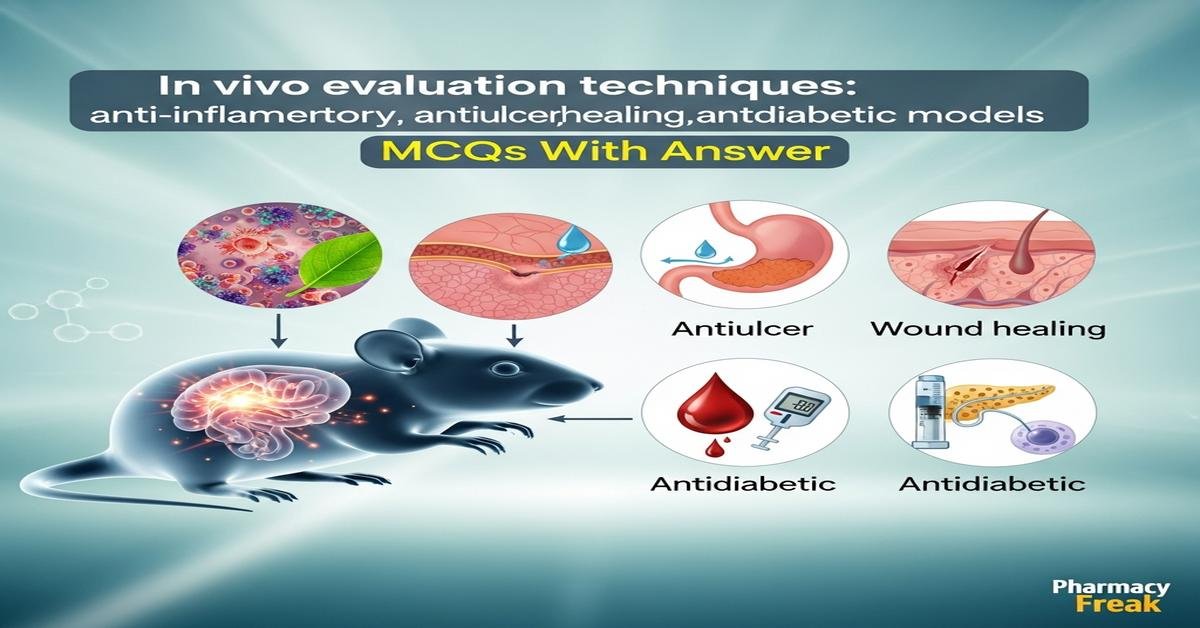
Introduction: This quiz collection focuses on in vivo evaluation techniques commonly used in advanced pharmacognosy research—specifically anti-inflammatory, antiulcer, wound healing, and antidiabetic models. Designed for M.Pharm students, the questions probe experimental design, mechanism-based interpretation, model selection, and outcome measures relevant to preclinical pharmacological evaluation. Emphasis is placed on understanding model-specific pathophysiology (e.g., carrageenan paw edema phases, pylorus ligation secrets, STZ-induced β-cell cytotoxicity), methodological nuances (measurement endpoints, controls, dosing, and ethical considerations), and interpretation of results for herbal or natural product testing. This set will help students prepare for examinations and design robust in vivo studies with critical appraisal skills.
Q1. Which inflammatory mediator is primarily responsible for the late phase (3–5 hours) of carrageenan-induced paw edema in rats?
- Histamine
- Bradykinin
- Prostaglandins (particularly PGE2)
- Serotonin
Correct Answer: Prostaglandins (particularly PGE2)
Q2. In the cotton pellet-induced granuloma model, which of the following endpoints best represents the proliferative phase of inflammation?
- Paw edema volume measured at 1 hour
- Wet and dry weight of the granuloma tissue after 7 days
- Vascular permeability measured by Evans blue dye
- Leukocyte migration into the peritoneal cavity within 4 hours
Correct Answer: Wet and dry weight of the granuloma tissue after 7 days
Q3. Which anti-inflammatory drug is expected to reduce the early phase (0–1.5 hours) of carrageenan-induced edema most effectively due to its effect on histamine and serotonin?
- Indomethacin (a nonselective COX inhibitor)
- Dexamethasone (a glucocorticoid)
- Promethazine (an antihistamine)
- Celecoxib (a COX-2 selective inhibitor)
Correct Answer: Promethazine (an antihistamine)
Q4. Which animal model is most appropriate for evaluating cytoprotective antiulcer activity mediated by increased mucosal defense rather than acid suppression?
- Pylorus ligation (Shay) model
- Ethanol-induced gastric ulcer model
- Indomethacin-induced gastric ulcer model
- Stress-induced (cold-restraint) ulcer model
Correct Answer: Ethanol-induced gastric ulcer model
Q5. In the pylorus ligation model, elevated gastric ulcer index is mainly attributed to which of the following physiological changes?
- Decreased gastric acid secretion and increased mucus
- Increased gastric acid and pepsin secretion leading to autodigestion
- Enhanced mucosal blood flow and epithelial proliferation
- Inhibition of H+/K+-ATPase by endogenous mediators
Correct Answer: Increased gastric acid and pepsin secretion leading to autodigestion
Q6. Which parameter is most commonly used as a quantitative measure of wound healing in the excision wound model?
- Tensile strength of healed skin
- Rate of wound contraction and period of epithelialization
- Hydroxyproline content in granulation tissue only after 1 year
- Number of infiltrating neutrophils at 1 hour post-wounding
Correct Answer: Rate of wound contraction and period of epithelialization
Q7. In the incision wound model, which outcome is primarily used to assess the mechanical integrity of healed tissue?
- Wound area measurement by planimetry
- Tensile strength measurement (breaking strength)
- Granulation tissue wet weight
- Time to first scab formation
Correct Answer: Tensile strength measurement (breaking strength)
Q8. Streptozotocin (STZ) induces diabetes in rodents primarily by which mechanism?
- Inhibition of peripheral insulin receptors
- Selective cytotoxicity to pancreatic β-cells via DNA alkylation and ROS generation
- Direct inhibition of hepatic gluconeogenesis only
- Blocking intestinal glucose absorption
Correct Answer: Selective cytotoxicity to pancreatic β-cells via DNA alkylation and ROS generation
Q9. Which modification of streptozotocin administration is commonly used to create a type 2 diabetes-like model with partial β-cell dysfunction?
- Single high-dose STZ (e.g., 60 mg/kg i.p.) in adult rats
- Multiple low-dose STZ injections (e.g., 20–40 mg/kg for 5 days)
- Nicotinamide pre-treatment followed by a moderate STZ dose
- Co-administration of STZ with alloxan
Correct Answer: Nicotinamide pre-treatment followed by a moderate STZ dose
Q10. Which of the following is the best primary endpoint for evaluating antihyperglycemic activity in acute preclinical studies?
- HbA1c measured after one week
- Fasting blood glucose measured repeatedly over hours to days
- Pancreatic histology only without glucose measurements
- Body weight change after 24 hours
Correct Answer: Fasting blood glucose measured repeatedly over hours to days
Q11. Which assay is commonly used to quantify collagen content in granulation tissue as a biochemical marker of wound healing?
- Myeloperoxidase activity assay
- Hydroxyproline estimation by colorimetric assay
- ELISA for TNF-α only
- Blood glucose estimation
Correct Answer: Hydroxyproline estimation by colorimetric assay
Q12. In indomethacin-induced gastric ulcer models, which mechanism is primarily responsible for ulcer formation?
- Direct necrosis of mucosal cells by acid
- Inhibition of prostaglandin synthesis causing reduced mucosal protection
- Excessive mucus secretion leading to reflux
- Activation of vagal cholinergic pathways only
Correct Answer: Inhibition of prostaglandin synthesis causing reduced mucosal protection
Q13. Which in vivo test is most suitable to evaluate anti-inflammatory activity mediated by inhibition of cell-mediated (chronic) inflammation?
- Carrageenan-induced paw edema (acute)
- Cotton pellet-induced granuloma (chronic proliferative)
- Acetic acid-induced writhing (visceral pain)
- Hot plate latency test (nociceptive thermal)
Correct Answer: Cotton pellet-induced granuloma (chronic proliferative)
Q14. Which parameter is critical when interpreting results from the oral glucose tolerance test (OGTT) in rodents to assess antidiabetic potential?
- Only the fasting insulin concentration at baseline
- Area under the glucose curve (AUC) after glucose load and time to return to baseline
- Gastric emptying rate exclusively
- Kidney size measured postmortem
Correct Answer: Area under the glucose curve (AUC) after glucose load and time to return to baseline
Q15. Which factor is most important to standardize when using the excision wound model across treatment groups?
- Wound induction method, wound size (area), and animal age/strain
- Only the color of the animal’s fur
- Diet composition during the last hour before wounding
- Type of bedding used one month after healing
Correct Answer: Wound induction method, wound size (area), and animal age/strain
Q16. Which of the following is a limitation of using alloxan to induce diabetes in rodents compared with STZ?
- Alloxan selectively induces insulin resistance without affecting β-cells
- Alloxan has a variable induction rate and high mortality due to nephrotoxicity and hypoglycemic crises
- Alloxan is more stable and predictable than STZ
- Alloxan produces a chronic type 2 diabetic phenotype reproducibly
Correct Answer: Alloxan has a variable induction rate and high mortality due to nephrotoxicity and hypoglycemic crises
Q17. During wound healing studies, an increase in which cytokine early in healing is typically associated with inflammation rather than repair?
- Transforming growth factor-beta (TGF-β)
- Interleukin-1β (IL-1β)
- Collagen type I
- Vascular endothelial growth factor (VEGF)
Correct Answer: Interleukin-1β (IL-1β)
Q18. Which experimental observation would most strongly suggest that a test compound has antisecretory antiulcer activity in the pylorus ligation model?
- Increased gastric mucus content without change in acid output
- Significant decrease in gastric volume and total acidity compared to control
- Faster epithelialization of excision wounds in separate study
- Reduction in carrageenan-induced edema in the same animals
Correct Answer: Significant decrease in gastric volume and total acidity compared to control
Q19. Which in vivo test would you choose to evaluate insulin-sensitizing effects of a plant extract rather than insulin secretagogue activity?
- Glucose-stimulated insulin secretion from isolated islets only
- Insulin tolerance test (ITT) measuring glucose drop after insulin administration
- Single high-dose STZ to destroy β-cells
- Measurement of gastric acid secretion
Correct Answer: Insulin tolerance test (ITT) measuring glucose drop after insulin administration
Q20. When designing anti-inflammatory studies with natural products, which control is essential to distinguish anti-inflammatory effects from general sedative or analgesic actions that reduce apparent inflammation?
- Vehicle control only
- Inclusion of a non-anti-inflammatory sedative/analgesic control and assessment of locomotor activity
- Only positive control NSAID needed
- No controls; rely on historical data
Correct Answer: Inclusion of a non-anti-inflammatory sedative/analgesic control and assessment of locomotor activity


I am a Registered Pharmacist under the Pharmacy Act, 1948, and the founder of PharmacyFreak.com. I hold a Bachelor of Pharmacy degree from Rungta College of Pharmaceutical Science and Research. With a strong academic foundation and practical knowledge, I am committed to providing accurate, easy-to-understand content to support pharmacy students and professionals. My aim is to make complex pharmaceutical concepts accessible and useful for real-world application.
Mail- Sachin@pharmacyfreak.com